
Question 12
The microstructures of two plain-carbon steels at room temperature are shown.
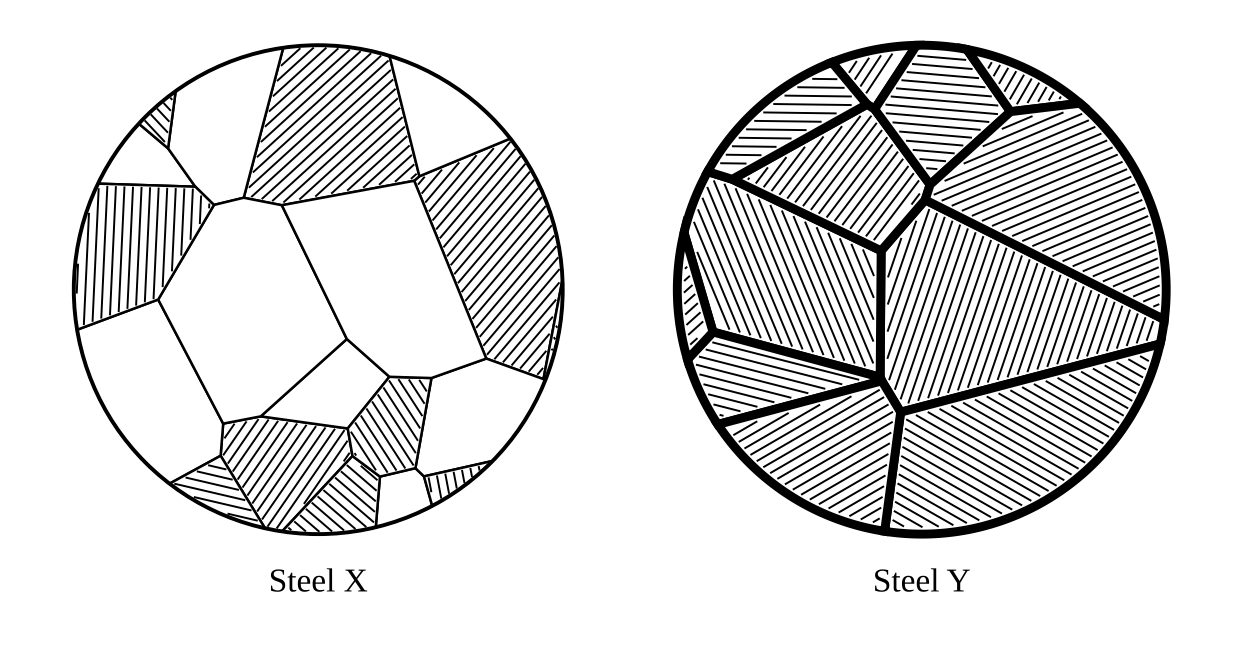
The steels are being considered for railway carriage wheels, which are subject to repeated impact loads.
Identify the microstructure of each steel. Determine the most appropriate steel for the wheels. Justify your choice with reference to the microstructures.
Ferrite takes the blow, cementite lets the crack through
The two printed micrographs, redrawn. First the phases are named, then a wheel's repeated impact loads arrive. Watch where the energy goes in each steel.
Grain for grain, these are the printed micrographs. The crack in Steel Y follows the thick cementite boundaries, the path the brittle phase gives it.
Name every phase, then let the wheels choose
Pick a phase, then click where you see it in the micrographs. Find all four. Then switch the demand on the wheels between impact and wear, and see which steel each property points to.
Steel X is ferrite and pearlite, so it is hypoeutectoid (medium carbon). Steel Y is pearlite with cementite at the grain boundaries, so it is hypereutectoid (high carbon). Those two sentences are Marks 1 and 2.
Choose a demand to see which property matters and where it comes from in the micrographs.
Work through the model response one mark at a time
Two identify marks, two explain marks and one decision mark. Write each sentence yourself before you reveal it.
Steel X consists of light ferrite grains and lamellar pearlite grains, so it is a hypoeutectoid (medium carbon) steel.
It names both phases in Steel X: ferrite and pearlite. The plain light grains are ferrite, and the grains filled with fine parallel lines are pearlite.
Accept 'medium carbon' or 'hypoeutectoid' for Steel X and 'high carbon' or 'hypereutectoid' for Steel Y only when the phases are also identified.
Marker: identifies that Steel X consists of ferrite and pearlite
Steel Y consists of pearlite grains surrounded by a network of cementite at the grain boundaries, so it is a hypereutectoid (high carbon) steel.
It names pearlite plus cementite, and it says where the cementite is: at the grain boundaries. That location is the thick dark network in the figure.
Accept 'medium carbon' or 'hypoeutectoid' for Steel X and 'high carbon' or 'hypereutectoid' for Steel Y only when the phases are also identified.
Marker: identifies that Steel Y consists of pearlite with cementite at the grain boundaries
The soft, ductile ferrite in Steel X absorbs impact energy, making Steel X tougher and more ductile than Steel Y.
It puts Steel X’s greater toughness and ductility down to its ferrite, and it compares Steel X with Steel Y.
Properties of Steel X include: tougher, more ductile, more impact resistant, less brittle, or other suitable response consistent with a reasonable understanding.
Marker: explains appropriately that the ferrite in Steel X makes it tougher or more ductile than Steel Y
The hard, brittle cementite network makes Steel Y harder and more wear resistant, but more brittle than Steel X, because cracks can travel along the cementite at the grain boundaries.
It puts both sides of Steel Y down to the cementite network: the hardness and wear resistance, and the brittleness.
Properties of Steel Y include: harder, more wear resistant, higher strength, more brittle, or other suitable response consistent with a reasonable understanding.
Marker: explains appropriately that the cementite network in Steel Y makes it harder or more wear resistant but more brittle than Steel X
Steel X is the most appropriate steel for the wheels, because its toughness lets it withstand repeated impact loads without cracking.
It selects Steel X and justifies it with the impact loads and resistance to cracking.
The decision mark is not awarded for selecting Steel X without a reason referencing impact (or toughness, or resistance to cracking). Selecting Steel Y on wear resistance alone does not earn the decision mark.
Marker: determines that Steel X is more suitable for railway carriage wheels, with a reason referencing impact loads or resistance to cracking
Steel X consists of light ferrite grains and lamellar pearlite grains, so it is a hypoeutectoid (medium carbon) steel. Mark 1 Steel Y consists of pearlite grains surrounded by a network of cementite at the grain boundaries, so it is a hypereutectoid (high carbon) steel. Mark 2
The soft, ductile ferrite in Steel X absorbs impact energy, making Steel X tougher and more ductile than Steel Y. Mark 3 The hard, brittle cementite network makes Steel Y harder and more wear resistant, but more brittle than Steel X, because cracks can travel along the cementite at the grain boundaries. Mark 4
Steel X is the most appropriate steel for the wheels, because its toughness lets it withstand repeated impact loads without cracking. Mark 5
Each phrase of the question gave you something
If I had to guess where you might lose marks…
- Naming only the carbon band. If you write only “medium carbon” and “high carbon” without naming the phases, you earn no identification marks.
- Missing the grain-boundary cementite. If you call Steel Y “pure pearlite” or “eutectoid”, you have missed the cementite at the grain boundaries, which is what the thick dark network shows.
- Choosing Steel Y because it is harder. If you pick Steel Y because it is harder or more wear resistant, you have ignored the repeated impact loads, and the decision mark is lost.
- Properties with no microstructure. If you state a property (“Steel X is tougher”) without linking it to the ferrite or the cementite network, it does not explain anything.
The past QCAA questions this one was modelled on
Only mark this done when you could do it without help. Reading the solution does not count.
A Tangent Tuition mock exam question. It is not a past QCAA question, and Tangent Tuition is not affiliated with the QCAA.
Spot a mistake on this page? Report it