
Question 19
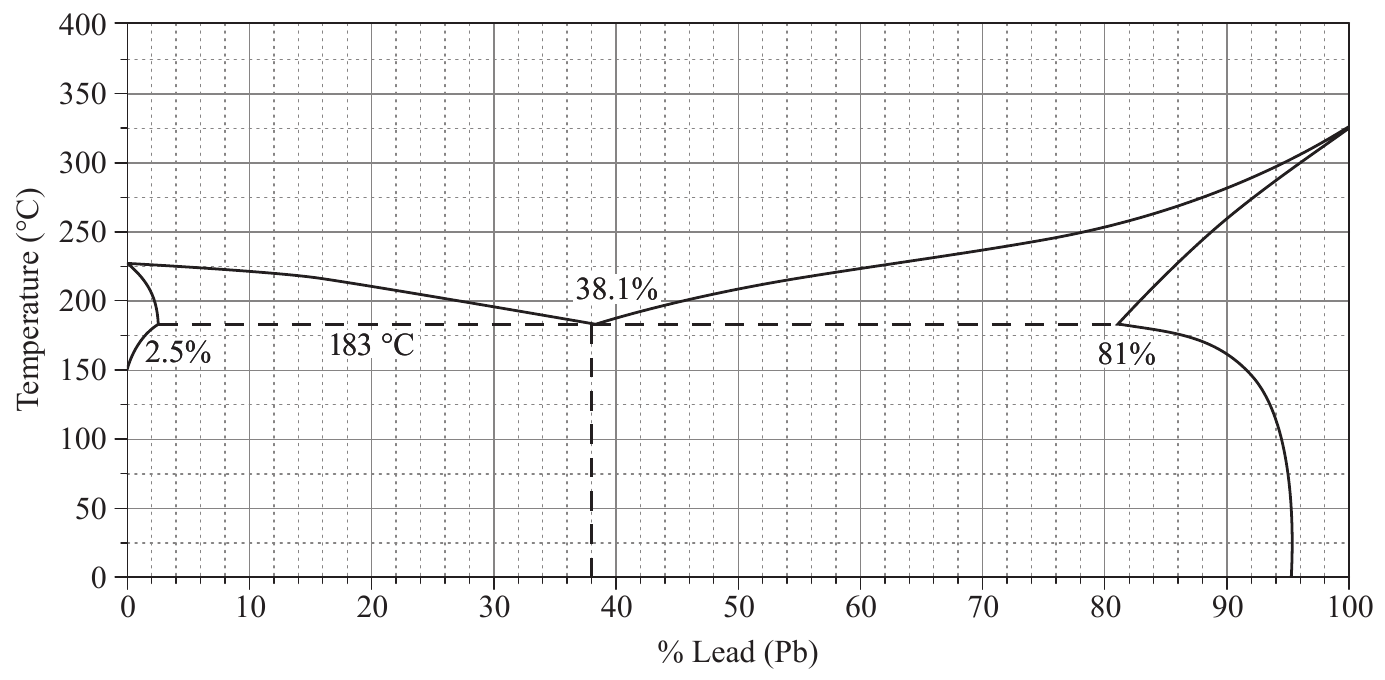
A lead–tin thermal-equilibrium diagram is shown.
The alloy sits nearer the liquid end, so there is more liquid than solid
First find the eutectic QCAA marked on its own diagram. Then watch a 60% lead alloy land on the 200 °C tie line and see which arm each phase takes.
That is the inverse in the inverse lever rule. The long arm, 23, reaches towards the solid end, and it gives the liquid, 61%.
Drag the alloy and watch which end of the tie line it sits near
This is QCAA’s 2025 diagram. Drag the orange point, or use the sliders. The readings are taken to the whole percent. At 200 °C the readings are QCAA’s own, 45% and 83% Pb. The eutectic for part a) is the V where the two liquidus branches meet, printed at 38.1%.
This is the question. The tie line runs from 45% to 83% Pb and the alloy sits at 60, nearer the liquid end. So there is more liquid than solid, 61% liquid and 39% solid.
Slide the alloy along the tie line. As it moves towards the liquidus end the liquid share grows, and towards the solidus end the solid share grows. The phase you have more of is always the end the alloy sits nearer.
This is the β + liquid field on the tin-rich side. The solid here is β, mostly tin. The rule is the same: the solid takes the arm reaching towards the liquid.
The point is above the liquidus, so the alloy is 100% liquid with the alloy’s own composition. There is no tie line.
The point is in a single solid field, so the alloy is 100% solid with its own composition. The lever rule only works between two boundaries.
This is the swap the word inverse warns you about. The near arm gives the other phase, and the swapped answers still add to 100%. The alloy sits closest to the phase you have most of, so check against the picture.
Work through the solution one mark at a time
Try each step yourself before you reveal it.
The eutectic is the V where the two liquidus branches meet at the 183 °C line. QCAA printed its composition right on the diagram.
QCAA notes: “Accept response as a decimal.” Write the number QCAA printed, not a value you have read off the grid, which puts the dashed line nearer 38%.
Marker: correctly identifies the percentage of lead in the eutectic composition from the diagram
The axis counts lead, so rule the vertical line at 60% Pb and the tie line at 200 °C. Mark where the tie line meets the liquidus, 45% Pb, and the solidus, 83% Pb.
QCAA notes the annotation “May or may not show lines of intersection between the solidus and liquidus lines, and 200 °C.” The 60% line meeting 200 °C is what earns it. Write the two readings on anyway, because the next two marks use them.
Marker: correctly annotates the diagram to show intersection of 60% lead alloy at 200 °C
The tie line is $83-45=38$ long. The solid takes the arm on the far side from it, from the liquidus across to the alloy.
Percentage solid:
QCAA: “Accept 35% to 42% solid inclusive.” Either phase may come first: “Accept either solid or liquid being calculated first.”
Marker: calculates the percentage of solid at 200 °C
Percentage liquid:
QCAA accepts “percentage of liquid as 100 percent minus the percentage of solid”, so $100-39=61\%$ earns this mark too. The window is “58% to 65% liquid inclusive.” Check the picture: 60 sits nearer 45 than 83, so liquid is the bigger share.
Marker: calculates the percentage of liquid at 200 °C
Each phrase of the question gave you something
The 2025 subject report says the effective responses read the eutectic as 38.1% from the diagram, annotated the diagram, and calculated both percentages inside the accepted range. Its high-level excerpts were chosen for a clearly annotated diagram and a well-structured inverse lever rule calculation.
QCAA did not publish a band for this question. It reads as simple familiar because part a) is a number printed on the diagram and part b) is the routine lever rule on the same 200 °C readings, 45% and 83% Pb, that the 2024 paper had already used. Only the alloy moved, from 70% to 60% lead.
If I had to guess where you might lose marks, it would be the swap. Moving the alloy from 70% to 60% lead flips which phase you have more of, so a student who memorised “solid is the bigger answer” from 2024 writes 61% solid. The 2025 subject report itself calls these percentages “the solid and liquid composition”. In your answer keep the words apart: composition is what a phase is made of, and percentage is how much of it there is.
Only mark this done when you could do it without help. Reading the solution does not count.
Question wording, any figures and marking-guide steps are from the 2025 QCAA Engineering external assessment, © State of Queensland (QCAA) 2025, licensed under CC BY 4.0, and have been adapted, except where a third-party source is named. Tangent Tuition is not affiliated with the QCAA.
Spot a mistake on this page? Report it