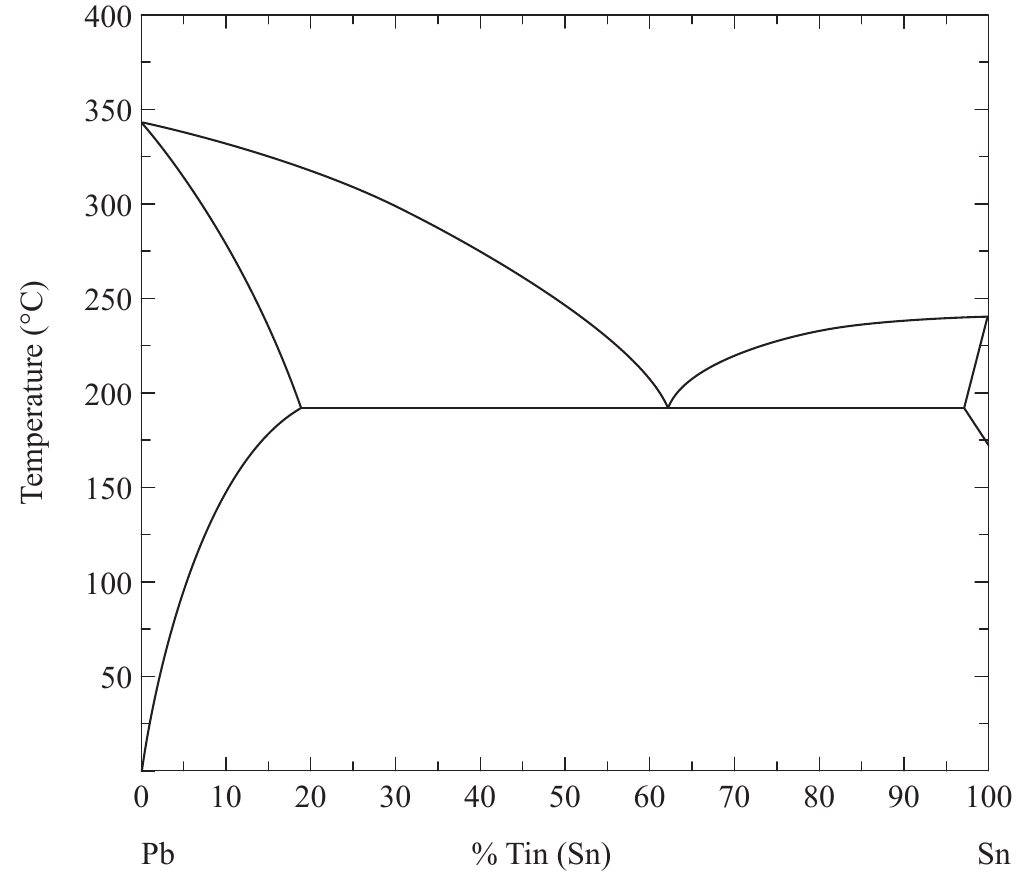
A thermal-equilibrium phase diagram shows which phases are present in an alloy at each composition and temperature. For lead and tin, composition runs along the bottom and temperature runs up the side. You read the diagram to name the phases and their compositions, and you use the lever rule to work out how much of each phase there is.
The lever rule is the only calculation in this topic, and the formula book gives you nothing for it. Learn the method and four anchor readings, then read the diagram in front of you. Tick off each skill once you can do it without help.
24
Section 3 marks, 2020–2025
15
Section 2 marks, 2020–2025
5 of 6
years in Section 3, absent only in 2023
±1%
reading tolerance in the 2021 and 2022 guides
Skills in this topic
Only tick a skill when you could do it in the exam. Your ticks are saved in this browser only.
Part 1
What the exam asks
A phase diagram calculation appeared in Section 3 in five of the six external exams from 2020 to 2025, every year except 2023. The 2023 paper had no lead–tin or lever-rule item anywhere, so do not treat the topic as guaranteed.
Across the six papers the topic carried 24 Section 3 marks, 15 Section 2 marks and two multiple choice questions. The Section 3 item was worth 4 or 5 marks every time it appeared.
The work is modest for the marks. The lever rule is one short calculation, and the marking guides allow about 1% either way on the readings that feed it.
What the syllabus says
These are the two dot points from Unit 4 Topic 3 of the 2025 syllabus.
Dot point 1. Explain key features, components and phases of a lead-tin thermal-equilibrium phase diagram, including the
•eutectic reaction, including composition and temperature
•single- and two-phase regions at different temperatures and compositions
•chemical composition of the phases
•hypoeutectic and hypereutectic compositions.
Dot point 2. Calculate the percentages solid and liquid, along with composition solid and liquid, using the lever rule for binary alloys with complete solid insolubility and partial solid solubility.
The second dot point asks for two different things. Composition is what each phase is made of, and you read it off the axis. Percentage is how much of each phase there is, and you calculate it. 2024 Question 19 asked for both, one in each part, so a student who confuses them loses part (a).
What the formula book gives you
Nothing for this topic. The formula and data book has no lever rule, no tie-line rule and no phase-diagram vocabulary. Its materials section covers density, stress, strain, Young’s modulus, factor of safety and ultimate tensile strength, and none of it applies here.
Everything in this guide has to be memorised.
What changes for 2026
The changes are small but real. The verb is now explain, and hypoeutectic and hypereutectic compositions are named for the first time. They were not examined from 2020 to 2025, so treat them as new.
The lever rule stays, now specified for alloys with complete solid insolubility (the shape of the 2021 A–B diagram) and with partial solid solubility (lead–tin). It is still not in the formula book, and it is still the only calculation in Unit 4 Topic 3.
Perusal drops from ten minutes to five. Read the axis label when you reach the question, not during perusal.
Part 2
Reading the lead–tin diagram
This is the diagram QCAA printed in 2024 and 2025, redrawn with the fields and curves named. The curves are traced from the 2024 paper, and at 200 °C they give QCAA’s published readings of 45% Pb on the liquidus and 83% Pb on the solidus.
The liquidus is orange. The solidus is solid black, and includes the horizontal line at 183 °C. The solvus is dashed. The ranges under the axis show which alloys are hypoeutectic and hypereutectic.
The liquidus is the upper boundary, and above it everything is molten. The solidus is the lower boundary of each solid-plus-liquid field. Between the liquidus and the solidus, solid and liquid exist together.
Term
What it is on the diagram
Liquidus
The upper boundary. Above it, everything is liquid.
Solidus
The lower boundary of each solid-plus-liquid field. Below it on the lead-rich side the alloy is solid α, down as far as the solvus.
Solvus
The boundary, below the eutectic temperature, between each single-phase solid field (α or β) and the two-phase α + β field.
Eutectic point
Where the two liquidus branches meet, at 38.1% Pb and 183 °C. It is the lowest melting point of any lead–tin mixture.
Eutectic reaction
At 183 °C the liquid turns directly into solid α + β with no mushy stage. That is why it gives a layered structure.
α
A solid solution of tin dissolved in lead. It is the lead-rich field, on the right of a % Lead diagram.
β
A solid solution of lead dissolved in tin. It is the tin-rich field, on the left of a % Lead diagram.
Below the eutectic temperature, any alloy between the two solvus lines is a mixture of α and β.
Practise
Exam question: naming the lines
2021 Question 8
Section 1 · Multiple choice · [1 mark]
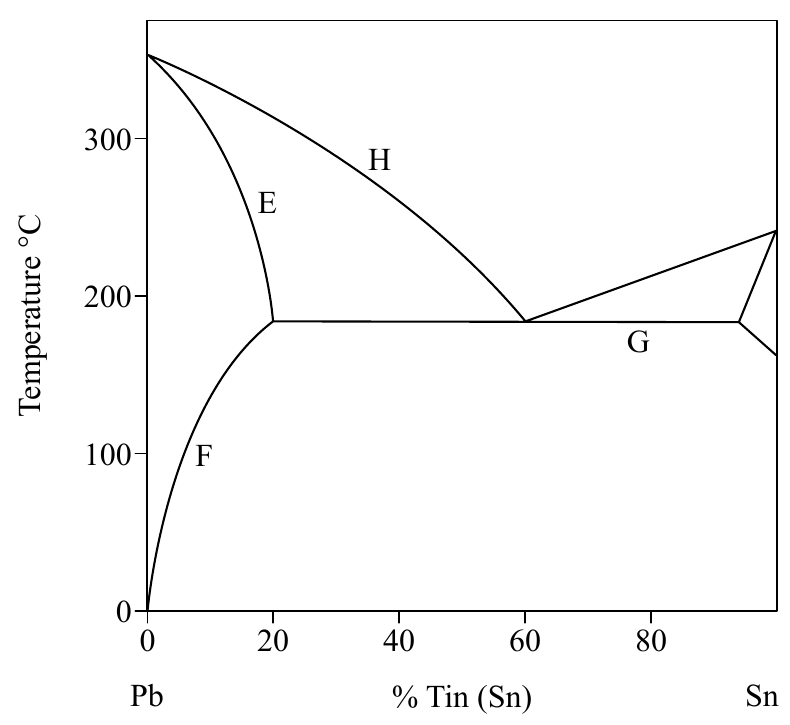
In the lead–tin thermal equilibrium phase diagram, a liquidus line is represented by the letter
H is the liquidus. It is the upper boundary, running from the melting point of lead down to the eutectic point, and everything above it is liquid.
E is the solidus on the lead-rich side, the boundary between the α field and the α + L field. F is the solvus, the boundary between α and α + β below the eutectic temperature. G sits on the horizontal eutectic line.
This drawing uses a % Tin axis, so the lead-rich side is on the left.
Answer
(D) H
Part 3
Which way the axis counts
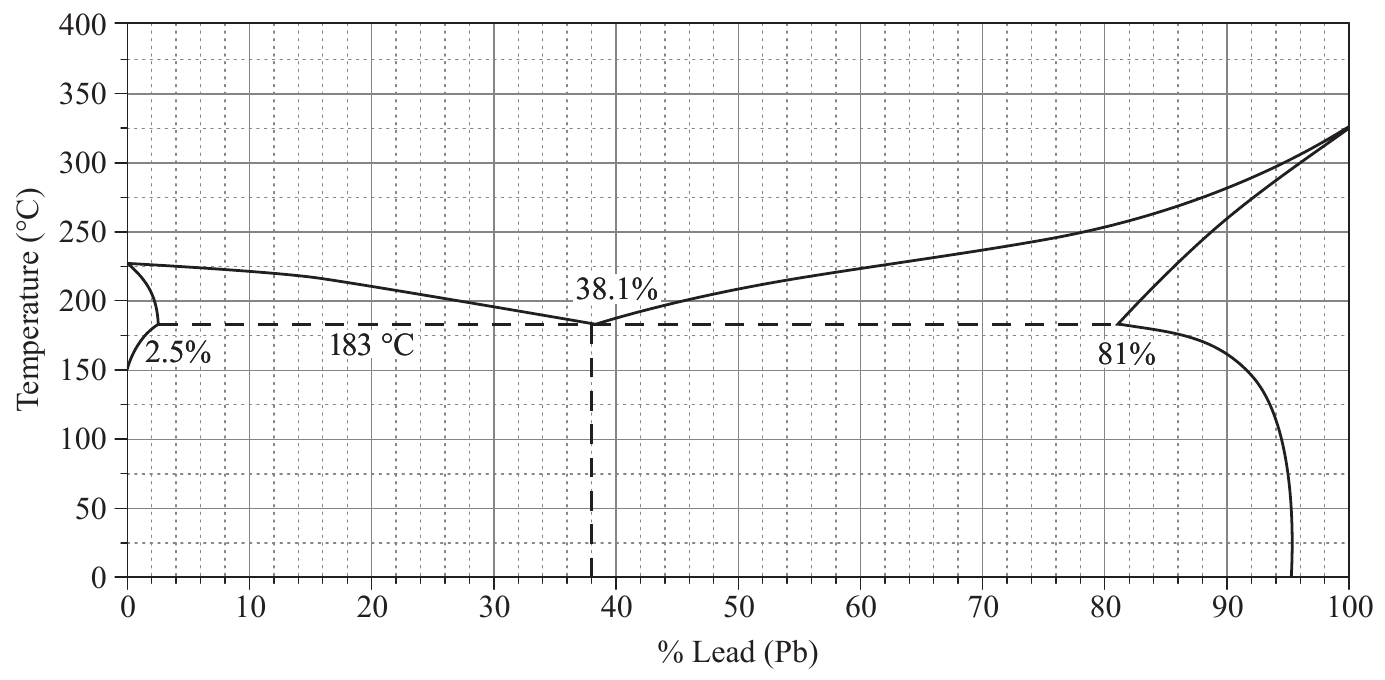
QCAA does not stick to one convention. The 2024 multiple choice book put % Tin on the axis, with lead at the left. The 2024 question and response book, in the same exam, put % Lead on the axis, with tin at the left. This is the same diagram mirrored onto a % Tin axis.
The same diagram on a % Tin axis. 38.1% Pb is 61.9% Sn, 81% Pb is 19% Sn and 2.5% Pb is 97.5% Sn. The eutectic is still at 183 °C. Only the counting has changed.
The axis trap
QCAA used a % Tin axis in 2021 multiple choice Question 8, 2022 Questions 14 and 21, and 2024 multiple choice Question 1. It used a % Lead axis in 2024 Question 19 and 2025 Question 19. Both conventions have appeared in Section 3.
So your first move on every phase diagram question is to read the axis label and write on the diagram which end is which. The printed values still work (38.1% Pb is the same point as 61.9% Sn), but reading the axis in the wrong direction turns a correct method into a wrong answer.
Hypoeutectic and hypereutectic
These terms describe which solid forms first as the alloy cools. That is a fact about the alloy, so flipping the axis does not change it.
Term
Range, and what forms first
Hypoeutectic
38.1% to 81% Pb (19% to 61.9% Sn). Primary α forms, then eutectic.
Hypereutectic
2.5% to 38.1% Pb (61.9% to 97.5% Sn). Primary β forms, then eutectic.
Above 81% Pb or below 2.5% Pb, the alloy solidifies as a single solid solution with no eutectic, so it is neither hypoeutectic nor hypereutectic.
The everyday check
An alloy of 45% Pb is 55% Sn. It is hypoeutectic, even though it is less than half lead.
60Sn–40Pb solder is the standard hypoeutectic solder. It contains 40% lead, which is between 38.1% and 81%. If a rule you have written down calls that alloy hypereutectic, the rule is the wrong way round.
What QCAA has already told you
Every value below is printed on a QCAA paper or published in a marking guide. Learn the first four. They are the anchors that let you check your reading of any diagram you are handed.
Reading
Value, and what QCAA accepted
Eutectic composition
38.1% Pb, so 61.9% Sn. Printed on the 2024 and 2025 papers.
Eutectic temperature
183 °C. In 2022, where it was not printed, the guide accepted 175.1 °C to 199.9 °C.
Maximum solubility of tin in lead
81% Pb, so 19% Sn. The 2022 guide accepted 80% to 83% lead, or 17% to 20% tin.
Maximum solubility of lead in tin
2.5% Pb, so 97.5% Sn. The 2022 guide accepted 96% to 98% tin, or 2% to 4% lead.
Liquidus at 200 °C
45% Pb, so 55% Sn. The 2024 guide accepted 44% to 46% lead.
Solidus at 200 °C
83% Pb, so 17% Sn. The 2024 guide accepted 82% to 84% lead.
Where a value is printed, quote it. Where it is not, read it and expect some latitude. The ranges are wide because QCAA is marking your reading of a printed diagram, not your memory. The 2022 eutectic temperature was accepted anywhere from 175.1 °C to 199.9 °C because the value was not printed and the axis is ticked only every 25 °C. QCAA’s drawing for 2022 Question 21 and 2024 multiple choice Question 1 puts the eutectic line near 192 °C.
Do not carry a remembered curve into the exam
QCAA’s diagrams disagree even at 200 °C. On the drawings used for 2022 Questions 14 and 21 and 2024 multiple choice Question 1, a 70% Pb alloy at 200 °C is about 71% to 73% solid. Only the 2024 and 2025 Section 3 drawings give the readings in this guide.
Higher up they differ more. At 250 °C the liquidus reads about 48% tin on the 2022 Question 21 drawing and about 21% tin on the 2024 Question 19 drawing, so the same alloy can be part solid on one and fully liquid on the other. Read the diagram in front of you.
Practise
Exam question: reading a % Tin axis
2024 Question 1
Section 1 · Multiple choice · [1 mark]
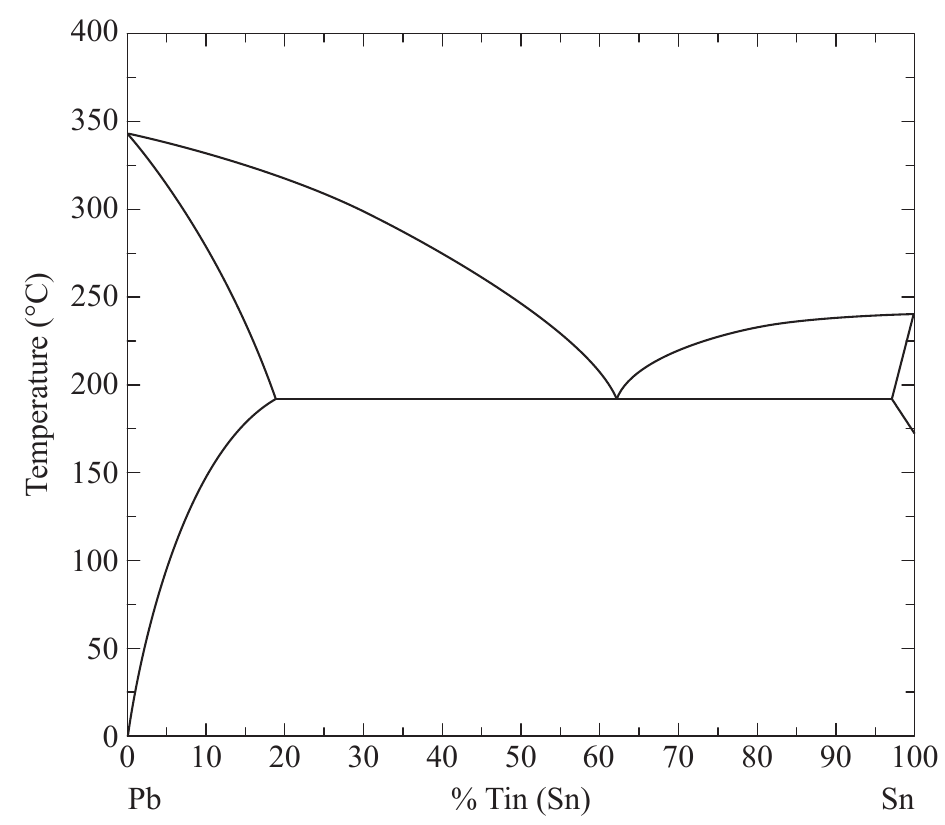
A lead–tin thermal-equilibrium phase diagram is shown.
What phase would be present in an alloy containing 35% Sn at a temperature of 225 °C?
The axis is % Tin, with lead at the left. At 225 °C on this drawing the lead-rich solidus is at about 16% Sn and the liquidus is at about 56% Sn. 35% Sn sits between them, inside the α + L field.
(A) β is the tin-rich solid at the far right of the diagram. (B) L would need the point to sit above the liquidus. (C) α + β is only found below the eutectic line, which is near 192 °C on this drawing.
Answer
(D) $\alpha+L$
Part 4
The lever rule
You need the lever rule whenever the alloy sits inside a two-phase region and the question asks how much of each phase is present.
Game plan: The lever rule
1Draw a vertical line at the alloy composition given in the question.
2Draw a horizontal tie line at the temperature given, from the solidus across to the liquidus. Read both intersections off the axis.
3The alloy composition splits the tie line into two arms. Each phase gets the arm on the far side from it.
4Divide that arm by the whole tie line and multiply by 100. The arm reaching towards the liquid gives the solid, and the arm reaching towards the solid gives the liquid.
As algebra, with $C_0$ the alloy, $C_S$ the solidus reading and $C_L$ the liquidus reading:
The subscripts name the curves, not the bigger number
$C_S$ is whatever you read where the tie line meets the solidus, and $C_L$ is whatever you read where it meets the liquidus. Take them that way and the formulas work on either axis.
On a % Lead axis at 200 °C, $C_S=83$ and $C_L=45$. On a % Tin axis they become $C_S=17$ and $C_L=55$, so the solidus is now the smaller number. A 70% lead alloy is 30% tin, and it still returns 65.8% solid, because the top and bottom of the fraction change sign together.
The formulas only break if you decide $C_S$ is whichever reading is larger. The safest habit is to draw the tie line, mark the two arms and take the arm on the far side over the whole line. That needs no subscripts at all.
The 200 °C tie line for a 60% lead alloy, as in 2025 Question 19. The liquidus reads 45% Pb and the solidus 83% Pb. The alloy sits closer to the liquidus, so there is more liquid than solid. The arm on the far side from the solid, 23, gives 61% liquid, and the other arm, 15, gives 39% solid.
Why it is called inverse
The name is a warning. The arm nearest the solid side does not give you the solid. It gives you the liquid. Swapping them is the error the whole question is built to catch, and swapped answers still add to 100%, so the sum check will not find it.
The check that works is that the phase you have more of is the one your alloy sits closer to. At 200 °C a 70% Pb alloy sits closer to the solidus reading of 83% than to the liquidus reading of 45%, so there must be more solid than liquid. The answer is 65.8% solid.
Do this before you write anything down.
The tolerance you are marked against
The 2024 guide accepts 82–84% Pb for the solidus reading and 44–46% Pb for the liquidus reading, and then accepts 63–69% solid and 31–37% liquid. The 2021 and 2022 guides allow 1% either way on each reading.
That is a six-point window on the final answer. You are being marked on drawing the right lines and dividing the right arms, not on the precision of your ruler.
Try it yourself
Use the lever rule anywhere
Drag the point around the diagram, or use the sliders. In a two-phase field the tie line appears, with the composition of each phase and its share from the lever rule.
Practise
Exam questions: the lever rule
The solutions show where each mark goes, from the QCAA marking guides. Both guides allow follow-through, so a slightly wrong reading still earns the later marks if your method is right.
2024 Question 19
Section 3 · Simple familiar (est.) · [5 marks]
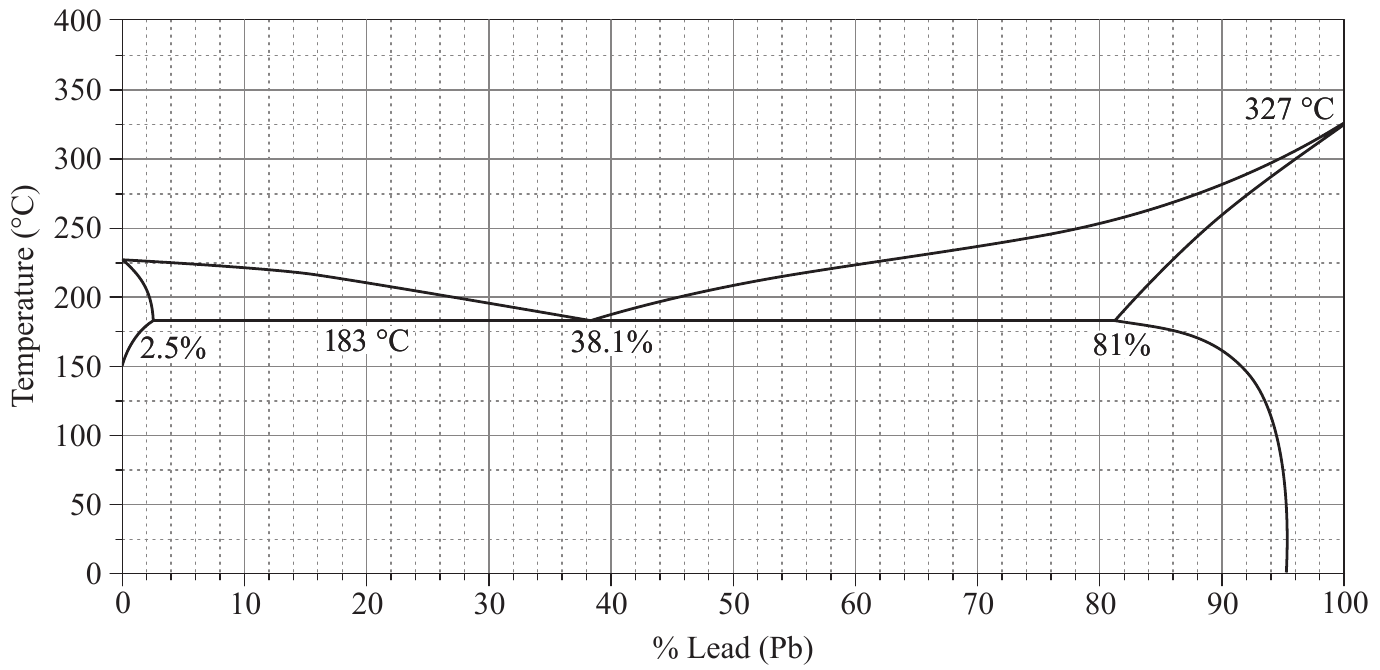
A lead–tin thermal-equilibrium diagram is shown.
a) Determine the composition of the solid and liquid in a 70% lead 30% tin alloy at 200 °C. Annotate the diagram to develop your response. [3 marks]
b) Determine the percentages of solid and liquid in a 70% lead 30% tin alloy at 200 °C. [2 marks]
(a) Rule a vertical line at 70% Pb and a horizontal tie line at 200 °C. Read where the tie line meets each boundary.
Solid (α)
Liquid
Composition
83% Pb, 17% Sn
45% Pb, 55% Sn
1 mark. Annotating the diagram, for example with tie lines at 45% and 83% Pb.
1 mark. The composition of the solid, 83% Pb and 17% Sn. The guide accepts 82–84% Pb.
1 mark. The composition of the liquid, 45% Pb and 55% Sn. The guide accepts 44–46% Pb.
The second figure in each pair is 100 minus the first. Write both, because the guide names lead and tin separately.
(b) The tie line is $83-45=38$ long. Percentage solid:
$$\frac{70-45}{83-45}=\frac{25}{38}=65.8\%$$
1 mark. The percentage solid at 200 °C. The guide accepts 63–69%.
Percentage liquid:
$$\frac{83-70}{83-45}=\frac{13}{38}=34.2\%$$
1 mark. The percentage liquid at 200 °C. The guide accepts 31–37%.
Check: $65.8+34.2=100$, and 70 sits closer to 83 than to 45, so there is more solid than liquid.
Answer
(a) solid 83% Pb, 17% Sn and liquid 45% Pb, 55% Sn (b) 65.8% solid, 34.2% liquid
2025 Question 19
Section 3 · Simple familiar (est.) · [4 marks]
A lead–tin thermal-equilibrium diagram is shown.
a) Identify the percentage of lead in the eutectic composition. [1 mark]
b) Determine the percentages of solid and liquid in a 60% lead alloy at 200 °C using the inverse lever rule. Annotate the diagram to support your response. [3 marks]
(a) The eutectic composition is printed on the diagram, 38.1% lead.
1 mark. The percentage of lead in the eutectic composition. A decimal is accepted.
(b) Rule the vertical line at 60% Pb and the tie line at 200 °C. The liquidus reads 45% Pb and the solidus 83% Pb, as in the tie-line figure earlier in this part.
1 mark. Annotating the diagram to show where the 60% lead alloy meets 200 °C.
Percentage solid:
$$\frac{60-45}{83-45}=\frac{15}{38}=39\%$$
1 mark. The percentage of solid at 200 °C. The guide accepts 35–42%.
Percentage liquid:
$$\frac{83-60}{83-45}=\frac{23}{38}=61\%$$
1 mark. The percentage of liquid at 200 °C. The guide accepts 58–65%, and accepts either answer as 100 minus the other.
As a check, 60 sits closer to 45 than to 83, so there is more liquid than solid.
Answer
(a) 38.1% (b) 39% solid, 61% liquid
Part 5
Splitting the liquid into lead and tin
2022 Question 21 went a step further than the lever rule. It asked for the percentage of the liquid components. That means how much of the whole sample is tin sitting in the liquid, and how much is lead sitting in the liquid. You take the composition of the liquid and scale it by how much liquid there is.
Game plan: Liquid components
1Convert the alloy to the axis you have been given.
2Rule the tie line at the stated temperature and read the solidus and the liquidus.
3Use the lever rule for the fraction of liquid.
4Read the composition of the liquid off the liquidus, as both metals.
5Multiply each metal’s share of the liquid by the liquid fraction. The two answers must add back to the liquid fraction, to within 1% after rounding.
Practise
Exam question: liquid components
This is the hardest lever-rule question QCAA has set, and the shape most worth practising.
2022 Question 21
Section 3 · Simple familiar (est.) · [5 marks]
Determine the percentage of the liquid components for an alloy containing 65% lead at a temperature of 250° C. Annotate the lead–tin equilibrium phase diagram as part of your response.
Step 1 · Convert. The axis on this paper is % Tin, so 65% lead is 35% tin. Every reading below is in tin.
1 mark. Using the diagram to locate the alloy, 65% lead and 35% tin.
Step 2 · Tie line at 250 °C. The guide reads the solidus at 13% Sn and the liquidus at 48% Sn, so the tie line is $48-13=35$ long.
1 mark. Plotting the percentage of liquid or solid at 250 °C.
Step 3 · Lever rule. Percentage liquid:
$$\frac{35-13}{35}\times100=63\%$$
Percentage solid:
$$\frac{48-35}{35}\times100=37\%$$
1 mark. The percentage of liquid. The guide accepts 60–66%.
Step 4 · The composition of the liquid. The liquid has the composition read off the liquidus, 48% tin and therefore 52% lead.
1 mark. The percentages of tin and lead in the liquid at 250 °C.
Step 5 · Split the liquid. Tin in the liquid:
$$0.48\times0.63\times100=30\%$$
Lead in the liquid:
$$0.52\times0.63\times100=33\%$$
1 mark. The percentages of the liquid components. The guide accepts 28–32% tin and 31–35% lead.
Check: $30+33=63$, the liquid fraction. The guide rounds the liquid fraction to 0.63 before multiplying. Using 0.629 gives the same 30% and 33%. The guide also allows 1% either way on each reading.
Answer
Liquid tin 30% and liquid lead 33% of the whole alloy
Read the readings off the paper in front of you
The readings in this solution are QCAA’s own, from the 2022 marking guide, and they earn the marks on that paper. They do not match what you would read off the diagram in Part 2 at 250 °C, because QCAA drew the 2022 and 2024 diagrams differently at higher temperatures.
This cannot catch you out in the exam, because you always work from the diagram on the paper. It is a reason to memorise the method and not the numbers.
Part 6
Earning the marks
Each dot point is worth one mark, and the dot points are the intermediate steps. Annotate the diagram even when you are unsure of the arithmetic.
What the 2024 and 2025 guides pay for (paraphrased)
Dot point
What earns it
Annotates the diagram to show the alloy at the stated temperature
The drawn tie line and vertical line
Identifies the eutectic composition (2025)
Reading 38.1% Pb
Determines the composition of the solid from the tie line (2024 only)
Reading 83% Pb, 17% Sn
Determines the composition of the liquid from the tie line (2024 only)
Reading 45% Pb, 55% Sn
Calculates the percentage of solid
The arm division
Calculates the percentage of liquid
The other arm, or 100 minus the first
Marks are attached to the drawn lines
The annotation mark and both reading marks are available before you divide anything. The 2021 guide asks for “evidence that the diagram is used”. Draw the vertical line, draw the tie line and label both intersections with numbers. That is three of the five marks on a 2024-shape question.
The 2025 guide also accepts the percentage of solid as 100 minus the percentage of liquid, so one lever-rule division and a subtraction earn both calculation marks.
Past QCAA questions: phase diagrams and the lever rule
These are every question on this topic in the 2020 to 2025 external exams. QCAA published the band split for 2020 only. The other band tags are my estimates from the mark value and the subject reports.
Question
Marks / band
What it tests
2021 Q8 (MC)
1 · SF
Which lettered line is a liquidus. % Tin axis. Worked as E1.
2024 Q1 (MC)
1 · SF
Which phase is present in a 35% Sn alloy at 225 °C. Answer α + L. % Tin axis. Worked as E2.
2020 Q13
5 · SF
Section 2. Explain how the microstructure of a 62% tin, 38% lead (near-eutectic) alloy changes as it cools from liquid to solid, with an annotated sketch.
2022 Q14
6 · SF (est.)
Section 2. Identify six key features of the lead–tin diagram. % Tin axis.
2025 Q11
4 · SF (est.)
Section 2. Label the phases present at 100 °C in the microstructures shown for a 10% tin and a 40% tin alloy.
2020 Q21
5 · SF
Lens-shaped diagram for metals A and B, 50% A at 1400 °C. Percentages of solid and liquid.
2021 Q18
5 · SF (est.)
Eutectic diagram for A and B whose solid is pure B, 20% A at 900 °C. Answer 62% solid, 38% liquid.
2022 Q21
5 · SF (est.)
65% lead at 250 °C. Liquid fraction, then the tin and lead in that liquid. % Tin axis. Worked as E5.
2024 Q19
5 · SF (est.)
70% lead at 200 °C. Compositions in (a), percentages in (b). Answer 65.8% solid. Worked as E3.
2025 Q19
4 · SF (est.)
Eutectic composition in (a), then 60% lead at 200 °C. Answer 39% solid, 61% liquid. Worked as E4.
2020 and 2021 used unnamed metals A and B
2020 used a lens-shaped diagram, where A and B are fully soluble in each other. 2021 used a eutectic diagram whose solid is pure B, so one end of the tie line is at 0%. The lever-rule method is the same on all of them, and nothing depends on which metals they are or on the temperature range. QCAA classed 2020 Question 21 as simple familiar.
If an unnamed diagram appears in 2026, treat it exactly like the lead–tin one. Read the axis, draw the tie line and divide the arms.
Self-checks to run inside the question
Checkpoint
How to run it
What does the axis count?
% Lead or % Tin? Write it on the diagram before you draw anything.
Am I inside a two-phase region?
The lever rule only works between two boundaries. Above the liquidus the alloy is 100% liquid and there is nothing to calculate.
Did I use the far arm?
The alloy sits closer to the phase there is more of. Check your answer against that.
Do they add to 100?
Solid plus liquid must total 100%. The 2021 guide says so explicitly.
Composition or percentage?
Composition is read off the axis. Percentage is calculated from the arms. 2024 Q19 wanted both.
Both metals named?
“83% Pb” is half an answer. Write “83% Pb, 17% Sn”.
Hypo or hyper?
Between 38.1% and 81% Pb means primary α, which is hypoeutectic. Between 2.5% and 38.1% Pb means primary β, which is hypereutectic.
Have I labelled?
Marks are attached to the drawn lines, not just the numbers.
Game plan
Your game plan for phase diagrams
1Read the axis label and write which end is lead and which is tin.
2Naming question? The liquidus is on top, the solidus sits under the solid-plus-liquid fields, the solvus is below 183 °C and the eutectic is at 38.1% Pb and 183 °C.
3Compositions? Rule the tie line and read both ends, with both metals.
4Percentages? Take the far arm over the whole tie line, then check that the alloy sits nearer the phase you have more of.
5Liquid components? Multiply the composition of the liquid by the liquid fraction, and check the two parts add back to it.
Four questions of my own, one for each of the main skills. Use the blank diagrams below, not the labelled ones above, because the marks in this topic are attached to lines you draw. Neither blank carries the printed anchors, which is the hardest case.
All four are set at 200 °C, the one temperature with published QCAA readings on the 2024 and 2025 drawing these blanks are traced from, so you can check your answers against QCAA’s own marking.
Blank, % Lead axis. Use it for Questions 1, 3 and 4. Print it or copy it so you can rule on it.Blank, % Tin axis. Work Question 3 again on this one and check you get the same answer.
Question 1 of 4
Skill 1: features and fields · Multiple choice · [1 mark]
Which phases are present in a 70% lead alloy at 200 °C?
At 200 °C the liquidus reads 45% Pb and the solidus reads 83% Pb. A 70% Pb alloy sits between them, inside the α + L field.
(A) would need the alloy to sit above the liquidus. You get it by checking only the liquidus, or by reading the axis as % Tin. (B) is the mirror error, reading past the solidus. (D) forgets that 200 °C is above the eutectic temperature of 183 °C, so α + β cannot be present.
Answer
(C) α + L
Question 2 of 4
Skill 2: the axis and hypo or hyper · Simple familiar · [3 marks]
a) State the eutectic composition and the eutectic temperature of the lead–tin system. [2 marks]
b) State whether an alloy of 25% lead is hypoeutectic or hypereutectic, and justify your answer. [1 mark]
(a) The eutectic composition is 38.1% lead (61.9% tin), and the eutectic temperature is 183 °C.
1 mark. The eutectic composition. 61.9% Sn is also correct.
1 mark. The eutectic temperature.
(b) 25% lead is 75% tin. It sits between 2.5% and 38.1% Pb, on the tin-rich side of the eutectic, so primary β forms first as it cools. The alloy is hypereutectic.
1 mark. Hypereutectic, justified against the eutectic composition. “Less lead than 38.1%”, “more tin than 61.9%” and “forms primary β” all work. “Below 50% lead” does not.
Answer
(a) 38.1% Pb (61.9% Sn) at 183 °C (b) hypereutectic
Question 3 of 4
Skill 4: the lever rule · Complex familiar · [4 marks]
Determine the percentages of solid and liquid present in a 75% lead alloy at 200 °C. Annotate the diagram to support your response.
Rule the vertical line at 75% Pb and the tie line at 200 °C. The liquidus reads 45% Pb and the solidus 83% Pb, so the tie line is 38 long.
1 mark. Annotating the diagram to show the 75% lead alloy at 200 °C.
1 mark. The compositions of the solid and the liquid from the tie line.
Percentage solid:
$$\frac{75-45}{83-45}=\frac{30}{38}=78.9\%$$
1 mark. The percentage of solid.
Percentage liquid:
$$\frac{83-75}{83-45}=\frac{8}{38}=21.1\%$$
1 mark. The percentage of liquid. Either one may be found as 100 minus the other.
As a check, 75 sits much closer to 83 than to 45, so most of the alloy is solid. With the 2024 tolerances (liquidus 44–46%, solidus 82–84%), anything from about 76% to 82% solid is a fair reading.
On the % Tin blank, 75% Pb is 25% Sn, the solidus reads 17% Sn and the liquidus 55% Sn. The far arm is again $\frac{30}{38}$, so you get the same answer.
Determine the percentage of the liquid components in a 60% lead alloy at 200 °C. Annotate the diagram as part of your response.
Allow about 8 minutes and work it as one question with no parts.
Use the same tie line as Question 3. The liquidus reads 45% Pb and the solidus 83% Pb, so the tie line is 38 long.
1 mark. Ruling the tie line at 200 °C and reading both ends, 45% Pb and 83% Pb.
1 mark. Annotating the diagram to show the 60% lead alloy at 200 °C.
The liquid has the composition read off the liquidus, 45% Pb and 55% Sn.
1 mark. The composition of the liquid from the tie line.
Percentage liquid:
$$\frac{83-60}{83-45}=\frac{23}{38}=60.5\%$$
1 mark. The percentage of liquid.
Lead in the liquid:
$$0.45\times0.605\times100=27.2\%$$
Tin in the liquid:
$$0.55\times0.605\times100=33.3\%$$
1 mark. The percentages of the liquid components, about 27% lead and 33% tin.
Check: $27.2+33.3=60.5$, the liquid fraction. After rounding, $27+33=60$, which is within 1% of the 61% liquid.
This follows 2022 Question 21, but on a % Lead axis, so the numbers do not look like the worked example even though the method is identical.
Answer
Liquid lead about 27% and liquid tin about 33% (60.5% liquid)
Sources: QCAA Engineering external assessment question and response books, multiple choice question books and marking guides 2020 to 2025. Engineering 2025 v1.4 general senior syllabus, Unit 4 Topic 3. QCAA Engineering subject reports 2020 to 2025. Engineering formula and data book 2025 v1.4. The diagrams in this guide are traced from the diagram QCAA printed in the 2024 question and response book, and reproduce that paper’s published readings at 200 °C.