
Game plan 4 · Unit 4 Topic 3
Metals: diagrams and microstructure
The lever rule, iron–carbon microstructures, plain-carbon steels and heat treatment.
A phase diagram or an iron–carbon diagram is printed on the page, or the question names a steel, a microstructure, a carbon percentage or a heat treatment process.
The lever rule is the only calculation in this topic. It was worth 24 Section 3 marks across five of the six papers from 2020 to 2025, and the formula book gives you nothing for it. Steels carried about 38 Section 2 marks over the same six papers, plus multiple choice every year.
Part 1
The split this game plan is built on
Every metals question either asks you to read a diagram or asks you to write about a steel. Decide which one you have before you write anything.
Ask this first
“Is there a diagram to read, or a steel to explain?”
A lead–tin or A–B diagram
A temperature and an alloy are given, and the question wants compositions or percentages of solid and liquid → Game plan 4.1
It wants you to name a line, a field or the eutectic → Game plan 4.2
A steel or a microstructure
A carbon percentage, a steel, an application or a picture of grains → Game plan 4.3
Explain, describe, compare or contrast → Game plan 4.4
Sketch → Game plan 4.5
A heat treatment
Annealing, normalising, quenching, tempering, or hot or cold working → Game plan 4.6
The chain behind every written answer
Composition → processing → microstructure → property
Every written metals question is one link in that chain, run forwards or backwards. How much carbon is there, how was it cooled, what structure formed, and what does that structure let the part do?
The mark guides pay for the links. Naming ferrite earns one mark at most. Naming ferrite, saying it gives ductility and saying that the ductility lets the tube be formed earns two, because that sentence covers two dot points in the 2024 guide.
Write each link as one sentence with two joins in it. For example: “Low-carbon steel is mainly ferrite, which is soft and ductile, so it can be formed into a tubular shape.”
Part 2
Lead–tin and the lever rule
Both routines start the same way. Read the axis label and write on the diagram which metal it counts. QCAA has printed the axis both ways, and in 2024 it did both in the same exam.
The lever rule
A temperature and an alloy are given, and the question wants how much solid and liquid there is. Nothing about it is in the formula book.
- 1Find the temperature on the vertical axis and rule a horizontal tie line across the two-phase region.
- 2Read where the tie line meets the liquidus and where it meets the solidus. Write both readings on the diagram with both metals, such as 83% Pb, 17% Sn.
- 3Rule a vertical line at the alloy composition and mark where it crosses the tie line.
- 4Each phase takes the arm on the far side from it. Divide that arm by the whole tie line.
- 5Multiply by 100 for a percentage, or by the total mass for a mass. Check that the two arms add to the whole tie line.
Worked on the 2024 readings. At 200 °C the liquidus reads 45% Pb and the solidus reads 83% Pb. For a 70% Pb alloy:
Percentage solid:
$$\frac{70-45}{83-45}=\frac{25}{38}=65.8\%$$
Percentage liquid:
$$\frac{83-70}{83-45}=\frac{13}{38}=34.2\%$$
The two arms are 25 and 13, and they add to 38, the whole tie line.
Reading the lead–tin diagram
The question asks you to name a line, a field or the eutectic, or whether an alloy is hypoeutectic or hypereutectic.
- 1Read the axis label. % Lead and % Tin run in opposite directions, so 38.1% Pb is the same point as 61.9% Sn.
- 2Find the eutectic at 38.1% Pb and 183 °C, where the two liquidus branches meet. Pure lead melts at 327 °C.
- 3Name the curves. The liquidus is the upper boundary, with everything liquid above it. The solidus is the lower boundary of each solid-plus-liquid field. The solvus is the boundary below 183 °C between each single-phase solid field and the α + β field.
- 4For hypo or hyper, decide which solid forms first. Between 38.1% and 81% Pb, primary α forms, so the alloy is hypoeutectic. Between 2.5% and 38.1% Pb, primary β forms, so it is hypereutectic.
Below 2.5% Pb or above 81% Pb the alloy solidifies as a single solid solution with no eutectic, so it is neither hypoeutectic nor hypereutectic.
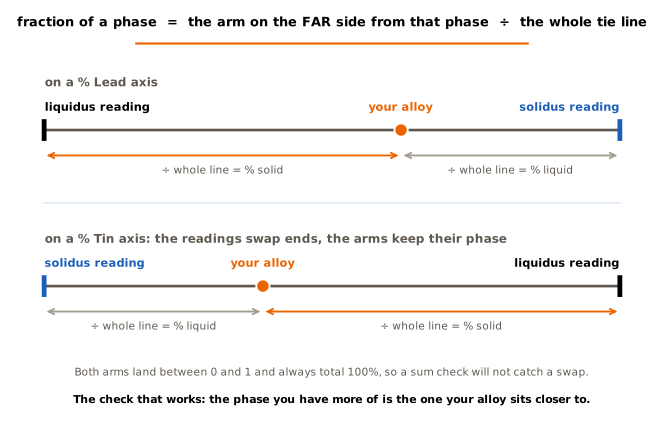
Why the far arm beats a memorised subtraction
The two readings swap ends when the axis changes. Take the same alloy, 70% Pb or 30% Sn, at 200 °C. On the lead axis the liquidus reads 45 and the solidus 83. On the tin axis the liquidus reads 55 and the solidus 17. The far arm gives $\frac{25}{38}=65.8\%$ solid either way, because it never asks you which reading is which.
Then check the answer against the picture. Your alloy sits nearer the phase you have more of. Swapped arms still land between 0 and 1 and still total 100%, so adding them up will not catch a swap.
Hypoeutectic or hypereutectic?
60Sn–40Pb solder settles any doubt. It contains 40% lead, which is between 38.1% and 81% Pb, so it is hypoeutectic. If a rule you have written down calls it hypereutectic, your rule is the wrong way round.
QCAA did not examine hypoeutectic or hypereutectic on lead–tin from 2020 to 2025. The 2025 syllabus now names both terms, so expect them. Hypoeutectoid and hypereutectoid are a different pair of words, and they belong to steel.
Eutectic and eutectoid are different words
A eutectic is a liquid turning directly into two solids. For lead–tin that happens at 38.1% Pb and 183 °C.
A eutectoid is one solid turning directly into two solids. For iron–carbon that happens at 0.83% C and 723 °C, where austenite becomes pearlite.
The “-oid” ending means solid to solid.
Part 3
Steels and microstructures
Three routines, and all three start by placing the steel in its carbon band.
Naming the steel and its structure
The question gives a carbon percentage, names a steel or an application, or shows a picture of grains.
- 1Place the carbon percentage in its band. Low carbon is 0.07% to 0.30%, medium carbon is 0.30% to 0.60% and high carbon is 0.60% to 2.0%.
- 2Compare it with 0.83% C, the eutectoid. Below 0.83% the steel is hypoeutectoid and cools to ferrite and pearlite. Above it the steel is hypereutectoid and cools to pearlite and cementite.
- 3Name the microstructure and the properties it gives, from the tables below.
- 4For an application, match it to the syllabus list for that band.
Austenite is the high-temperature form of iron, stable above 723 °C in eutectoid (0.83% C) steel and at higher temperatures for other carbon contents, and it dissolves far more carbon than the room-temperature form. Ferrite is nearly pure iron, soft and ductile with low strength. Cementite is iron carbide, $\text{Fe}_3\text{C}$, hard and brittle. Pearlite is a layered mixture of ferrite and cementite formed at the eutectoid, with properties between the two.
Steel stops at about 2.1% carbon. Above that it is cast iron, which is outside the course. The high-carbon band ends at 2.0%, which is the top of the band and not the steel limit.
Explaining or comparing a steel
Explain, describe, compare or contrast, with a steel and a use.
- 1Count what the question asks for: the number of steels, properties and applications. One mark usually sits on each.
- 2Name the microstructure of the steel’s band.
- 3Link each constituent to a property, and the property to what it lets the part do.
- 4For compare or contrast, make every statement comparative, with “than” in it.
- 5If a decision is asked for, give it its own sentence, with the property that settles it as the reason.
For the full compare and contrast template, see Game plan 7.
Sketching a microstructure
“Sketch” or “annotated sketch”. The 2023 mark guide paid for drawing and for labelling separately.
- 1Draw grains as closed cells with visible boundaries, not a block of shading.
- 2Draw ferrite as plain grains and pearlite as banded grains, so the two kinds are clearly different.
- 3Label both on the diagram.
- 4Match the proportions to the carbon content. Low carbon is mostly plain grains and high carbon is mostly banded grains.
Pearlite is alternating ferrite and cementite, so ferrite shows up twice on your sketch, as whole plain grains and as the pale bands inside the pearlite. Label the plain grains as ferrite.

The three plain-carbon steels
| Steel | Microstructure, then properties |
|---|---|
| Low carbon, 0.07–0.30% C | Mostly ferrite, a little pearlite. Soft, very ductile, easily formed, good toughness, low strength. |
| Medium carbon, 0.30–0.60% C | Ferrite and pearlite in roughly equal measure. Good strength, good toughness, moderate hardness. |
| High carbon, 0.60–2.0% C | Mostly pearlite, with cementite at the grain boundaries above 0.83% C. High hardness, high strength, wear resistant, low ductility, lower toughness. |
Applications, as the 2025 syllabus lists them
| Steel | Applications |
|---|---|
| Low carbon | Automobile body parts, wire products, structural plates and sections, seamless tubes, boiler plate |
| Medium carbon | Automotive components including shafts, axles, gears and crankshafts, stampings and forgings, train rails, wheels and axles |
| High carbon | High-strength spring materials and wires, cutting tools, punches, dies, industrial knives |
Most multiple choice items are these two tables
Most steels multiple choice questions test these two tables, or ask you to identify a microstructure from a picture.
2022 Question 8 asked what high carbon steel is used to make, from boiler plates, railway tracks, punching tools and engine crankshafts. Only punching tools is on the high-carbon list. 2025 Question 1 ran it in reverse and asked which application uses medium carbon steel. The answer was train rails.
Learn the three lists.
Which steel gets “a small amount of cementite”
Those are QCAA’s words for mild (low-carbon) steel in its 2024 Question 14 sample response, where the small amount of cementite gives toughness. In high-carbon steel the extra cementite lowers toughness. Use the phrase for low-carbon steel only.
The carbon axis is not numbered
QCAA has printed the full iron–carbon diagram with temperature numbered on both sides, 0 to 1600 °C, and the carbon axis as a bare line labelled Carbon (%). Three landmarks are already drawn on it:
- •The right-hand edge is 6.7% carbon, which is cementite.
- •The left-hand end of the upper horizontal line is about 2.1% carbon, where steel ends.
- •The lower horizontal line is the eutectoid temperature, about 723 °C.
2021 Question 13 used this diagram for a 3% carbon cast iron. Cast iron is outside the 2025 syllabus, so that question cannot be set in 2026. Use it only to learn the landmarks.
Part 4
Heat treatment
Heat treatment is new to the Unit 4 syllabus for 2026, and no question from 2020 to 2025 asked about annealing, normalising, quenching, martensite or tempering. Apart from annealing, which belonged to an earlier unit, and “highly tempered” in the old ultra-high carbon dot point, none of it was in the 2019 Unit 4 syllabus.
The nearest miss is 2024 multiple choice Question 2, which asked for the material most suitable for “highly tempered punches and axles”. That phrase was the 2019 syllabus description of ultra-high carbon steel, which was the answer. The term has now been removed from the syllabus.
So there are no past questions to cram from, but the syllabus list is specific. Learn every process it names, including the quench media (water, oil, air and furnace) and how the cooling rate decides how much martensite forms.
Explaining a heat treatment
“Explain the effect of” a process, or any question naming annealing, normalising, quenching, tempering, or hot or cold working. No mark guide exists yet, so this shape is my prediction from every other materials question.
- 1Name the process and what it does to the temperature: how hot, relative to the critical temperature, and how fast it cools.
- 2Say what that does to the grain structure.
- 3Say what that grain structure does to the properties.
- 4Say what those properties allow the part to do.
What each process does
| Process | What happens to the grains, and the result |
|---|---|
| Hot working | Grains deform and recrystallise straight away while the metal is shaped. It stays soft and workable, so large reductions are possible. |
| Cold working | Grains stretch and distort in the working direction, with no recrystallisation. The steel gets harder and stronger but less ductile, until it is too hard to work (work hardening). |
| Process annealing | Heated below the lower critical temperature, so no austenite forms, and the distorted ferrite recrystallises. Enough ductility comes back to keep forming. |
| Full annealing | Heated into austenite, then cooled in the furnace to coarse pearlite. Soft, ductile and easy to machine, with the lowest strength. |
| Normalising | Heated into austenite, then cooled in still air to fine pearlite. Stronger and tougher than annealed, with a more uniform grain. |
| Quenching | Cooled so fast the carbon has no time to move out, leaving a strained structure called martensite. Very hard and very brittle. |
| Cooling rate | Water quenching is fastest, then oil quenching, then air cooling, then furnace cooling. The faster the cooling, the more martensite forms and the harder the steel. |
| Tempering | Reheated to below the lower critical temperature (about 723 °C) and held, so some carbon leaves the strained structure, giving tempered martensite. It loses a little hardness and gains a lot of toughness. |
Two differences to know by heart
Full annealing and normalising differ only in how they cool. Both heat the steel into the austenite range. Full annealing cools in the furnace over hours, and normalising cools in still air over minutes. Slower cooling gives coarser pearlite and a softer steel.
Quench then temper is the two-step most hardened tools go through. Quenched martensite is too brittle to use, and an untempered chisel could shatter on the first blow. Tempering gives up some hardness to gain toughness, and the tempering temperature decides how much.
Each of these is a three-sentence explanation. Rehearse both.
In the Topic Guides
Part 5
Common QCAA language: metals
Look for “thermal-equilibrium diagram”, “phase diagram”, “lever rule”, a carbon percentage, or a named steel such as mild, medium carbon or high carbon steel. Past papers say “mild steel”. Read it as low-carbon steel, which is the 2025 syllabus name.
| You see this | The move it demands |
|---|---|
| A phase diagram with a temperature and an alloy named | The lever rule. Rule the tie line, read both boundaries and take the far arm. Check the arms add to the tie line. Game plan 4.1 |
| “Determine the mass of solid” | Not asked from 2020 to 2025. If it is, find the fraction with the lever rule, then multiply by the total mass. |
| “eutectic” | Liquid to two solids. Lead–tin, 38.1% Pb, 183 °C. |
| “eutectoid” | Solid to two solids. Iron–carbon, 0.83% C, 723 °C, where austenite becomes pearlite. |
| “Explain how the chemical composition of [steel] contributes to its suitability for [use]” | The chain. Carbon content, then microstructure, then property, then what it allows. One sentence with two joins. Game plan 4.4 |
| “Compare” or “contrast” two steels | Make every statement comparative, then give the selection its own sentence with its reason. Game plan 7 has the template. |
| “Sketch the microstructure” | Grains, plain against banded, both labelled. Drawing and labelling earn separate marks. Game plan 4.5 |
| “Explain the effect of [heat treatment]” | Process, then grain structure, then property, then what it allows. Game plan 4.6 |
In the Topic Guides
Wording quoted from past QCAA Engineering external assessments is © State of Queensland (QCAA), licensed under CC BY 4.0. Tangent Tuition is not affiliated with the QCAA.
© 2026 Tangent Tuition. This resource is licensed to you for your own study. Please don’t share it, send it to anyone else or post it anywhere. See the Terms of Use.
Spot a mistake on this page? Report it