
Question 1
A lead–tin thermal-equilibrium phase diagram is shown.
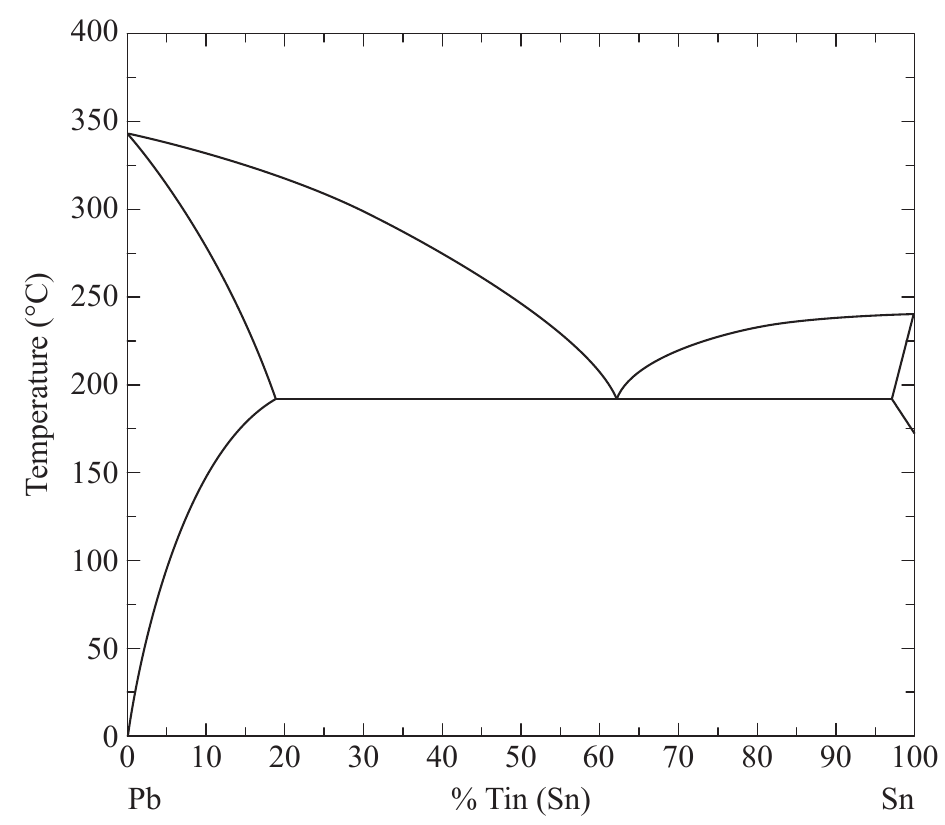
What phase would be present in an alloy containing 35% Sn at a temperature of 225 °C?
Not quite. $\beta$ is the tin-rich solid, the thin sliver at the right edge beyond about 97% Sn. A 35% Sn alloy is lead-rich, so the solid it makes is $\alpha$. In 2024, 3.2% of Queensland students chose (A).
Not quite. Counting 35% in from the tin end puts you at 65% Sn, and at 225 °C that point is above the tin-side liquidus, so it is all liquid. Count from Pb at the left. At 225 °C the liquidus is at about 56% Sn, so 35% Sn is still below it. In 2024, 7.9% of Queensland students chose (B).
Not quite. $\alpha+\beta$ only exists below the horizontal eutectic line, at about 192 °C on this drawing. 225 °C is above that line, so some liquid is still present. In 2024, 11.5% of Queensland students chose (C).
That is it. Step through the hints below to see why. In 2024, 77.1% of Queensland students chose (D).
Redrawn from the diagram on QCAA’s 2024 multiple choice paper, traced from the paper itself. The shaded region is the field your point sits in.
Read the axis label before you look at the curves. This one counts % Tin, with Pb at the left.
$$35\%\text{ Sn}=65\%\text{ Pb}$$
So the alloy is on the lead-rich side of the eutectic point, which sits at about 62% Sn. Its solid will be $\alpha$, which rules out (A).
Rule a vertical line up from 35 and a horizontal line across at 225 °C. The point is where they cross.
The horizontal eutectic line on this drawing sits at about 192 °C, a little above the 183 °C you may have learnt. Your point is above it, so the alloy is not yet fully solid. That rules out (C).
At 225 °C the lead-side solidus is at about 16% Sn and the liquidus is at about 56% Sn.
$$16\%\lt35\%\lt56\%$$
The point sits between the two curves, in the field where solid $\alpha$ and liquid exist together. It is below the liquidus, which rules out (B).
$$\begin{aligned}&\text{solidus }16\%\text{ Sn}\lt35\%\text{ Sn}\\&\lt\text{liquidus }56\%\text{ Sn}\\&\Rightarrow\ \alpha+L\end{aligned}$$
At 225 °C a 35% Sn alloy sits between the solidus and the liquidus on the lead-rich side, above the eutectic line. It is part solid $\alpha$ and part liquid.
The most common wrong answer was (C), $\alpha+\beta$. That field only starts below the horizontal eutectic line, near 192 °C on this drawing, so check which side of that line your point is on before you name anything.
Only mark this done when you could do it without help. Reading the solution does not count.
Question wording and any figures are from the 2024 QCAA Engineering external assessment, © State of Queensland (QCAA) 2024, licensed under CC BY 4.0, and have been adapted, except where a third-party source is named. Tangent Tuition is not affiliated with the QCAA.
Spot a mistake on this page? Report it