
Question 20
A pulley system moves a generator with a mass of 300 kg up a 15º incline. The coefficient of static friction between the incline and the generator is 0.3.
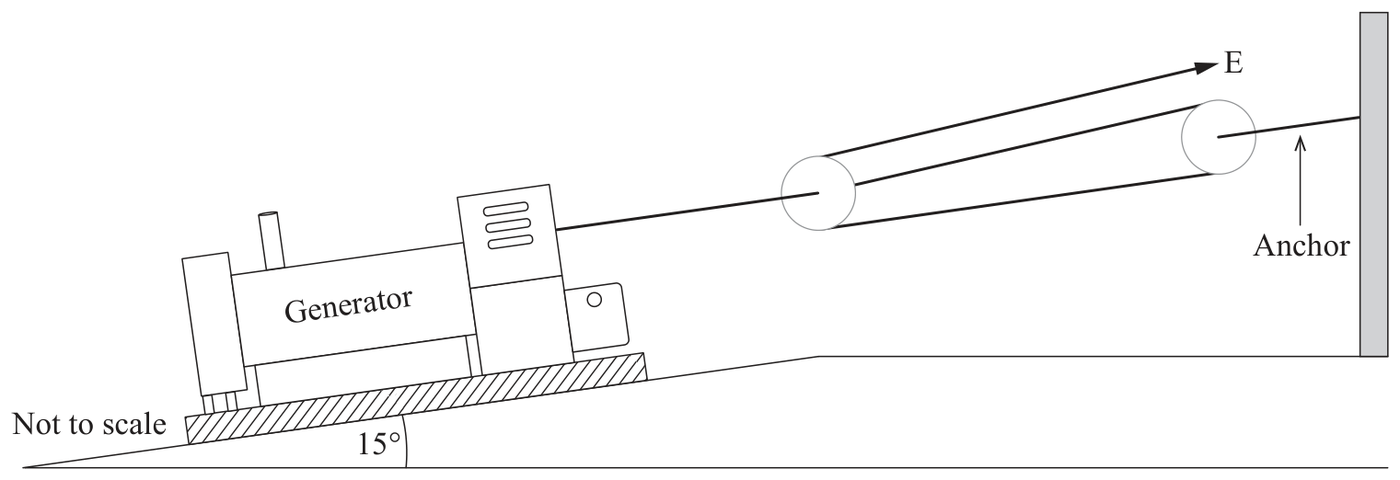
Determine the tension in the pulley rope required at E to almost begin moving the generator up the incline if the pulley system is 80% efficient. Answer to two decimal places.
Assume that the pulley system is parallel to the incline.
The rope has to beat friction and the slope together, and the pulley then shares that pull
This is the QCAA figure set moving, and every force arrow on the generator is drawn to scale. Watch which way friction points, and how the two pulls down the slope add up to the tension the rope needs.
The tension $T$ is the load the pulley system lifts. Find it from the slope first, then hand it to the machine.
Change the slope, the friction and the machine
Tilt the slope, change the coefficient, set the efficiency and the number of strands, and choose which way the generator is about to move. The forces on the generator are drawn to scale. The question is 15°, 0.3, 80%, three strands and up the slope.
This is the question. The generator is about to move up, so friction points down the slope beside $F_\parallel$. The rope needs $T=760.93+851.95=1612.88$ N, and the machine with $\text{MA}=2.4$ turns that into 672.03 N at E.
Pulled up the slope, friction always works against the rope, so $T=F_\parallel+F_f$. A steeper slope grows $F_\parallel$ and shrinks $F_N$, but the total still rises. The machine only changes the last line, $E=T\div\text{MA}$.
About to slide down, friction flips and points up the slope, so it helps the rope. Now $T=F_\parallel-F_f$. This is the held-back case from Game plan 1.1, and it is the wrong picture for this question.
Here $\tan\theta$ is at most $\mu_s$, so static friction alone can hold the generator and the rope does no work at all. Friction only grows as large as it needs to, up to $\mu_s F_N$.
Work through the solution one mark at a time
Try each step yourself before you reveal it. The guide says the free-body diagram and annotations are not required, but drawing one is how you get the friction direction right.
Draw a boundary around the moving pulley. Three strands pull it up the slope: the two that run to the anchored pulley, and the free end at E, because it leaves the moving pulley and is pulled the same way. So $\text{VR}=3$. Use the efficiency as a decimal.
$$\begin{aligned}\eta&=\frac{\text{MA}}{\text{VR}}\times100\%\\\text{MA}&=0.8\times3=2.4\end{aligned}$$
Marker: correctly determines MA
Turn the mass into the weight force. Everything on the slope is built from this number.
$$\begin{aligned}F_g&=mg=300\times9.8\\&=2940\text{ N}\end{aligned}$$
Marker: correctly determines mg
The normal force balances the part of the weight pressing into the slope. “Almost begin moving” means static friction at its maximum, and it points down the slope because the generator is about to move up.
$$\begin{aligned}F_N&=mg\cos15^\circ\\&=2839.82\text{ N}\\F_f&=\mu_s F_N\\&=0.3\times2839.82\\&=851.95\text{ N}\end{aligned}$$
The guide’s own sketch draws $F_N$ straight up and adds an arrow labelled $F_r$ up the slope that it never explains. The normal force is perpendicular to the incline, and the only forces along the slope are $T$, $F_\parallel$ and friction, which points down the slope.
Marker: correctly determines the force of friction (Ff). “Allow FT error for incorrect mg when determining force of friction.”
The other part of the weight pulls the generator down the slope. It takes the sine.
$$\begin{aligned}F_\parallel&=mg\sin15^\circ\\&=2940\times\sin15^\circ\\&=760.93\text{ N}\end{aligned}$$
The guide calls this $F_p$, the force parallel. Check the swap: on a gentle slope $F_\parallel$ must be much smaller than $F_N$, and 760.93 N against 2839.82 N passes.
Marker: correctly determines the force parallel (Fp)
On the point of moving, the forces along the slope balance. The rope pulls up, and friction and $F_\parallel$ both pull down.
$$\begin{aligned}T&=F_f+F_\parallel\\&=851.95+760.93\\&=1612.88\text{ N}\end{aligned}$$
Kept unrounded, the sum is 1612.87 N. That is why the guide accepts a range.
Marker: correctly determines the force total (T). “Accept force total (T) range from 1612.874571 to 1612.88 N.” FT is allowed for an incorrect Ff or Fp.
The tension is the load the pulley system has to move, $F_L=T$. Rearrange the formula book MA for the effort at E.
Two decimal places, as the question asks, with the unit. Dividing by the VR instead gives 537.63 N and loses this mark.
Marker: correctly determines the answer to two decimal places. FT is allowed for an incorrect force total (T) or MA.
Each phrase of the question gave you something
The 2022 subject report says effective responses correctly determined the MA of the 80% efficient pulley system and gave the answer to two decimal places. The same report asks teachers to strengthen the parallel and perpendicular components of the weight on an incline, and answers given in the form the question specifies.
Each half is a routine you have drilled: balance a slope at the point of moving, then run one machine chain. The 2022 subject report calls it “This simple familiar question”, even at six marks, because nothing in it is new once you see that the rope tension is the machine’s load.
If I had to guess where you might lose marks, it would be the last division. Dividing $T$ by the VR gives 537.63 N, and multiplying by 0.8 afterwards gives 430.10 N. The machine is less than perfect, so the effort has to come out bigger than $T\div3$, never smaller. The other trap is pointing friction up the slope, which makes the pulls nearly cancel and leaves you with a negative tension.
Only mark this done when you could do it without help. Reading the solution does not count.
Question wording, any figures and marking-guide steps are from the 2022 QCAA Engineering external assessment, © State of Queensland (QCAA) 2022, licensed under CC BY 4.0, and have been adapted, except where a third-party source is named. Tangent Tuition is not affiliated with the QCAA.
Spot a mistake on this page? Report it