Topic guide 2 · Unit 4 Topic 2 · Machines, mechanisms and control
Simple machines: MA, VR and efficiency
A machine changes a force. It does not create energy, so whatever you gain in force you give up in distance. Mechanical advantage and velocity ratio are the two ratios that describe that trade, and efficiency connects them. This guide covers levers, pulleys, screws and inclined planes. Gears and belt drives have their own guide.
Machine questions turn up in every paper, from one-mark multiple choice questions to nine-mark Section 3 chains. Most of them run one chain of relationships, forwards or backwards. Tick off each skill once you can do it without help.
14
multiple choice questions, 2020–2025, four of them shared with the energy guide
41
Section 2 and 3 marks, 2020–2025, on the count in Part 8
6 of 6
years with a machine question, and multiple choice every year
Skills in this topic
Only tick a skill when you could do it in the exam. Your ticks are saved in this browser only.
Part 1
What the exam asks about simple machines
Simple machines appear in every past paper, and there has been at least one multiple choice question on them every year. Every year except 2020 also had a Section 2 or Section 3 question on this guide’s machines. In 2020 the machine questions were a gear train (Q16) and a worm winch (Q20), both worked in Topic guide 3.
On the count explained in Part 8, 2020 to 2025 carried 14 multiple choice questions, 14 marks in Section 2 and 27 marks in Section 3.
Four of the five Section 3 questions on these machines were worth 3 to 6 marks. The exception was 2023 Q17, a 9-mark screw question. They often sit early in Section 3. In 2025, three of the first four Section 3 questions were machine questions (Q17, Q18 and Q20).
The written question has not kept one shape. Recent Section 2 machine questions (2022 pulley, 2023 bicycle gearing, 2024 crowbar) asked you to explain MA, VR or both through a named machine, with a sketch. 2021 Q16 asked for work and power with mathematical reasoning instead. 2025 had no Section 2 machine question.
What the syllabus says
These are the Unit 4 Topic 2 dot points this guide covers, quoted from the syllabus:
•Comprehend the function and purpose of basic machines, including bicycle, car jack and crowbar.
•Identify four types of motion, including linear, rotary, oscillatory and reciprocating.
•Calculate MA and VR using the formulas $\text{MA} = \frac{\text{load} }{\text{effort} } = \frac{F_L}{F_E}$, $\text{VR} = \frac{\text{distance moved by effort} }{\text{distance moved by load} } = \frac{d_E}{d_L}$ and $\text{VR of screws} = \frac{\text{circumference} }{\text{pitch} } = \frac{2\pi r}{P}$.
•Comprehend and calculate the function and operation of mechanical components, using mechanical advantage and velocity ratio, including inclined planes and screws, levers (first, second and third order) and simple pulley systems (fixed and moveable, using one continuous rope) where the MA or VR is determined by addition of the number of ropes supporting the load.
•Calculate energy efficiency, using the formula $\eta = \frac{\text{useful output} }{\text{input} } \times 100\% = \frac{\text{MA} }{\text{VR} } \times 100\%$.
Gears and belt drives sit in the same syllabus topic. They are in Topic guide 3. Work and power are covered in Topic guide 4.
What the formula book gives you
Supplied
•$\text{MA} = \frac{F_L}{F_E}$ and $\text{VR} = \frac{d_E}{d_L}$
•VR for screws = circumference ÷ pitch. The book does not print $2\pi r \div P$, so you supply circumference $= 2\pi r$ yourself.
•Pulley MA and VR by counting the rope segments supporting the load. The syllabus names the method, but there is no formula for it.
•The lever orders, and which everyday machines are examples of each.
•The four types of motion, and which mechanisms produce them.
•Circumference $= 2\pi r = \pi d$.
•$\text{MA} = \eta \times \text{VR}$, with $\eta$ as a decimal. The book gives $\eta = \frac{\text{MA} }{\text{VR} } \times 100\%$, and rearranging it is left to you. Most questions need the rearranged form.
New for 2026
The screw formula is new in the 2025 v1.4 formula book, and so is the “× 100%” on the efficiency formula. Every paper from 2020 to 2025 was sat with the 2019 book, which had no screw formula, so those students had to recall it. The past papers make a screw question look harder than it will be in 2026.
The 2025 syllabus revision report also lists the definition of MA and VR as reduced subject matter. Part 7 shows why the definitions still matter.
Part 2
Mechanical advantage, velocity ratio and efficiency
Mechanical advantage is the force ratio. It is the load force divided by the effort force:
$$\text{MA} = \frac{F_L}{F_E}$$
An MA of 4 means the machine lets you lift four times the force you push with.
Velocity ratio is the distance ratio. It is the distance moved by the effort divided by the distance moved by the load:
$$\text{VR} = \frac{d_E}{d_L}$$
A VR of 4 means you pull 4 m of rope to raise the load 1 m. The VR is set by the geometry alone, so friction and wear do not change it.
A perfect machine would have MA = VR. A real machine loses some of the effort to friction, so its MA is always smaller than its VR. With $\eta$ written as a decimal, the rearranged form $\text{MA} = \eta \times \text{VR}$ is the one most exam questions need.
Game plan: The efficiency chain
1Read the VR from the geometry: ropes, arm lengths or $2\pi r \div P$. Sometimes it is given, as in “has a velocity ratio (VR) of 16”.
2Find $\text{MA} = \eta \times \text{VR}$. This is the step behind “is 90% efficient”.
3Find the missing force with $F_L = \text{MA} \times F_E$ or $F_E = F_L \div \text{MA}$, as in “Calculate the effort required”.
4Find the missing distance with $d_E = \text{VR} \times d_L$, as in “to raise an object 150 mm”.
5Find the work with $W = F_E d_E$ or $W = F_L d_L$, as in “Calculate the work done on the lever arm”.
6Find the power with $P = W \div t$, as in “Calculate the power input”.
Run the chain in whichever direction the question needs. Most Section 3 machine questions give you two or three links and ask for one further along.
Which force goes with which distance
You can calculate work on either side of the machine, but the pairs must match. Use the effort force with the effort distance, or the load force with the load distance. Mixing them gives an answer that is wrong by a factor of the VR.
The 2025 mark guide accepts both routes for Q18b. The effort side gives $20 \times 0.04 = 0.8\ \text{J}$. The load side gives $288 \times 0.0025 = 0.72\ \text{J}$, which is the useful output, and dividing by the efficiency of 0.9 gives the same 0.8 J of input.
Practise
Exam question: the efficiency chain
For written-answer questions, the solutions show where each mark goes, based on the QCAA marking guides. Follow-through applies every year. If an earlier step is wrong but you use your wrong answer correctly, you can still earn the later marks.
2025 Question 18
Section 3 · Simple familiar (est.) · [4 marks]
A bottle opener is used to remove the bottle cap from a glass drink bottle. An effort force of 20 N is exerted on the bottle opener to lift the bottle cap by 2.5 mm. The bottle opener has a velocity ratio (VR) of 16 and is 90% efficient.
a) Calculate the load force on the bottle opener. [2 marks]
b) Calculate the work done on the bottle opener to lift the bottle cap. [2 marks]
1 mark Calculates the load force on the bottle opener.
(b) The work done on the opener is done by the effort, so you need the effort distance. The question gives the load distance, so multiply by the VR first:
1 mark Calculates the work done on the bottle opener.
The guide also accepts the load route: $W_L = 288 \times 0.0025 = 0.72\ \text{J}$, then $W_E = 0.72 \div 0.9 = 0.8\ \text{J}$. A bottle opener is a second-order lever, with the cap between the fulcrum and your hand.
Answer
(a) 288 N, (b) 0.8 J
Part 3
Levers
A lever turns about a fulcrum. Its order is named by what sits in the middle: the fulcrum, the load or the effort.
First order
The fulcrum is in the middle, as in a crowbar. The VR is above 1 when the effort arm is longer than the load arm.
Second order
The load is in the middle, as in a wheelbarrow or a bottle opener. The effort arm is always the longer one, so the VR is always above 1.
Third order
The effort is in the middle, as in tweezers. The VR is always below 1, so the MA is too. It gives up force to gain speed and range of movement.
For any lever, the VR is the ratio of the two arm lengths, both measured from the fulcrum:
A longer effort arm gives a bigger VR and a bigger MA. That is why a crowbar is long, with the fulcrum close to the load.
Practise
Exam question: explaining a lever
2024 Question 11
Section 2 · Simple familiar (est.) · [4 marks]
Explain the purpose of a crowbar using the concepts of mechanical advantage and velocity ratio. Include a sketch to support your response.
One mark is for the sketch and three are for the wording. Here is a response that earns all four.
A crowbar is a first-order lever. Its purpose is to let a small effort force ($F_E$) move a large load force ($F_L$), using a fulcrum placed close to the load.
It provides a mechanical advantage, $\text{MA} = \frac{F_L}{F_E}$. The longer the effort arm is compared with the load arm, the smaller the effort needed to move the load.
The velocity ratio is the distance moved by the effort divided by the distance moved by the load, $\text{VR} = \frac{d_E}{d_L}$. The handle end moves a long way while the tip lifts the load a short way, and that extra distance is what pays for the smaller effort.
Sketch a bar on a fulcrum near one end, with the load at the short end and an effort arrow at the long end. Label $F_E$ and $F_L$, or $d_E$ and $d_L$. The first-order lever above is enough.
1 mark Includes an appropriate sketch of a crowbar, showing effort force and load force, or effort distance and load distance.
1 mark Explains the purpose of a crowbar, with wording about a reduced effort force moving a load force.
1 mark Uses MA, with wording that as the effort arm gets longer, the effort needed to move the load reduces. The guide also accepts the reverse: a shorter effort arm needs more effort.
1 mark Uses VR, with wording that it is the distance moved by the effort divided by the distance moved by the load.
Answer
A labelled sketch, the purpose, an MA sentence and a VR sentence
Part 4
Pulleys
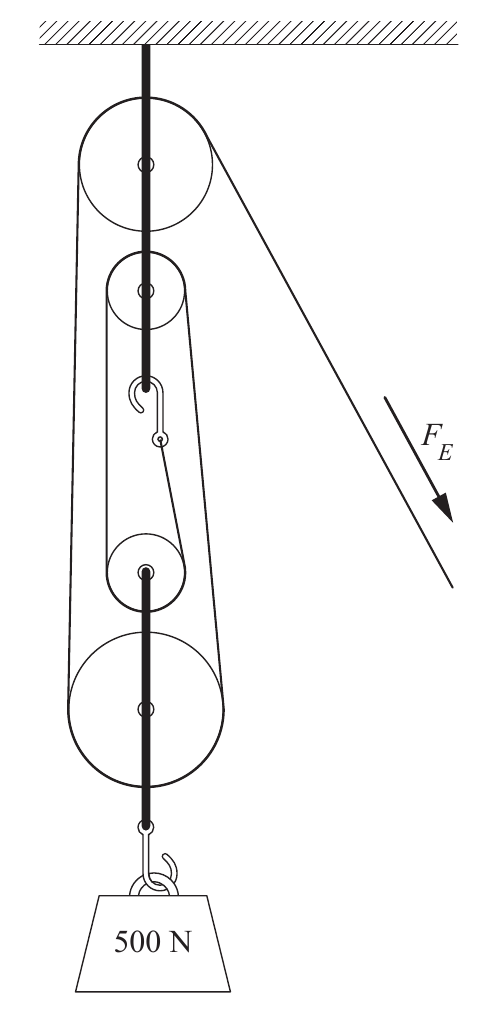
For a simple pulley system using one continuous rope, count the rope segments that support the load. That count is the VR. If the system were 100% efficient, it would also be the MA.
VR = 1
A single fixed pulley only changes the direction of the effort.
VR = 2
Two segments hold up the moving pulley. The effort rope is not counted.
VR = 4
Four segments hold up the moving block. MA = 4 only at 100% efficiency.
Each moving pulley you add raises the VR. The effort rope leaving the system does not count unless it pulls upward on the load block.
Write the 100% sentence
When a question says to assume 100% efficiency, write “MA = VR when 100% efficient” before you use it. The 2025 mark guide gave this its own mark, and the 2025 subject report asks students to state it rather than leave it implied.
Try it yourself
Build a pulley system
Choose how many rope segments hold the load, then lower the efficiency. Watch which numbers change and which one stays the same.
Practise
Exam questions: pulleys
2025 Question 17
Section 3 · Simple familiar (est.) · [3 marks]
A block and tackle pulley system is shown.
a) Identify the velocity ratio (VR) of the pulley system. [1 mark]
b) Calculate the effort required to raise the load. Assume the system is 100% efficient. [2 marks]
(a) Draw a boundary round the lower block and count the rope segments that cross it. Four segments hold the lower block up. The rope running from the top pulley to $F_E$ is not counted.
$$\text{VR} = 4$$
1 mark Correctly identifies the velocity ratio from the number of ropes in the system. The guide accepts the boundary drawn on the diagram.
(b) Write the assumption before you use it. At 100% efficiency, MA = VR:
A pulley system with an efficiency of 75% is used to vertically raise a 120 kg load a distance of 3 m. If the length of pulley rope pulled to raise the load is 8 m, the effort required is
There is no diagram, so take the VR from the two distances, then run the chain:
(C) is close to 441 N, the effort a perfect machine would need. (A) is that 441 N multiplied by 0.75 instead of divided. (B) uses 3 as the VR. A real machine always needs more effort than a perfect one, so the answer must be above 441 N.
Answer
(D) 588 N.
Part 5
Screws and inclined planes
An inclined plane is a machine. A long, gentle slope needs less force than a short, steep one to raise the same load. Its VR is the distance moved along the slope divided by the height gained. 2023 multiple choice Q8 used this: a 3 m rise on a 30° incline gives 6 m of slope, so VR = 2.
A screw is an inclined plane wrapped round a cylinder. One turn moves the load forward by one pitch, while the effort travels one full circle of whatever turns the screw:
Where there is a handle or lever arm, $r$ is the radius of the effort path, measured from the screw’s axis to where the effort is applied. Where a motor turns the rod directly, as in 2023 Q17, QCAA used the rod’s own circumference, $\pi \times 30$ mm.
Read what rises per turn
2022 multiple choice Q4 gave a scissor jack with a 2.5 mm screw pitch and a 100 mm handle. The question tells you the vehicle rises 5 mm per revolution of the handle, so use 5 mm. When a question states how far the load moves per turn, use that figure in place of the pitch.
The unit conversion carries its own mark
In 2024 Q18 every length arrives in millimetres, and the answers are wanted in metres, joules and watts. The mark guide gives a mark for recognising that the radius must be converted from millimetres to metres, separate from the mark for the distance itself. Convert once, at the start, and write the converted values down.
Practise
Exam questions: screws
2022 Question 4
Section 1 · Multiple choice · [1 mark]
A scissor jack is used to lift a 1.5 tonne vehicle.
If the 2.5 mm pitch of the central screw allows the vehicle to be raised 5 mm during one revolution of the handle, the velocity ratio of the jack is
The effort goes round a 100 mm handle once while the vehicle rises 5 mm:
That rounds to 126:1. (C) uses the 2.5 mm pitch in place of the 5 mm rise. (A) is $100 \div 2.5$, which leaves out the $2\pi$ and uses the pitch. (D) is $1500 \div 5$, which uses the vehicle’s mass, and mass plays no part in a VR.
Answer
(B) 126:1
2024 Question 18
Section 3 · Simple familiar (est.) · [5 marks]
An effort of 120 N is applied at the end of the lever arm of a screw jack for 180 seconds to raise an object 150 mm.
a) Calculate the work done on the lever arm. [4 marks]
The guide accepts 23.56 to 23.6 m, 2827.2 to 2832 J and 15.7 to 15.73 W. Each range is the same calculation with different intermediate rounding. The stem gives no precision for (b), and the guide’s own answer is 15.71 W. Follow-through applies, so a wrong turn count still earns the later marks if the method is right.
Answer
(a) 2827.2 J, (b) 15.71 W
2023 Question 17
Section 3 · Simple familiar (est.) · [9 marks]
A threaded rod with a pitch of 2.5 mm and an outside diameter of 30 mm is used as a mechanism to vertically raise a 40 kg load with a potential energy of 980 J. The threaded rod is directly driven by a variable-speed electric motor with an efficiency of 62%.
Determine the power required from the motor to raise the load in 15 seconds. Answer to one decimal place.
This is the whole chain, starting from an energy. First find how high the load goes:
$$\begin{aligned} PE &= mgh \\[10pt] h &= \frac{980}{40 \times 9.8} \\[10pt] &= 2.5\ \text{m} \end{aligned}$$
1 mark Determines the vertical distance the load is raised.
The motor turns the rod directly, so the effort travels the rod’s own circumference on each turn:
The guide also accepts a shorter route. The output power is $980 \div 15 = 65.33\ \text{W}$, and the input power is $65.33 \div 0.62 = 105.37\ \text{W}$, which is 105.4 W to one decimal place. On that route, separate marks go to rounding to one decimal place and to the unit.
Answer
105.4 W
Part 6
Four types of motion
The syllabus asks you to identify four types of motion. The examples are the ones the QCAA has used or that you can sketch quickly.
Motion
What it does, with an example
Linear
Moves in a straight line, in one direction. A conveyor carrying a package.
Rotary
Turns about an axis. A crank, a wheel or a gear.
Reciprocating
Moves back and forth in a straight line. A piston rod or a jigsaw blade.
Oscillating
Swings back and forth about a pivot. A pendulum or a metronome arm.
Reciprocating or oscillating
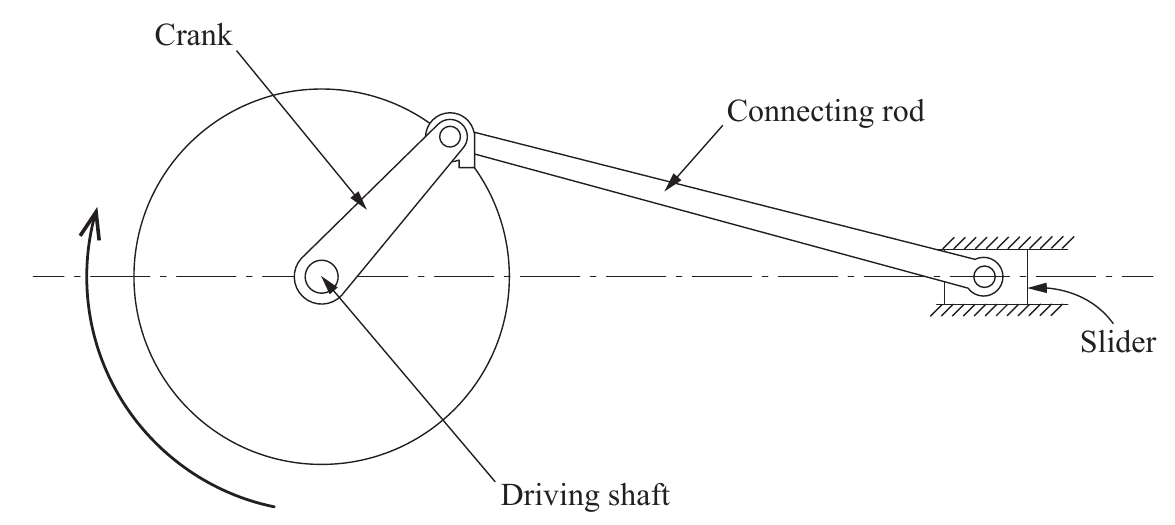
2022 multiple choice Q10 showed the piston rod of a steam engine, and 2024 multiple choice Q3 showed a crank driving a slider. Both asked what the rod or slider does. Both answers are reciprocating, which the QCAA printed as “reciprocal”.
Reciprocating and oscillating motion both go back and forth. The difference is the path. Reciprocating motion travels along a straight line, and oscillating motion swings through an arc about a pivot. A piston reciprocates and a pendulum oscillates.
Practise
Exam question: types of motion
2024 Question 3
Section 1 · Multiple choice · [1 mark]
The crank moves continually in the direction shown.
Identify the type of motion that best describes what is experienced by the slider.
The crank rotates, but the slider is held in its guide. It can only move back and forth along a straight line, which is reciprocating motion. The QCAA printed the option as “reciprocal”.
(A) would need the slider to swing through an arc about a pivot. (C) describes the crank, not the slider. (D) is motion in one direction, but the slider keeps reversing.
Answer
(B) reciprocal
Part 7
Earning the marks on the written question
The written machine question has not kept one shape. Here is what each one asked and where the marks went.
Question
What it asked, and where the marks went
2021 Q16 · 5 marks
A windlass lifting a bucket from a well. Explain the work done and the power used, with mathematical reasoning. Marks went to the formulas for work and power, the value of MA, and the values of the work and power.
2022 Q11 · 5 marks
Explain MA and VR using a simple pulley system, with an annotated sketch. One mark for the MA wording, one for the VR wording, and three for the sketch (effort, load, and the distances moved).
2023 Q12 · 5 marks
Explain how bicycle gearing gives a mechanical advantage up an incline, and its effect on the work done on the pedals. Four marks for the wording and one for the sketch. It is worked in Topic guide 3.
2024 Q11 · 4 marks
Explain the purpose of a crowbar using MA and VR, with a sketch. Three marks for the wording and one for the sketch. It is worked in Part 3.
In 2024, three of the four marks were for the wording. In 2022, the sketch carried three of the five. Learn the definitions and draw a fully labelled sketch.
The 2021 guide adds a warning that applies to all of them. A response that is only equations, without words relating the concepts, is not a complete response.
Game plan: Explaining a machine
1Name the machine and say what it is for, using the idea of a reduced effort force moving a larger load force.
2Explain MA in words, naming what reduces the effort, such as a longer effort arm or more ropes supporting the load.
3Define VR in words as the distance moved by the effort divided by the distance moved by the load.
4Draw the sketch. Label the effort force and the load force, or the effort distance and the load distance. If you have time, label both.
5Keep it under 150 words. The 2025 syllabus caps written paragraph responses at 150 words per question.
Reduced for 2026, but still worth learning
The 2025 syllabus revision report (July 2024) lists the definition of MA and VR as reduced subject matter in Unit 4. It can still be examined.
Learn both definitions as sentences. Mechanical advantage is how much the machine reduces the effort force needed to move the load. Velocity ratio is the distance moved by the effort divided by the distance moved by the load.
Expect fewer marks here, but prepare it fully. Do not assume 2026 will repeat a question that is only the definitions.
How the marks are given in a calculation
The 2024 Q18a mark guide shows how a calculation is split into marks. It is worked in full in Part 5.
Mark guide dot point (2024 Q18a)
What earns it
demonstrates appropriate mathematical reasoning to determine correct number of rotations
$150 \div 12 = 12.5$
recognises that radius needs to be converted from mm to metres
300 mm = 0.3 m
calculates the distance travelled by the effort
23.56 m
calculates work done
2827.2 J
The same guide accepts a distance of 23.56 to 23.6 m, work of 2827.2 to 2832 J and power of 15.7 to 15.73 W. Each range is the same calculation with slightly different intermediate rounding. It also allows follow-through throughout.
QCAA accepts intermediate values rounded to anywhere from two to nine decimal places. Final answers go to the nearest whole unit unless the question says otherwise.
Part 8
Past QCAA questions and self-checks
This table covers levers, pulleys, screws, inclined planes as machines, efficiency and the types of motion. Gear and belt items are in Topic guide 3.
How the marks are counted
A question that appears in both this guide and Topic guide 3 is counted once. Screw questions are counted here (2023 Q17). Gear and worm questions are counted in Topic guide 3 (2020 Q20 and 2023 Q12). Those two are listed below so you can see them, but they are left out of this guide’s totals. Questions that are also listed in the friction or energy guides are counted in full here.
On that basis, this table holds 14 multiple choice questions, 14 Section 2 marks and 27 Section 3 marks.
The bands (SF, CF, CU) are derived. The 2020 bands follow from the subject report’s split of marks by section, and some 2021 and 2022 bands are named in those years’ subject reports.
Question
Marks / band
What it tests
2020 Q6 (MC)
1 · SF
Efficiency of an irrigation pump system. Answer 37%. Also in the energy guide.
2021 Q5 (MC)
1 · SF
Rope distance for a 20 m lift through a pulley system. Answer 80 m.
2021 Q6 (MC)
1 · SF
Crowbar efficiency from forces and distances. Answer 29%.
2021 Q7 (MC)
1 · SF
Effort for a 120 kg load, 75% efficient, 8 m of rope for 3 m of lift. Answer 588 N. Worked in Part 4.
2021 Q9 (MC)
1 · SF
Work done by a jack raising 1500 kg by 180 cm. Answer 26 460 J. Also in the energy guide.
2022 Q4 (MC)
1 · SF
Scissor jack VR from the handle radius and the lift per revolution. Answer 126:1. Worked in Part 5.
2022 Q10 (MC)
1 · SF
Motion of a steam engine piston rod. Answer “reciprocal” (reciprocating).
2023 Q5 (MC)
1 · SF
Conveyor efficiency from effort and VR. Answer 70%.
2023 Q8 (MC)
1 · SF
Force to pull a 45 kg box up a 30° incline with a 3 m rise, 80% efficient, VR 2. The incline is the machine. Answer 276 N.
2024 Q3 (MC)
1 · SF
Motion of a crank-driven slider. Answer “reciprocal” (reciprocating). Worked in Part 6.
2024 Q6 (MC)
1 · SF
Bicycle efficiency from MA and VR. Answer 80%.
2024 Q9 (MC)
1 · SF
Effort for a drum winch, VR 3, 90% efficient. Answer 181.48 N.
2024 Q10 (MC)
1 · SF
Work done raising a box through a simple pulley system. Answer 360 J. Also in the energy guide.
2025 Q10 (MC)
1 · SF
Time for a 1.2 kW motor to raise a 1500 kg car 500 mm. Answer 6.13 s. Also in the energy guide.
2021 Q16
5 · SF
Written. A windlass: explain the work done and the power used, with mathematical reasoning.
2022 Q11
5 · SF
Written. Explain MA and VR using a simple pulley system, with an annotated sketch.
2023 Q12
5 · SF (est.)
Written. Bicycle gearing on an incline. Counted in Topic guide 3.
2024 Q11
4 · SF (est.)
Written. Explain the purpose of a crowbar using MA and VR, with a sketch. Worked in Part 3.
2020 Q20
9 · CU
Worm-driven winch, then a compound machine. Counted in Topic guide 3.
2022 Q20
6 · SF
Pulley system at 80% efficiency pulling a generator up a 15° incline. Also in the friction guide.
2023 Q17
9 · SF (est.)
Threaded rod: screw VR from the rod’s circumference and pitch, then power. Worked in Part 5.
2024 Q18
5 · SF (est.)
Screw jack: work done on the lever arm, then power input. Worked in Part 5.
2025 Q17
3 · SF (est.)
Block and tackle: identify the VR, then calculate the effort. Worked in Part 4.
2025 Q18
4 · SF (est.)
Bottle opener: load force from efficiency and VR, then work done. Worked in Part 2.
Fourteen of these are multiple choice, and four of them are shared with the energy guide. This topic supplies more of Section 1 than any other, so a one-mark question here is worth drilling.
Self-checks to run inside the question
Checkpoint
How to run it
Is MA smaller than VR?
It must be, unless the machine is 100% efficient. If MA came out larger, you applied the efficiency the wrong way round.
Which radius goes in the screw formula?
The effort path, meaning the handle or lever arm, where there is one. When a motor turns the rod directly (2023 Q17), use the rod’s own circumference.
Do the force and distance come from the same side?
Effort force with effort distance, or load force with load distance. Never one of each.
Did I count only the supporting ropes?
Count only the segments that hold the load block up.
What did the question say rises per turn?
A per-turn lift stated in the question replaces the screw pitch.
Are the units converted?
Millimetres to metres before you calculate work or power.
Is the motion along a line or an arc?
A straight line is reciprocating. An arc is oscillating.
What changes for 2026
The MA and VR definitions were reduced in the revised syllabus. The screw VR formula and the “× 100%” on the efficiency formula are new in the v1.4 formula book. Both changes make this topic slightly lighter than the past papers suggest.
The calculation dot points were clarified rather than rewritten. They name the same machines, now with the screw formula and the rope-counting rule for pulleys written in, so the Section 3 question forms carry over. A written machine question with a sketch ran in three of the last four years (2022, 2023 and 2024). My prediction is that a written machine question appears again in 2026, although its exact shape has changed from year to year.
Game plan
Your game plan for simple machines
1Name the machine and read its VR from the geometry: ropes, arm lengths or $2\pi r \div P$.
2Turn VR into MA with $\text{MA} = \eta \times \text{VR}$, using $\eta$ as a decimal. At 100% efficiency, write “MA = VR when 100% efficient”.
3Find the missing force with $F_L = \text{MA} \times F_E$ or $F_E = F_L \div \text{MA}$.
4Convert millimetres to metres, then find the missing distance with $d_E = \text{VR} \times d_L$.
5For work, pair each force with its own distance. Then $P = W \div t$.
6Check that MA came out smaller than VR and that your final answer has its unit.
(B) is the VR. It is what you get if you read the geometry and stop before the efficiency. (C) is $3 \div 0.75$, dividing by the efficiency instead of multiplying, and it gives an MA bigger than the VR, which is impossible. (D) is $1 - 0.75$.
Explain the purpose of a wheelbarrow using the concepts of mechanical advantage and velocity ratio. Include a sketch to support your response.
This is 2024 Q11 with the machine swapped, so the marks follow that guide. A response that earns all four:
A wheelbarrow is a second-order lever. The wheel is the fulcrum, the load sits in the tray between the wheel and the handles, and the effort is applied upwards at the handles.
Its purpose is to reduce the effort force needed to move a heavy load. The effort arm, from the wheel to the handles, is longer than the load arm, from the wheel to the tray, so the effort force is less than the load force and $\text{MA} = \frac{F_L}{F_E}$ is greater than 1.
The velocity ratio is the distance moved by the effort divided by the distance moved by the load, $\text{VR} = \frac{d_E}{d_L}$. The handles move further than the load rises, and that extra distance is what pays for the reduced force.
Sketch a side view with the wheel as the fulcrum, the load in the tray and an upward effort arrow at the handles. Label the two forces or the two distances.
1 mark Includes an appropriate sketch of a wheelbarrow.
1 mark Explains the purpose of a wheelbarrow, with wording about a reduced effort force moving a load force.
1 mark Uses MA, with wording that as the effort arm gets longer, the effort needed to move the load reduces.
1 mark Uses VR, with wording that it is the distance moved by the effort divided by the distance moved by the load.
Answer
A labelled sketch, the purpose, an MA sentence and a VR sentence
Question 3 of 4
Skill 3: Pulleys · Complex familiar · [4 marks]
A block and tackle with four ropes supporting the load is used to raise a 320 kg engine. The system is 85% efficient.
a) Calculate the mechanical advantage of the system. [2 marks]
b) Calculate the effort force required to raise the engine. [2 marks]
(a) Four ropes support the load, so VR = 4.
1 mark Identifies the VR as 4 from the number of ropes supporting the load.
1 mark Correctly calculates the effort force, with the unit. That is 922 N to the nearest whole unit.
Follow-through applies to an incorrect MA. The 2025 Q17 question supplied the load force directly, and this one makes you find it from the mass first.
Answer
(a) 3.4, (b) 922 N
Question 4 of 4
Skill 4: Screws · Complex unfamiliar · [6 marks]
A screw jack has a pitch of 8 mm and is operated by a lever arm 250 mm long. An effort of 90 N is applied to the end of the lever arm to raise a load 120 mm in 45 seconds. The jack is 30% efficient.
Determine the mass of the load raised, and the power input to the jack.
The stem never mentions turns, effort distance or work. You have to see that you need all three. Work out the VR first, then the efficiency gives the MA, the load force and the mass. The power needs the effort distance, which comes from the number of turns.
VR of the jack. The radius is the lever arm, 0.25 m, and the pitch is 0.008 m:
1 mark Correctly determines the power input, with the unit: 47 W to the nearest whole unit.
Close any chained machine question with a check. The useful output is $5301.44 \times 0.120 = 636.17\ \text{J}$, and $636.17 \div 2120.58 = 0.30$, the efficiency in the stem. If the check does not return the stated efficiency, one of your two distances is wrong, and it is almost always the effort distance.
Answer
541 kg and 47 W
Sources: QCAA Engineering external assessment question and response books, multiple choice question books and marking guides, 2020 to 2025. Engineering 2025 v1.4 general senior syllabus, Unit 4 Topic 2, and the 2025 syllabus revision report. QCAA Engineering subject reports, 2020 to 2025. Engineering formula and data book, 2019 and 2025 v1.4. All numerical answers verified computationally against the published marking guides.