Topic guide 3 · Unit 4 Topic 2 · Machines, mechanisms and control
Gears and belt drives
Gears and belts carry rotation from one shaft to another, and change its speed and turning force on the way. They are machines, so everything in Topic guide 2 still applies, including MA, VR and efficiency. What changes is how you find the VR.
Gear questions on past papers are long chains. You find a ratio, turn revolutions into a distance, cross the drive to another shaft, and usually finish with work, power or efficiency. Tick off each skill once you can do it without help.
5 of 6
years with a gear or belt question (none in 2024)
5
Section 3 questions with a gear, worm or roller step, 2020–2025
4
ratio formulas in the formula book for the first time in 2026
Skills in this topic
Only tick a skill when you could do it in the exam. Your ticks are saved in this browser only.
Part 1
What the exam asks about gears and belts
Gear and belt items appear in Section 3 in 2020, 2021, 2023 and 2025, with a roller-rpm conversion in 2022. 2024 had no gear or belt item in any section. There were also written questions in 2020 and 2023, and multiple choice questions in 2020, 2023 and 2025.
On the count explained in Part 5, 2020 to 2025 carried 36 Section 3 marks, 10 Section 2 marks and 5 multiple choice questions. The 36 includes 2022 Q22 (9 marks), which is mostly a friction question with one rpm step at the end.
The questions are long. 2020 Q20 is 9 marks, 2023 Q18 is 7 marks across three parts, and 2021 Q22 is 6 marks. Each one chains several steps, and the marks are spread across those steps.
This guide covers the ratio itself. The MA, VR and efficiency relationships it depends on are in Topic guide 2.
What the syllabus says
These are the Unit 4 Topic 2 dot points this guide covers, quoted from the syllabus:
•Comprehend and calculate the function and operation of belts (flat and V) connecting a driver and a driven pulley using the formulas VR = (radius, diameter, circumference of driven pulley) ÷ (radius, diameter, circumference of driver pulley), and VR = input speed ÷ output speed.
•Comprehend and calculate the function and operation of spur, worm, and rack and pinion gears using the formulas GR or VR for gears = (radius, diameter, circumference or number of teeth on driven gear) ÷ (radius, diameter, circumference or number of teeth on driver gear), and GR or VR for gears = angular movement of driver gear (effort) ÷ angular movement of driven gear (load).
Both dot points give you several measures for the same ratio. Use whichever the question supplies, and do not mix them. Use teeth with teeth and diameter with diameter.
What the formula book gives you
Supplied
•Belt VR by the radius, diameter or circumference of the driven pulley over the driver pulley
•Belt VR = input speed ÷ output speed
•Gear GR or VR by radius, diameter, circumference or number of teeth, driven over driver
•Gear GR or VR by angular movement, driver over driven
•Worm VR as wheel teeth ÷ worm starts. The supplied formula says teeth on the driven gear over teeth on the driver, and for a worm the driver’s tooth count is its number of starts. You have to recall that translation. It was examined twice in 2020 (MC Q1 and Q20).
•Circumference $= \pi d = 2\pi r$, and the fact that one revolution moves a load by one circumference. Almost every question in this topic needs it.
•Gear train ratios multiply, and idler gears do not change the overall ratio.
•Efficiencies in a compound machine multiply: $\eta_{\text{total} } = \eta_1 \times \eta_2$. 2020 Q20b turns on it.
New since the 2019 book
The four gear and belt ratio formulas were not in the 2019 book that every 2020 to 2025 paper was sat with. They came in with the 2025 syllabus revision. MA, VR, efficiency, work and power were already supplied in 2019, as $W = Fd$ and as $\eta = \frac{\text{MA} }{\text{VR} }$ without the × 100%.
So the past papers overstate how hard these questions will be in 2026. Most of what you still have to recall is in the Not supplied list above.
Part 2
Reading the ratio for gears and belts
The velocity ratio for gears is the driven gear divided by the driver gear. You can measure it by teeth, radius, diameter or circumference, whichever the question supplies. A big driven gear on a small driver gives a high VR, with more turning force and less speed.
The driver is the gear the power comes in through, usually on the motor or the pedals. The driven gear is the one carrying the load. Get them the wrong way round and your answer inverts.
Belt drives work the same way, with pulley diameters in place of tooth counts. The second form, VR = input speed ÷ output speed, is the same ratio measured in revolutions per minute.
Label the driver and the driven on the diagram before you divide anything.
Drive
VR is
Direction
Spur gear pair
teeth (or diameter) on the driven gear ÷ the driver
An open belt keeps both pulleys turning the same way. A crossed belt reverses the driven pulley.
Worm and wheel
teeth on the wheel ÷ starts on the worm
The two axes are at right angles.
Rack and pinion
One pinion turn moves the rack by the number of pinion teeth × the tooth pitch.
Rotation becomes straight-line motion.
The two gear formulas are inverses of each other
The 2025 v1.4 formula book prints the velocity ratio for gears twice, and the two forms divide in opposite directions. By radius, diameter, circumference or number of teeth it is driven ÷ driver. By angular movement it is driver ÷ driven.
Both are labelled “GR or VR for gears”, and they sit near each other on the sheet. Reach for the wrong one and your ratio comes out inverted, which in a multiple choice question is usually one of the wrong options.
Before you divide, name the quantity you were given. Teeth, radius, diameter and circumference are all geometry, so the driven gear goes on top. Only angular movement (revolutions or degrees turned) flips it. Then check against the picture. If the ratio is above 1, the driver must turn more times than the driven.
A VR above 1 and a VR below 1 both make sense
A winch has a small driver turning a large driven gear. Its VR is above 1, so the output turns slower with more force. That is what you want for lifting.
A bicycle in a high gear has a large driver at the pedals turning a small driven gear at the wheel. Its VR is below 1, so the wheel turns faster than the pedals with less force. That is what you want for speed.
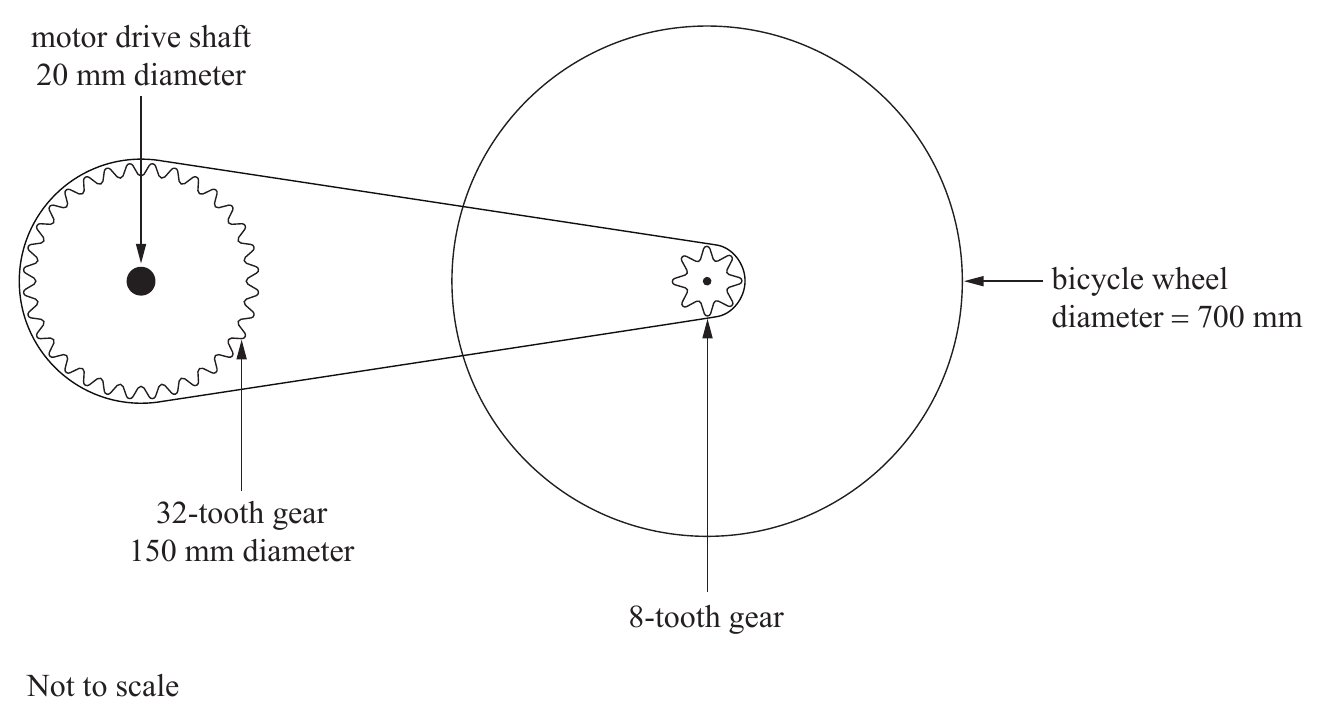
2023 Q18 gives $\text{GR} = 8 \div 32 = 0.25$, and it is correct. Do not “fix” a ratio because it comes out below 1.
Practise
Exam question: radius or diameter
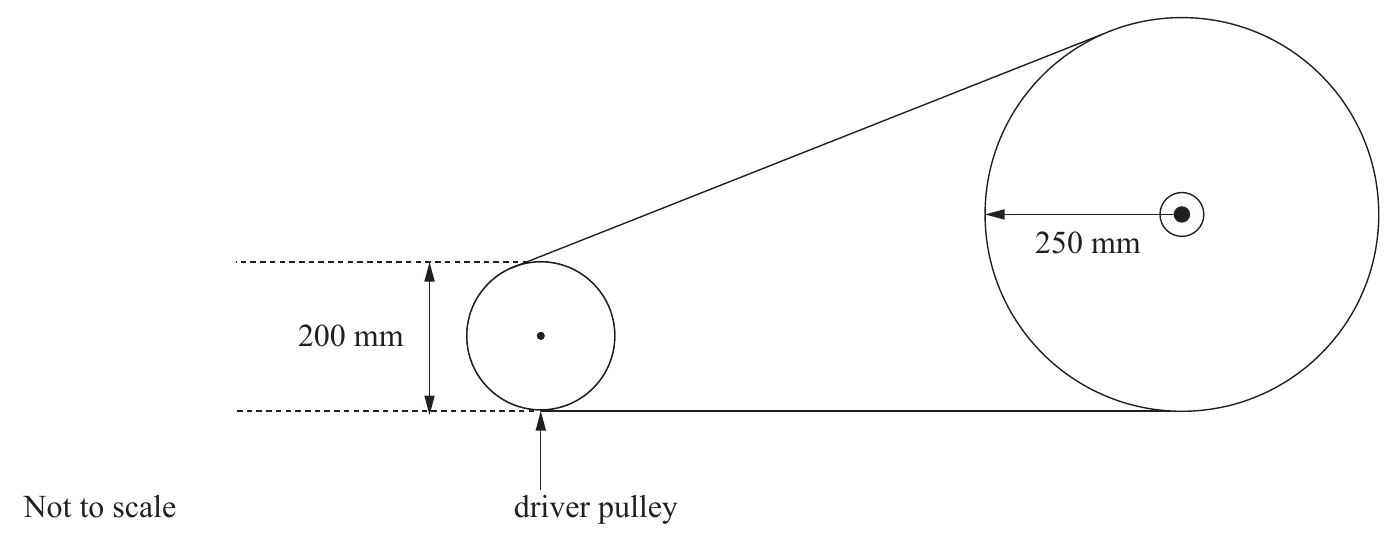
2023 Question 4
Section 1 · Multiple choice · [1 mark]
A simple pulley and belt driving system is shown.
The velocity ratio of the system is
Read each dimension arrow before you read its number. The 200 mm on the driver spans the whole pulley between two tangent lines, so it is a diameter. The 250 mm on the driven pulley runs from the centre dot to the rim, so it is a radius. Convert both to diameters:
(B) and (C) are what you get by treating both numbers as diameters. (A) is the right ratio upside down.
Answer
(D) 2.50
Part 3
Worm drives, gear trains and compound machines
A worm is a screw meshing with a toothed wheel. Its VR is the number of teeth on the wheel divided by the number of starts on the worm. A single-thread worm has one start and a double-threaded worm has two. One pair gives a very high ratio, which is why worm drives turn up in winches and lifts.
$$\begin{aligned} \text{VR} &= \frac{\text{teeth on the wheel} }{\text{starts on the worm} } \end{aligned}$$
A rack and pinion turns rotation into straight-line movement. One turn of the pinion moves the rack by the number of teeth on the pinion multiplied by the tooth pitch.
For a train of several gears, multiply the ratios of each pair. For a simple train with one gear per shaft, that comes to the same thing as the last driven gear over the first driver. An idler gear changes the direction of rotation but not the overall ratio.
Try it yourself
Mesh two gears
Change the teeth on each gear, then add an idler between them. Track the VR, the speed of the driven gear and the way it turns.
When one machine drives another, their efficiencies multiply:
$$\eta_{\text{total} } = \eta_1 \times \eta_2$$
Two stages at 90% and 80% give $0.9 \times 0.8 = 0.72$, which is 72%. That is lower than either stage, and it is not the average of the two. Neither the train rule nor this one is in the formula book.
Practise
Exam questions: worm drives
2020 Question 1
Section 1 · Multiple choice · [1 mark]
What is the gear ratio of this worm and wheel?
The wheel has 18 teeth. The worm is single-start, so it has one start. The three loops you can see are one thread wrapped three times round the worm, not three starts.
$$\begin{aligned} \text{VR} &= \frac{\text{teeth on the wheel} }{\text{starts on the worm} } \\[10pt] &= \frac{18}{1} \end{aligned}$$
(D) is what you get by counting the loops as starts. (A) and (B) come from dividing the 18 teeth by the three loops.
Answer
(C) 18:1
2020 Question 20
Section 3 · Complex unfamiliar · [9 marks]
A double-threaded worm and 40-tooth worm wheel are used to drive a mechanical winch. The efficiency of the machine is 45%. The pitch of a double-threaded worm is halved.
a) Determine the mass of the load lifted by the winch using an effort of 50 N on the circumference of the worm wheel. Answer to the nearest whole unit. [5 marks]
b) An effort wheel is added to the worm axle, decreasing the efficiency of the compound machine to 36%. Determine the velocity ratio of the added component. Answer to two decimal places. [4 marks]
1 mark Provides correct working to give the correct load.
$$\begin{aligned} F &= mg \\[10pt] m &= \frac{450}{9.8} \\[10pt] &= 45.92 \end{aligned}$$
1 mark Provides the correct formula and substituted values for mass.
1 mark Gives the correct answer to the nearest whole unit with the correct unit: 46 kg.
(b) This is QCAA’s published working from the 2020 mark guide, and it earns the marks. Efficiencies in series multiply, so find the efficiency of the added effort wheel first:
1 mark Provides the correct formula and substituted values for velocity ratio.
1 mark Provides correct working to give the correct answer to two decimal places.
Treat (b) as the way to earn these marks, not as a general method. It reuses the MA of 9 from the worm with the efficiency of the effort wheel, and the question gives you no MA for the added component. The step you can reuse elsewhere is the first one, that efficiencies in series multiply.
Answer
(a) 46 kg, (b) 11.25
Two things 2020 Q20 wants you to know
Double-threaded means two starts. The worm advances the wheel by two teeth per turn instead of one, which halves the VR. A single-thread worm with the same 40-tooth wheel would give a VR of 40.
Efficiencies of machines in series multiply. They do not add, and they do not average. Neither fact is in the formula book.
Part 4
The two conversions every question needs
Revolutions to distance
One revolution of a wheel, drum or pulley moves the load by one circumference:
In 2021 Q22b a 500 mm drum has $\pi d = 1.571\ \text{m}$, so lifting 2 m needs $2 \div 1.571 = 1.27$ drum revolutions.
In 2025 Q20a a 150 mm worm wheel drives a rack, so raising the platform 2 m needs $2 \div (\pi \times 0.15) = 4.24$ turns of the wheel.
Revolutions on one shaft to revolutions on another
Multiply or divide by the gear ratio, depending on which way you are travelling through the drive. 2021 Q22b continues with a 15-tooth driver and a 100-tooth driven gear, so $\text{GR} = 100 \div 15$, and 1.27 drum revolutions needs $\frac{100}{15} \times 1.27 = 8.5$ motor revolutions.
When the ratio is above 1, the driver always turns more times than the driven. Check your answer against that before you move on.
Practise
Exam questions: turns and distance
2025 Question 3
Section 1 · Multiple choice · [1 mark]
The diameter of the rear wheel of a bicycle is 725 mm. A gear with 50 teeth is attached to the rear wheel and driven by a pedal gear with 150 teeth. The pedals complete four rotations.
What is the distance travelled by the bicycle, rounded to one decimal place?
The pedal gear is the driver. Each pedal turn moves 150 teeth past the 50-tooth wheel gear, so the wheel turns 3 times. Four pedal turns give 12 wheel turns:
(A) uses the ratio upside down. (B) is one pedal turn instead of four. (C) leaves out the $\pi$.
Answer
(D) 27.3 m
2020 Question 9
Section 1 · Multiple choice · [1 mark]
A bicycle has gearing with a VR of 1:3. The rear tyre has an outside diameter of 740 mm. What is the distance travelled for every three rotations of the foot pedals?
A VR of 1:3 means the wheel turns 3 times for each pedal turn, so three pedal turns give 9 wheel turns:
That is 21 m. (A) is double the answer. (C) leaves out the $\pi$. (D) is about one turn of the wheel, 2.32 m.
Answer
(B) 21 m
2023 Question 18
Section 3 · Simple familiar (est.) · [7 marks]
An electric motor with an output force of 600 N is attached to the driver gear of an electric-powered bicycle using a 20 mm diameter drive shaft.
a) Calculate the number of driver gear rotations required for the bicycle wheel to move 15 m. Answer to one decimal place. [2 marks]
b) Calculate the number of motor drive shaft rotations required for the bicycle wheel to move 15 m. Answer to the nearest whole unit. [2 marks]
c) Determine the output power of the electric motor if the bicycle wheel takes 2 seconds to travel 15 m. Answer to the nearest whole unit. [3 marks]
First decide which gear is the driver. The motor drives the large 32-tooth gear, so that is the driver. The small 8-tooth gear at the wheel hub is the driven. On this bicycle the driver is the bigger gear, which is the opposite of a winch.
(a)
$$\begin{aligned} \text{GR} &= \frac{\text{teeth on driven} }{\text{teeth on driver} } \\[10pt] &= \frac{8}{32} \\[10pt] &= 0.25 \end{aligned}$$
1 mark Determines the VR or GR of the driven to driver gears.
1 mark Determines the answer in W to the nearest whole unit.
Using the unrounded 1.7 rotations gives 0.107 m, 64.3 J and 32 W. The guide accepts that too. It allows distances from 0.1068 to 0.13 m, work from 64 to 75.6 J and power from 32 to 38 W. The 2025 subject report advises leaving rounding until the end.
Answer
(a) 1.7, (b) 2, (c) 38 W
Part 5
Earning the marks, past questions and self-checks
Where the marks go in a gear chain
The 2020 Q20a mark guide splits a five-step chain into five marks:
Mark guide dot point (2020 Q20a)
What earns it
provides correct working to give correct gear ratio (VR)
$40 \div 2 = 20$
provides correct formula and substituted values for mechanical advantage
$\eta = \frac{\text{MA} }{\text{VR} }$ with the numbers in
provides correct working to give correct $F_L$
450 N
provides correct formula and substituted values for mass
$F = mg$ rearranged
provides correct working to give correct answer to the nearest whole unit with correct unit provided
46 kg
Two of the five marks are for writing the formula down
Two dot points award “correct formula and substituted values” before any answer is produced. The 2021 guide defines the phrase as “Correct formula means substituted and constant values are correctly applied”.
So write the formula, then write it again with the numbers in, then evaluate. In a five-step chain that habit can earn several marks even when the arithmetic goes wrong later.
The written gear question in 2023 asked about mechanical advantage and work rather than defining VR. Four of its five marks were for the wording.
Practise
Exam question: explaining bicycle gearing
2023 Question 12
Section 2 · Simple familiar (est.) · [5 marks]
Explain how the gearing system on a bicycle provides a mechanical advantage to a cyclist moving up an incline, and the system’s effect on the work done on the pedals. Sketch the mechanical components involved to support your response.
Here is a response that earns all five marks:
To climb an incline the cyclist needs a high mechanical advantage. The gear attached to the pedals is made smaller, with fewer teeth, than the gear attached to the rear wheel. The smaller the pedal gear is compared with the rear wheel gear, the higher the mechanical advantage, so less force is needed to turn the pedals.
Because the pedal gear is smaller, the pedals have to make more rotations to move the bicycle the same distance. The work done on the pedals stays the same, because the smaller force on the pedals moves through a greater distance.
Sketch a small pedal gear linked by a chain to a larger rear wheel gear, and label which is which.
1 mark Explains MA with wording that the pedal gear is smaller than the rear wheel gear. The guide also accepts tooth counts, radii or diameters, or the reverse wording.
1 mark States that the work done remains the same.
1 mark States that less force is needed to move the pedals.
1 mark States that more rotations of the pedals are needed.
1 mark Provides a sketch with the larger rear wheel gear linked to the smaller pedal gear.
Answer
Smaller pedal gear, less force, more pedal turns, same work, plus a labelled sketch
2025 Q20 shows the usual shape
It has three parts, each building on the last: turns of the worm wheel, then the work done raising the platform, then the efficiency from the power input.
Part (a) is the circumference conversion. Part (b) is $W = mgh$. Part (c) is $P = W \div t$ followed by $\eta = \frac{P_{\text{out} } }{P_{\text{in} } } \times 100\%$. Each part carries its own marks, and each is still available if an earlier part went wrong, because follow-through applies.
Past QCAA questions: gears and belt drives
How the marks are counted
A question that appears in both this guide and Topic guide 2 is counted once. Gear and worm questions are counted here (2020 Q20 and 2023 Q12). The screw question 2023 Q17 is counted in Topic guide 2, so it is listed below but left out of this guide’s totals. Questions also listed in the friction guide are counted in full here.
On that basis, this table holds 5 multiple choice questions, 10 Section 2 marks and 36 Section 3 marks. 2024 has no gear or belt item at all.
The bands (SF, CF, CU) are derived. The 2020 bands follow from the subject report’s split of marks by section, and some 2021 and 2022 bands are named in those years’ subject reports.
Screw conveyor volume from pitch and rpm. Answer 24 m³.
2020 Q9 (MC)
1 · SF
Bicycle distance from a VR of 1:3 and the tyre diameter. Answer 21 m. Worked in Part 4.
2023 Q4 (MC)
1 · SF
Belt and pulley VR. The 200 mm on the driver is a diameter and the 250 mm on the driven pulley is a radius. Answer 2.50. Worked in Part 2.
2025 Q3 (MC)
1 · SF
Distance travelled by a bicycle from gear teeth and pedal rotations. Answer 27.3 m. Worked in Part 4.
2020 Q16
5 · SF
Written. Identify a gear train, determine the ratio of gear A to gear C, and explain the reasoning. Rack and pinion.
2023 Q12
5 · SF (est.)
Written. Explain how bicycle gearing gives a mechanical advantage on an incline, with a sketch. Also listed in Topic guide 2. Worked above.
2020 Q20
9 · CU
Double-threaded worm winch: load mass, then compound machine efficiency. Also listed in Topic guide 2. Worked in Part 3.
2021 Q22
6 · CF (est.)
Winch crane: output power, then motor revolutions to lift 2 m. Answer 8.5.
2022 Q22
9 · CU
Airport luggage system: conveyor rpm from a roller diameter, chained from a friction calculation. Also in the friction guide.
2023 Q17
9 · SF (est.)
Threaded rod raising a load: power required from a 62% efficient motor. Counted in Topic guide 2.
2023 Q18
7 · SF (est.)
Electric bicycle: driver rotations, drive shaft rotations, output power. Worked in Part 4.
2025 Q20
5 · SF (est.)
Worm-driven platform lift: wheel turns, work done, then efficiency.
Self-checks to run inside the question
Checkpoint
How to run it
Which gear is the driver?
The one the motor or the pedals drive. Label it on the diagram first.
Same measure top and bottom?
Teeth over teeth, or diameter over diameter. Never teeth over diameter.
Worm starts, not worm teeth?
A single-thread worm has 1 start and a double-threaded worm has 2. The wheel’s teeth go on top.
Radius or diameter?
$\pi d$ and $2\pi r$ are the same thing. Check which one the question gave you.
Does the driver turn more times?
It should, whenever the ratio is above 1.
Have I converted mm to m?
Do it once, at the start.
Which efficiency applies?
Efficiencies in series multiply, so a compound machine is less efficient than either part.
What changes for 2026
All four gear and belt ratio formulas are now supplied in the formula book, which cuts what you have to recall in this topic.
The dot points were clarified rather than rewritten. The 2025 revision gave belts and gears their own dot points with the ratio formulas attached, but they cover the same drives as before, so the question forms carry over. My prediction is that 2026 runs the same chains (ratio, then revolutions, then distance, then work or power), with less to memorise before you start them.
Game plan
Your game plan for gears and belt drives
1Label the driver and the driven on the diagram.
2Find the ratio, driven over driver, with the same measure top and bottom. For a worm, divide the wheel teeth by the worm starts.
3Turn a distance into revolutions with $\pi d$, then cross the drive to the other shaft with the ratio.
4Check that the driver turns more times than the driven whenever the ratio is above 1.
5Carry the result into the machine chain for force, work, power or efficiency. Multiply the efficiencies of machines in series.
Four questions of my own, written to QCAA form. Allow about ten minutes for Question 4.
Question 1 of 4
Skill 1: Reading the ratio · Simple familiar · [1 mark]
A belt drive has a driver pulley of 300 mm diameter turning at 1500 rpm and a driven pulley of 120 mm diameter. What is the speed of the driven pulley?
A small driven pulley must turn faster than a large driver, so you can rule out (A) and (B) before calculating. (A) inverts the ratio, giving $1500 \times 0.4$. (B) assumes the belt passes the speed on unchanged. (D) does not match either way of using these two diameters.
Answer
(C) 3750 rpm
Question 2 of 4
Skill 4: Two conversions · Simple familiar · [4 marks]
A 16-tooth driver gear meshes with a 48-tooth driven gear attached to a 250 mm diameter cable drum.
a) Calculate the gear ratio of the system. [1 mark]
b) Calculate the number of driver gear rotations required to wind 4 m of cable onto the drum. Answer to one decimal place. [3 marks]
(a)
$$\text{GR} = \frac{48}{16} = 3$$
1 mark Determines the gear ratio of the driven to driver gears.
1 mark Determines the number of driver gear rotations to one decimal place: 15.3.
This is 2021 Q22b with new numbers. Accept 15.2 to 15.3 rotations from intermediate rounding, and follow-through for a wrong gear ratio or circumference.
A single-thread worm meshes with a 45-tooth worm wheel in a lifting mechanism that is 40% efficient. An effort of 60 N is applied at the circumference of the worm.
Determine the mass of the load that can be raised. Answer to the nearest whole unit.
A single-thread worm has one start. There is no number for it in the stem, so you have to supply it.
1 mark Provides correct working to give the correct $F_L$.
$$m = \frac{F_L}{g} = \frac{1080}{9.8} = 110.20$$
1 mark Provides the correct formula and substituted values for mass.
1 mark Gives the correct answer to the nearest whole unit with the correct unit: 110 kg.
Answer
110 kg
Question 4 of 4
Skill 5: Drive ratio into power · Complex unfamiliar · [7 marks]
A hoist motor drives a 12-tooth gear that meshes with a 60-tooth gear attached to a 400 mm diameter cable drum. The hoist raises a 150 kg load 3 m vertically in 20 seconds. The hoist is 75% efficient.
Determine the number of motor rotations required, to one decimal place, and the power input to the motor.
There are two separate chains from the same setup. The rotations chain runs from distance to drum revolutions to motor revolutions. The power chain runs from work to output power to input power. Neither depends on the other, so attempt both even if one stalls.
Rotations.
$$\text{GR} = \frac{60}{12} = 5$$
1 mark Determines the gear ratio.
$$\pi d = \pi \times 0.4 = 1.2566\ \text{m}$$
1 mark Determines the circumference of the cable drum.
Divide by the efficiency to get the input. Multiplying by 0.75 would give an input smaller than the output, which is impossible.
Answer
11.9 rotations and 294 W
Sources: QCAA Engineering external assessment question and response books, multiple choice question books and marking guides, 2020 to 2025. Engineering 2025 v1.4 general senior syllabus, Unit 4 Topic 2, and the 2025 syllabus revision report. QCAA Engineering subject reports, 2020 to 2025. Engineering formula and data book, 2019 and 2025 v1.4. All numerical answers verified computationally against the published marking guides.