Topic guide 6 · Unit 4 Topic 2 · Machines, mechanisms and control
Friction, the normal force and the inclined plane
Friction is a force that opposes sliding between two surfaces in contact. Its size is the coefficient of friction times the normal force, $F_f = \mu F_N$. The coefficient belongs to the pair of surfaces. It has no unit, and it does not change with mass or gravity.
Every paper from 2020 to 2025 had a friction question in Section 3, and nearly all of them follow one of four shapes. To start any of them you need to resolve the weight on a slope, decide which way friction points and tell whether the forces balance. Tick off each skill once you can do it without help.
85
Section 3 marks in twelve friction questions, 2020 to 2025
6 of 6
papers with a friction question in Section 3
4
friction questions that demanded a drawn force diagram
Skills in this topic
Only tick a skill when you could do it in the exam. Your ticks are saved in this browser only.
Part 1
What the exam asks about friction
Friction has been in Section 3 every year from 2020 to 2025. I count twelve whole Section 3 questions whose main job is friction, worth 85 marks: 2020 Q18 and Q22, 2021 Q19 and Q23, 2022 Q19 and Q20, 2023 Q19 and Q20, 2024 Q17, Q20 and Q22, and 2025 Q22. That is one to three a year, usually two.
2022 Q22 also opens with luggage sliding down a ramp, inside a 9-mark conveyor question. I have left it out of the 85, because only three of its nine marks are for the friction on the ramp. Add 2025 Q13 (6 marks in Section 2) and nine multiple choice items on friction or inclines, and friction carried 100 marks across the six papers.
The biggest friction question each year has been worth 8 to 10 marks. In 2021 it was the largest question on the paper (Q23, 10 marks).
The 2022 and 2023 subject reports both listed the parallel and perpendicular components of the weight on an incline as something to strengthen. The 2025 report asked for the difference between static and kinetic friction, with force vectors clearly labelled and arrowed.
What the syllabus says
Unit 4 Topic 2, Machines, mechanisms and control, has four dot points on friction:
•Recognise that friction is a force opposing motion.
•Calculate to solve problems using coefficient of friction, normal force and angle of repose, using the formulas $\mu_s = \tan\theta$ and $F_f = \mu F_N$.
•Distinguish between and solve integrated linear motion problems involving static and kinetic friction, using the formulas $F_f = \mu_s F_N$ and $F_f = \mu_k F_N$.
•Calculate to solve problems involving one-body systems in motion on an inclined plane, including uniform velocity and uniform acceleration.
Read the last dot point slowly. Uniform velocity and uniform acceleration need different first moves, and the question always tells you which one you are in. Uniform velocity means the forces balance. Uniform acceleration means they do not, so you need $F = ma$ and then the motion equations.
The word “integrated” in the third dot point means friction is often joined to motion, work, energy or a machine, as in 2021 Q23, 2022 Q20, 2023 Q19 and 2025 Q22.
Reduced for 2026, but still examinable
The QCAA’s syllabus revision report lists the definitions of coefficient of friction, normal force and angle of repose as reduced subject matter in Unit 4.
2025 Q13 (6 marks) asked you to describe static and kinetic friction in terms of the angle of repose, with two force diagrams. It was set under the old syllabus, which had a separate dot point asking you to define all three terms. That dot point has gone. The dot point asking you to distinguish between static and kinetic friction is still there, and so is the angle of repose calculation, so a question like 2025 Q13 is still possible.
Learn each definition well enough to write it in one sentence. Then put your time into resolving the weight, choosing the coefficient and deciding which way friction points.
•$F_N = mg\cos\theta$ and $F_\parallel = mg\sin\theta$. The book gives $F_H$ and $F_V$ against horizontal and vertical axes. Nothing on it tells you to tilt the axes onto the slope.
•Weight $= mg$. Students hunt for a formula starting “$W =$” and find $W = Fs$, which is work. Weight is $F = ma$ with $a = g$.
•$F_N = mg\cos\theta$ only when nothing else pushes into the surface or lifts off it. Add a rope pulling at an angle and the normal force changes.
•$P = Fv$. Build it from $P = \frac{W}{t}$ and $W = Fs$.
Part 2
Resolving the weight on a slope
The normal force is the surface pushing back, perpendicular to the surface. On a horizontal surface it equals the weight, $F_N = mg$. On an incline it balances only the part of the weight pressing into the slope, $F_N = mg\cos\theta$.
Drawn to scale for $\theta = 28^\circ$, so $F_N$ is the same length as the dashed $mg\cos\theta$, about 0.88 of $F_g$. Friction is drawn for a block sliding down.
Tilt your axes so one runs along the slope and the other runs perpendicular to it. When every other force runs along the slope or perpendicular to it, the weight is the only force that does not already lie on those axes, so it is the only force you resolve.
Component of the weight
Why that ratio
Perpendicular to the slope, $F_\perp = mg\cos\theta$
It is the side next to the angle. It balances $F_N$.
Parallel to the slope, $F_\parallel = mg\sin\theta$
It is the side opposite the angle. It pulls the object down the slope.
The sine and cosine swap
The 2022 and 2023 reports both list the components of the weight vector as an area to strengthen, and swapping sine and cosine is the usual way to get them wrong. One check catches it.
A gentle slope has a big normal force and a small pull down the slope. At $\theta = 0^\circ$ the surface carries the whole weight and nothing slides. Since $\cos 0^\circ = 1$ and $\sin 0^\circ = 0$, that gives $F_N = mg$ and $F_\parallel = 0$, which only works if $F_N$ takes the cosine.
If your normal force comes out bigger than $mg$, you divided instead of multiplying. $F_N$ can never exceed $mg$ on a plain incline.
Practise
Exam question: friction on the flat
2025 Question 6
Section 1 · Multiple choice · [1 mark]
A car with a mass of 1620 kg brakes so hard that its tyres slide on a horizontal road. The coefficient of kinetic friction between the tyres and the road is 0.75.
What is the kinetic frictional force between the tyres and the road, rounded to one decimal place?
The road is horizontal, so the normal force is the whole weight:
(A) leaves out $g$, since $0.75 \times 1620 = 1215$ N. (B) divides the mass by the coefficient. (D) divides the weight by the coefficient instead of multiplying. 82.8% of students chose (C).
Answer
(C) 11.9 kN
Part 3
Which way friction points
Friction opposes sliding between the two surfaces, or the slide that is about to start. It does not simply oppose gravity. Decide what the object is doing, or is about to do, then draw $F_f$ against it.
Sliding down
Friction acts up the slope.
Pushed up
Friction acts down the slope.
About to slide
Static friction acts up the slope, at its maximum value.
Friction can also be the force that makes something move. In 2021 Q23 the static friction from the conveyor belt is what accelerates the component, so there friction points the way the component moves.
The phrase in the question tells you the case
The question says
What it means
“at a constant velocity”, “uniform velocity”
The forces balance and $a = 0$. Use $\mu_k$ and write a balance equation. Do not use $F = ma$.
“just on the point of sliding”, “almost begin moving”, “to prevent the car from rolling”, “keep the machine from slipping”
Static friction is at its maximum, so use $\mu_s$. The forces still balance.
“accelerates”, “decelerate at a constant rate”, “Determine the time taken”, “Determine the distance the box slides”, “before coming to a complete stop”
The forces do not balance. Find $F_{net}$, then $a = F_{net} \div m$, then use a motion equation.
Practise
Exam question: the direction of friction
2025 Question 7
Section 1 · Multiple choice · [1 mark]
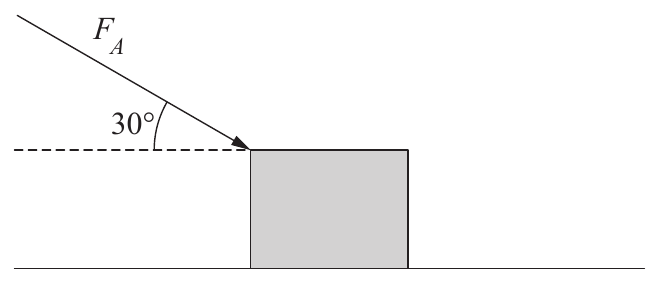
An object is pushed along a horizontal surface at a constant velocity by an applied force, as shown.
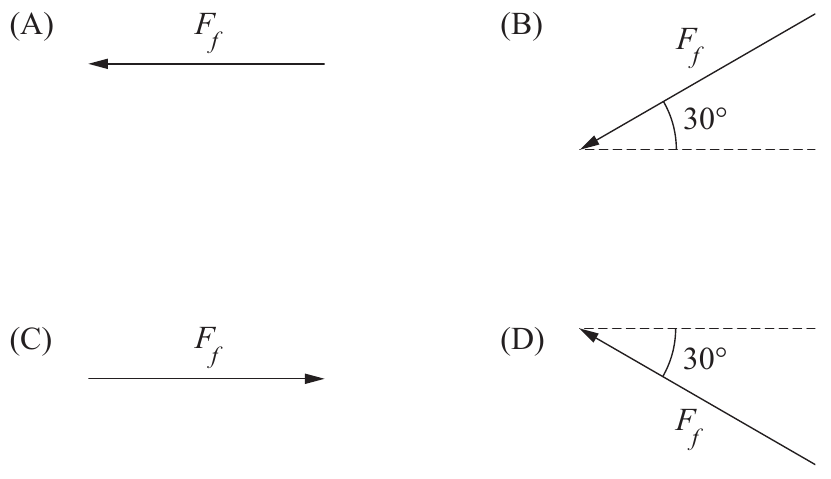
Which arrow best shows the direction of the frictional force acting on the object?
The push has a horizontal part to the right, so the object slides to the right. Friction acts along the contact surface, against the sliding, so it is horizontal and points left.
(B) and (D) copy the 30° angle of the applied force, but friction always lies along the surface. (C) points the same way as the motion. 65.8% of students chose (A), and 25.0% chose (D).
Answer
(A) horizontal, to the left
Part 4
Static friction, kinetic friction and the angle of repose
Static friction acts while the object is still. It adjusts itself to match the pull, up to a maximum of $\mu_s F_N$. Kinetic friction acts once the object is sliding and stays roughly constant at $\mu_k F_N$. The maximum static friction is the larger of the two, which is why things are harder to start than to keep moving.
Static friction
At or below the angle of repose, static friction matches the pull down the slope and nothing moves.
Kinetic friction
Above the angle of repose the object slides. Kinetic friction is smaller than the pull down the slope, so the object accelerates.
Both diagrams are drawn to scale. The dashed arrows are the components of $F_g$, not extra forces.
The angle of repose is the steepest angle at which an object will stay still. Tilt the slope until the object is on the point of sliding. At that moment friction equals the pull down the slope:
The mass cancels and so does $g$. That is why 2020 Q18 could put a machine on Mars and still ask about $\mu_s$.
Answer shape for the 2025 written question
2025 Q13 (6 marks): “An object on an inclined plane is subjected only to its own weight. Describe static friction and kinetic friction in terms of the angle of repose. Draw two force diagrams to support your response.”
Describe means provide an account of a characteristic, feature or event. The marking guide split the six marks into two diagram marks and four description marks:
1a labelled force diagram for static friction
2a labelled force diagram for kinetic friction
3static friction acts while there is no relative motion between the surfaces
4the object stays at rest while the angle of the incline is less than or equal to the angle of repose
5kinetic friction acts once the surfaces slide over each other
6the object slides when the angle of the incline is greater than the angle of repose, where $\mu_s = \tan\theta$ marks the boundary.
Each diagram needs $F_N$, $F_f$ up the slope and the weight. The guide accepted the weight with no components shown, or with both components labelled. For the response shape, see Template T1 in Game plan 7.
Try it yourself
Tilt the slope
Raise the angle until the block slides. The forces are drawn to scale. Try a different mass and see whether the angle it slides at changes.
Practise
Exam questions: the angle of repose
For the written-answer questions, the solutions show where each mark goes, using the wording of the QCAA marking guides. Most marks allow follow-through, so a wrong earlier value used correctly still earns the later marks.
2020 Question 18
Section 3 · Simple familiar · [5 marks]
A 900 kg machine is designed to rest without slipping on a slope of up to 30° on the surface of Mars. The acceleration due to gravity on Mars is one-third of that on Earth.
a) Determine the coefficient of static friction required to keep the machine from slipping on a 30° incline on Mars. Answer to two decimal places. [1 mark]
b) Calculate the resulting force of static friction between the machine and Mars’ surface. Answer to the nearest whole unit. [2 marks]
c) Explain what would happen to the coefficient of static friction if the machine was tested on Earth. [2 marks]
a) On the point of slipping, $\mu_s = \tan\theta$:
$$\mu_s = \tan 30^\circ = 0.58$$
1 mark · the coefficient of static friction to two decimal places (the guide accepts 0.57 or 0.58)
b) Gravity on Mars is a third of Earth’s, $9.8 \div 3 = 3.27\ \text{m s}^{-2}$, so the machine’s weight there is $900 \times 3.27 = 2943$ N:
1 mark · correct answer to the nearest whole unit, with the unit
Keep full precision and you get exactly 1470 N, because $\tan 30^\circ \cos 30^\circ = \sin 30^\circ$. The guide shows 1478 N from the rounded $\mu_s$ and $g$, and it accepted anything from 1451 N to 1478 N.
c) The coefficient of static friction depends only on the angle of repose, because $m$ and $g$ cancel in $\mu_s = \tan\theta$. So $\mu_s$ is the same on Earth as on Mars.
1 mark · μs depends only on the angle of repose
1 mark · μs is the same on Mars and Earth
The friction force does change. On Earth it would be three times bigger, $900 \times 9.8 \times \sin 30^\circ = 4410$ N. Say which quantity you mean.
Answer
a) 0.58 · b) 1478 N · c) no change
2020 Question 7
Section 1 · Multiple choice · [1 mark]
A 20 kg box sits just on the point of sliding on an incline plane. If the coefficient of static friction is 0.27, what is the angle of repose?
On the point of sliding, $\mu_s = \tan\theta$, so:
The 20 kg is not needed, because the mass cancels. (D) is close to $\sin^{-1}(0.27) = 15.7^\circ$, the wrong ratio. (A) and (B) would need coefficients of 0.09 and 0.23.
Answer
(C) 15°
2022 Question 7
Section 1 · Multiple choice · [1 mark]
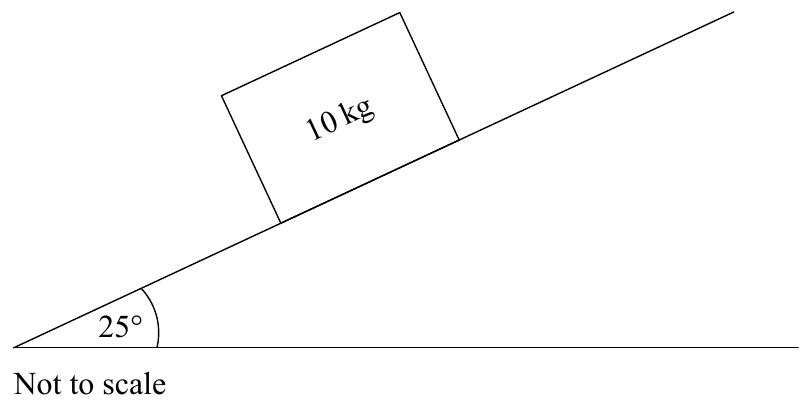
A 10 kg wheelbarrow sits stationary but just on the point of sliding on an inclined ramp. When the ramp is raised by 5° to make an angle of 20° to the horizontal, the wheelbarrow slowly starts to slide.
The minimum amount of additional force required to stop the wheelbarrow from sliding is
At 15° the wheelbarrow is on the point of sliding, so 15° is the angle of repose:
The extra force makes up the difference, $33.52 - 24.68 = 8.84$ N. The only option close to this is (D) 8 N. QCAA’s 8 N matches $F_\parallel - mg\sin 15^\circ = 8.15$ N, which keeps friction at its 15° value.
(B) 34 N is $F_\parallel$ alone, with friction forgotten, and 31.5% of students chose it. (C) 25 N is the friction force on its own. Only 38.75% chose (D), the lowest of any friction multiple choice item with published results (2021 to 2025).
Answer
(D) 8 N
Part 5
The four question shapes
Every past incline question is one of these four shapes, or two of them chained together.
Shape
What the question says, and your first move
Find $F_N$ or $\mu_s$
The object is parked or at rest, “to prevent the car from rolling”. First move. $F_N = mg\cos\theta$, then $\mu_s = \tan\theta$ if the coefficient is wanted.
Balance the slope
“uniform velocity”, “just on the point of sliding”, “force is required to move”. First move. Pushed up, $F_{\text{applied} } = F_\parallel + F_f$. Held back, $F_{\text{applied} } + F_f = F_\parallel$.
Accelerate, then move
“before coming to a complete stop”, “Determine the time taken”, “Determine the distance the box slides”. First move. $F_{net}$ is the sum of the forces along the slope, $a = F_{net} \div m$, then $v^2 = u^2 + 2as$ or $s = ut + \tfrac{1}{2}at^2$.
Chain it
A ramp then a horizontal surface, a ramp then a conveyor, or a machine driving the object. First move. Solve the ramp and carry $v$ forward as the next stage’s $u$. On the flat $F_N = mg$, not $mg\cos\theta$.
The chaining trap
2023 Q19 ran a box down a 25° ramp and then along a horizontal floor. On the floor there is no incline, so $F_N = mg$ and $F_f = \mu mg$.
Carrying $\cos 25^\circ$ into stage two loses the horizontal-friction mark straight away. The final answer is then wrong, even if follow-through rescues the steps in between.
The velocity at the bottom of the ramp is the only thing that crosses between the stages. Write it down clearly, then start the second stage with a fresh diagram.
Practise
Exam questions: balanced and unbalanced
2020 Question 2
Section 1 · Multiple choice · [1 mark]
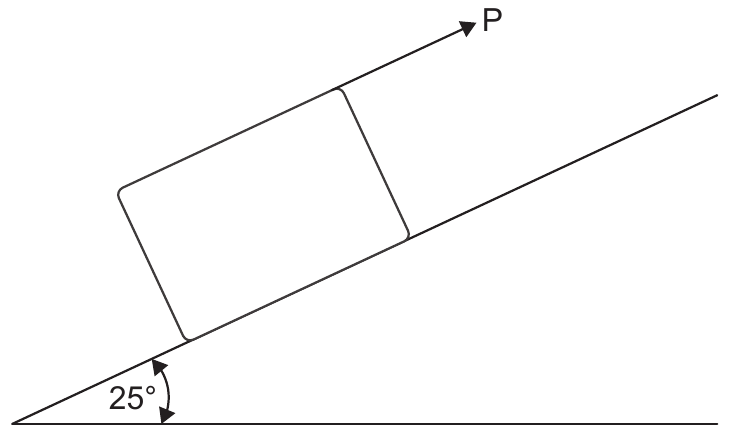
A 25 kg block is pulled up an incline using a force P as shown. What is the minimum value of P required to just move the box from rest if the coefficient of static friction is 0.4?
“Just move the box from rest” is the static threshold, so the forces balance with friction at its maximum. The box is pulled up, so friction acts down the slope, alongside the weight component:
(B) is $g\sin 25^\circ$, the acceleration with friction left out, and 25.4% of students chose it. 45.4% chose (C).
Answer
(C) 2.4 m/s²
Part 6
Two worked eight-mark questions
2025 Q22 and 2024 Q22 are mirror images. The sled slides down and slows, so friction acts up the slope. The cart is pushed up and speeds up, so friction acts down the slope. Both start with the same steps: the diagram, then $F_N$, $F_f$ and $F_\parallel$.
Practise
Exam questions: full incline questions
The solutions show where each mark goes, using the wording of the QCAA marking guides.
2025 Question 22
Section 3 · Complex familiar (est.) · [8 marks]
A child on a sled slides down a snow-covered hill with a 15° incline at an initial velocity of 4 m/s. The combined mass of the sled and the child is 40 kg. The coefficient of kinetic friction between the sled and the snow is 0.35.
Calculate the distance the sled travelled downhill before coming to rest. Include a force diagram to support your response.
Note: If you make a mistake, cancel it by ruling a single diagonal line through your work and use the additional response space at the back of this book.
Step 1 · Draw the force diagram before you calculate anything. The sled slides down, so friction acts up the slope.
Drawn to scale. The dashed components replace $F_g$ in the working, so they are dashed to show they are not extra forces.
1 mark · includes an appropriate free-body diagram correctly showing all forces
Use whichever method you can finish cleanly. Do not start one, abandon it and start the other, because the marks come from finished steps.
The marking guide prints 10.3 m although the stem names no precision. Its own working writes the net force as $F_f - F_\parallel$ with mixed signs. The signs above are the consistent version.
Answer
10.3 m downhill
2024 Question 22
Section 3 · Complex familiar (est.) · [8 marks]
A sorting conveyor cart in a recycling plant is initially at rest and has a mass of 5 kg. It is pushed a distance of 3 m up a 30° incline using a force of 60 N parallel to the incline. Assume $\mu_k = \mu_s = 0.58$.
Determine the time taken to move the cart 3 m up the incline. Include a free-body diagram showing all the forces involved.
Note: If you make a mistake in the diagram, cancel it by ruling a single diagonal line through your work and use the additional response space at the back of this question and response book.
This is the mirror image of the sled. The cart is driven up the slope, so friction acts down the slope, alongside the weight component.
Step 1 · Free-body diagram.
Drawn to scale. Friction points down the slope because the cart is pushed up it.
1 mark · includes an appropriate free-body diagram showing all forces ($F_N$, $F_g$, $F_f$ and $F_p$)
Step 7 · Time from rest. You know $u = 0$, $s = 3$ and $a$, and you want $t$, so use the equation with no $v$:
$$\begin{aligned}3 &= 0 \times t + \tfrac{1}{2}(2.18)t^2 \\ t &= \sqrt{\frac{6}{2.18} } = 1.66\ \text{s}\end{aligned}$$
1 mark · demonstrates appropriate mathematical reasoning to calculate the time
1 mark · determines the time taken to displace the object 3 m up the incline
Here $\mu_s = \mu_k$, so you never have to choose between them. You can check that the cart starts moving: $F_\parallel + \mu_s F_N = 24.5 + 24.62 = 49.12$ N, which is less than the 60 N push.
Answer
1.66 s
Why 2024 Q22 reads as complex familiar
Three forces act along the slope, and one of them is the applied push. Getting the signs right needs the diagram.
It ends in a motion equation, so it joins two syllabus dot points. The question never mentions acceleration. You have to see that “initially at rest” plus a net force means you need one.
Part 7
How the marks are allocated
The marking guides give one mark per dot point, and the dot points are nearly always the intermediate quantities. Partial working is worth a lot.
includes an appropriate free-body diagram correctly showing all forces
The drawing itself.
correctly identifies that normal force is equal to the force perpendicular to the hill
Writing $F_N = F_\perp$.
correctly calculates the normal force
378.64 N
calculates the frictional force
132.53 N
calculates the parallel force
101.46 N
calculates the net force
−31.07 N
identifies that work is equal to the change in kinetic energy
Naming the principle.
calculates the distance travelled downhill
10.3 m
Method 1 (kinematics) replaces “identifies that work is equal to the change in kinetic energy” with “calculates the acceleration”.
Most of the marks come before the answer
Draw the diagram, then calculate $F_N$, $F_f$, $F_\parallel$ and $F_{net}$. If you stall completely after that, you already have six of the eight marks.
Every marking guide also allows follow-through. An error carried forward still earns the later marks if the method is right. So never stop, and never rub out a wrong intermediate value.
Rounding, units and the tolerance QCAA applies
The rule printed in every marking guide from 2020 to 2025 is that intermediate results are accepted anywhere from two to nine decimal places. Final answers go to the nearest whole unit unless the question says otherwise, and if it does, that instruction wins.
The 2024 Q22 guide accepts $F_N$ from 42 to 42.44 N, $F_f$ from 24.36 to 24.62 N, $F_{net}$ from 10.88 to 11.14 N, $a$ from 2.18 to 2.23 m s⁻² and $t$ from 1.64 to 1.66 s. Every one of those range ends is what you get by rounding $F_N$ to 42 N, a whole number. That is outside the two-decimal-place rule, so QCAA was lenient here. Do not rely on it. Keep two decimal places or better.
You cannot be marked wrong for rounding to two decimal places at each step. Keeping full precision in the calculator is still less work, and it removes the risk.
Unit trap
Where it bites
mm or m
2021 Q19 wanted the sliding distance in mm. Answer in metres and the number is out by a factor of 1000.
N or kN
2022 Q18 wanted the answer in kN. Read the last line of the question as carefully as the first.
Writing the unit
Several final-answer dot points in the 2020 and 2021 guides end “with correct unit provided”, and 2021 Q21a gave the unit a mark of its own. The 2021 report noted students who did not meet requirements stated in the question, including the unit asked for.
$\mu$ has no unit
A coefficient of friction is a ratio of two forces. “0.47 N” is wrong, so do not risk it.
Degrees, not radians
Check the calculator mode before the first question, not after the third wrong answer.
Free-body diagram checklist
Arrowheads and labels come from the 2025 report and the marking guides. The rest is standard practice.
•Every force, and only forces. $F_g$ straight down, $F_N$ perpendicular to the surface and $F_f$ along the surface, plus any applied force or tension. That is three arrows for something sliding on its own, and four when it is pushed or pulled.
•Arrowheads on every vector. The 2025 report asked for arrows on force vectors. A line without a head is not a force.
•A label on every arrow, with the symbol and, where you have it, the value and unit.
•$F_N$ perpendicular to the slope. It is not vertical on an incline.
•$F_f$ against the sliding. It does not simply point against gravity.
•Components dashed, and both or neither. If you show $mg\sin\theta$ and $mg\cos\theta$, draw them dashed so nobody counts the weight twice.
•The angle marked at the base of the incline.
The 2025 guide accepted a diagram without the slope drawn, so a clean set of vectors from one point is fine. It did not accept a missing force.
If you make a mistake, rule one diagonal line through it and redraw in the additional response space. Every diagram question from 2020 to 2025 printed this instruction.
Part 8
Past questions, self-checks and 2026
These are all the friction questions in the 2020 to 2025 external exams. The bands are QCAA’s where a subject report names them (all of 2020, 2021 Q19 and Q23, and 2022 Q20 and Q22). The others are my estimates.
Question
Marks · band
What it tests
2020 Q2 (MC)
1 · SF
Minimum force to start a 25 kg block up a 25° incline, $\mu_s = 0.4$. Answer 192.3 N. Worked in Part 5.
2020 Q7 (MC)
1 · SF
Angle of repose from $\mu_s = 0.27$. Answer 15°. Worked in Part 4.
2021 Q4 (MC)
1 · SF
Acceleration of a 10 kg box down a 25° slope, $\mu = 0.2$. 45.4% correct. Worked in Part 5.
2022 Q7 (MC)
1 · SF
Wheelbarrow on the point of sliding at 15°, ramp raised to 20°, extra force needed. 38.75% correct, the lowest of any friction multiple choice item with published results (2021 to 2025). Worked in Part 4.
2023 Q2 (MC)
1 · SF
Force to just stop an 80 kg box sliding down a 20° incline. No friction is given, so $F = mg\sin 20^\circ = 268$ N. The key is (C) 265 N, the nearest option. 67.5% correct.
2023 Q8 (MC)
1 · SF
45 kg box pulled up a 30° incline with a 3 m rise, 80% efficient, VR = 2. The incline itself is the machine (6 m of slope for a 3 m rise), so $F_E = mg \div (\eta \times VR) = 276$ N, the same as $mg\sin 30^\circ \div 0.8$. 60.3% correct.
2023 Q10 (MC)
1 · SF
Work done pushing 40 kg 3 m up a 25° incline at uniform velocity, with friction 163 N given. Answer 986 J. 60.0% correct.
2025 Q6 (MC)
1 · SF
Kinetic friction on a braking car on a horizontal road. 82.8% correct. Worked in Part 2.
2025 Q7 (MC)
1 · SF
Direction of friction on an object pushed along a horizontal surface by a force at 30°. Friction is horizontal, against the motion. 65.8% correct. Worked in Part 3.
2020 Q18
5 · SF
Machine on a 30° slope on Mars. $\mu_s$, the friction force, and what changes on Earth. Worked in Part 4.
2020 Q22
9 · CU
Luggage chute at 20°. The difference between two coefficients of friction. Answer 0.02.
2021 Q19
8 · CU
Package lands in a carton on a conveyor. Static then kinetic friction, two free-body diagrams demanded, answer in mm.
2021 Q23
10 · CU
Component on a horizontal conveyor. The transfer time is cut by 20%, so find the $\mu_s$ needed for it not to slip. Answer 0.32.
2022 Q19
9 · CU (est.)
Cable car on a 25° incline. The brakes change $\mu$ from 0.01 to 0.6 mid-slide. Two stages. It stops 13 m from the cable failure, 3 m past the siren point.
2022 Q20
6 · SF
Generator pulled up a 15° incline by an 80% efficient pulley system with VR = 3. Answer 672.03 N.
2022 Q22
9 · CU
Luggage slides down a 45° steel ramp ($\mu_k = 0.42$), then rides two conveyors. Find the motor speed (209 rpm). Only the ramp stage is friction, so this question is not in the 85-mark count.
2023 Q19
9 · CF (est.)
Box down a 25° ramp, then along a horizontal floor. Answer 1.24 m. QCAA’s guide prints 1.235 m and accepts 1.234 to 1.260 m, although the stem asked for the nearest whole unit, which is 1 m.
2023 Q20
5 · SF (est.)
Trolley pushed up a 10° incline by 160 N at uniform velocity. Find $\mu$. Answer 0.65.
2024 Q17
4 · SF (est.)
Car parked on a 25° driveway. The normal force (11.55 kN), then $\mu_s$ (0.47).
2024 Q20
4 · SF (est.)
Parcel sliding at constant velocity with $F_N$ given. Find the mass. The stem’s $\mu_k = 0.37$ does not match $\tan 20^\circ = 0.364$, so the guide accepts anything from 10.66 to 11 kg.
2024 Q22
8 · CF (est.)
5 kg cart pushed 3 m up a 30° incline. Find the time. Free-body diagram demanded. Worked in Part 6.
2025 Q13
6 · SF (est.)
Section 2 (written). Describe static and kinetic friction in terms of the angle of repose, with two force diagrams.
2025 Q22
8 · CF (est.)
Sled down a 15° hill. Find the stopping distance. Force diagram demanded. Worked in Part 6.
Four of these demanded a drawn diagram: 2021 Q19 (two), 2024 Q22, 2025 Q13 (two) and 2025 Q22, so six diagrams in all. Across the whole of Section 3, three of the five questions that demanded a free-body diagram were friction questions.
Self-checks to run inside the question
Checkpoint
How to run it
Is $F_N$ smaller than $mg$?
$F_N = mg\cos\theta$ and cosine is never above 1. If yours is bigger, you divided.
Which way is it going?
Read the verb in the question. Sliding down means friction acts up the slope.
Balanced or not?
“Uniform velocity” and “just on the point of sliding” mean balanced. A time, a distance or “coming to a complete stop” means unbalanced.
$\mu_s$ or $\mu_k$?
Still, or on the verge of moving, takes $\mu_s$. Already sliding takes $\mu_k$.
Did the surface change?
On a horizontal surface $F_N = mg$, with no cosine.
Have I answered the question asked?
2020 Q22 wanted the difference between two coefficients, not either one of them.
Is the unit written down?
Every final answer needs one, in the unit the question asked for.
What changes for 2026
The revision reduced the three definitions: coefficient of friction, normal force and angle of repose. Every calculation dot point in this guide is unchanged.
One exam condition changes. Perusal drops from ten minutes to five, so reading and planning have to be quicker. The calculator rule is not new. The 2019 syllabus already required a non-programmable scientific calculator, and only the wording on the old paper covers was different.
The 2025 report flagged static against kinetic friction with labelled force vectors, so I expect that skill to be tested again in 2026.
Game plan
Your game plan for friction and inclines
1Find the phrase that decides the case. “Constant velocity” and “just on the point of sliding” mean the forces balance. A time, a distance or “coming to a complete stop” means they do not.
2Draw the free-body diagram first, with every force arrowed and labelled.
3Tilt the axes onto the slope and resolve the weight: $F_N = mg\cos\theta$ and $F_\parallel = mg\sin\theta$.
4Choose the coefficient. Use $\mu_s$ if the object is still or on the verge of moving, and $\mu_k$ if it is already sliding.
5Point friction against the sliding, then write either the balance equation or $F_{net} = ma$.
6If the surface changes, start a new stage with a new diagram, and carry only the velocity across.
7Check that $F_N$ is less than $mg$, that $\mu$ has no unit, and that the final answer has the precision and unit the question asked for.
I wrote these four to the QCAA format and checked every answer in Python. Question 4 has the complex unfamiliar shape, so attempt it as one question with no parts, and give yourself about 12 minutes.
Question 1 of 4
Skill 1: Resolve the weight on a slope · Simple familiar · [1 mark]
A 12 kg crate rests on a ramp inclined at 18° to the horizontal. What is the normal force acting on the crate?
(A) uses sine, which gives $F_\parallel$. (C) is $mg$, as if the ramp were flat. (D) divides by $\cos 18^\circ$ instead of multiplying, and it is bigger than $mg$, which is impossible on a plain incline.
Answer
(B) 111.84 N
Question 2 of 4
Skill 3: Static friction and the angle of repose · Simple familiar · [4 marks]
A 65 kg motorcycle is parked on a slope of 22° to the horizontal.
a) Calculate the normal force acting on the motorcycle. Answer to two decimal places. [2 marks]
b) Calculate the coefficient of static friction required between the tyres and the road surface to prevent the motorcycle from sliding. Answer to two decimal places. [2 marks]
A 25 kg drum is winched up a 12° ramp at a uniform velocity of 0.4 m s⁻¹ by a cable running parallel to the ramp. The coefficient of kinetic friction between the drum and the ramp is 0.21.
Determine the power delivered by the winch. Answer to two decimal places.
Uniform velocity means the forces along the ramp balance, so the cable force equals $F_\parallel + F_f$.
1 mark · identifies that uniform velocity means the forces along the ramp are balanced
1 mark · correctly determines the power to two decimal places, with the unit
Answer
40.51 W
Question 4 of 4
Skill 5: A full incline question · Complex unfamiliar · [8 marks]
An 18 kg tote box is released from rest at the top of a 5 m chute inclined at 28° to the horizontal. The coefficient of kinetic friction between the tote and the chute is 0.25. At the foot of the chute the tote slides onto a stationary horizontal belt, where the coefficient of kinetic friction is 0.45.
Determine the distance the tote travels along the belt before coming to rest. Include a free-body diagram of the tote on the chute. Answer to two decimal places.
This has the chained shape of 2023 Q19. Solve the chute, carry the velocity at the bottom across as the starting velocity on the belt, and remember that the belt is horizontal.
Stage 1 · The chute.
1 mark · includes an appropriate free-body diagram correctly showing all forces on the chute
1 mark · correctly determines the distance to two decimal places, with the unit
Check it with energy. The kinetic energy arriving at the belt, $\tfrac{1}{2} \times 18 \times 24.37 = 219.33$ J, should equal the work done against friction on the belt, $79.38 \times 2.763 = 219.33$ J. This check catches a wrong velocity carried between the stages.
Answer
2.76 m
Sources: QCAA Engineering question and response books, multiple choice books and marking guides, 2020 to 2025. Engineering 2025 v1.4 general senior syllabus, Unit 4 Topic 2, and the syllabus revision report. QCAA Engineering subject reports, 2020 to 2025. Engineering formula and data book 2025 v1.4. Every numerical answer was checked in Python against the published marking guides.