
Question 5
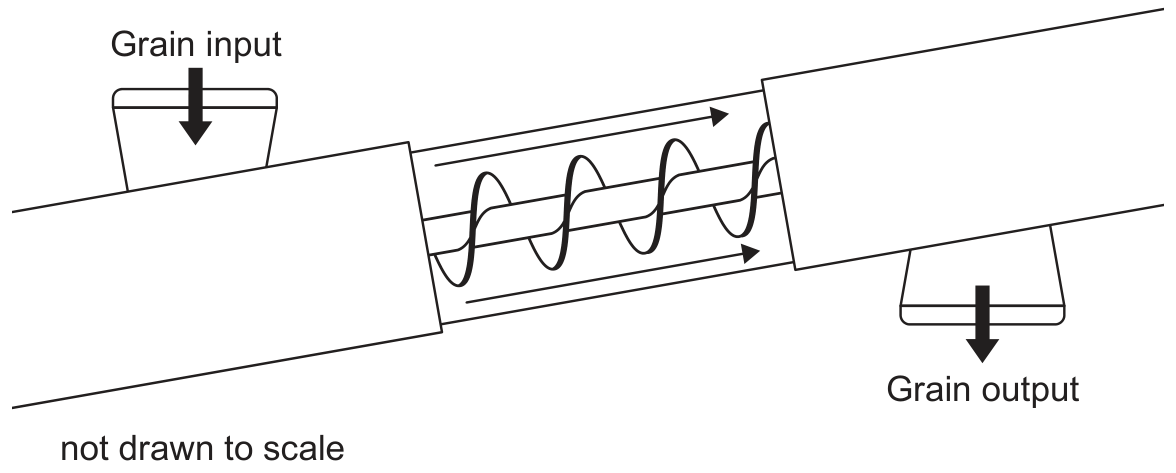
| Screw conveyor specifications | |||
|---|---|---|---|
| Screw pitch | Screw length | Capacity moved per individual screw | Conveyor rpm |
| 150 mm | 2400 mm | 0.15 m3 | 10 |
A screw conveyor is used to transport grain from an input chute up a 10° slope to a holding bin using the specifications shown. What is the volume of grain moved each minute?
Not quite. 225 is $150\times0.15\times10$, which uses the 150 mm pitch as if it were a count of screws. The pitch is a length. Dividing the screw length by it is what counts the flights.
That is it. Step through the hints below to see why.
Not quite. 2.4 m³ is $16\times0.15$, the grain sitting in the whole screw at one moment. The question asks for each minute, and the conveyor turns at 10 rpm.
Not quite. 1.5 m³ is $0.15\times10$, which treats the whole screw as one individual screw and leaves the screw length unused. A 2400 mm screw with a 150 mm pitch is 16 individual screws, and the table says each one moves 0.15 m³.
The 10° slope plays no part in a volume count. Each “individual screw” is one flight, one pitch long, and the table says it moves 0.15 m³. Count the flights along the screw.
$$\text{flights}=\frac{2400\text{ mm}}{150\text{ mm}}=16$$
Divide a length by a length. Multiplying by the 150 itself is what gives (A).
Every individual screw moves its 0.15 m³ on each turn, and the conveyor makes 10 turns a minute.
$$\begin{aligned}16\times0.15&=2.4\text{ m}^3/\text{turn}\\[6pt]2.4\times10&=24\text{ m}^3/\text{min}\end{aligned}$$
That is (B). Stopping after the first line gives (C).
Check that you used every row of the table. Leaving out the screw length gives
$$0.15\times10=1.5\text{ m}^3/\text{min}$$
which is option (D). It counts one individual screw where the table describes 16. A screw moves its load one pitch per turn, the idea behind the screw VR, circumference ÷ pitch, which the 2026 formula book now prints and the 2020 book did not.
$$\frac{2400}{150}\times0.15\times10=24\text{ m}^3$$
Count the 16 individual screws, multiply by the 0.15 m³ each one moves, then multiply by the 10 turns a minute.
One note on the physics. In a real conveyor the grain passes from flight to flight, so each turn about one flight’s worth falls out of the output chute, $0.15\times10=1.5\text{ m}^3$ a minute. The stem asks for the grain moved and the table gives a capacity for each individual screw, so QCAA counts all 16.
With no 2020 data, the wrong answer I would expect most often is (C), from stopping at one turn and forgetting the 10 rpm.
Only mark this done when you could do it without help. Reading the solution does not count.
Question wording and any figures are from the 2020 QCAA Engineering external assessment, © State of Queensland (QCAA) 2020, licensed under CC BY 4.0, and have been adapted, except where a third-party source is named. Tangent Tuition is not affiliated with the QCAA.
Spot a mistake on this page? Report it