
Question 21
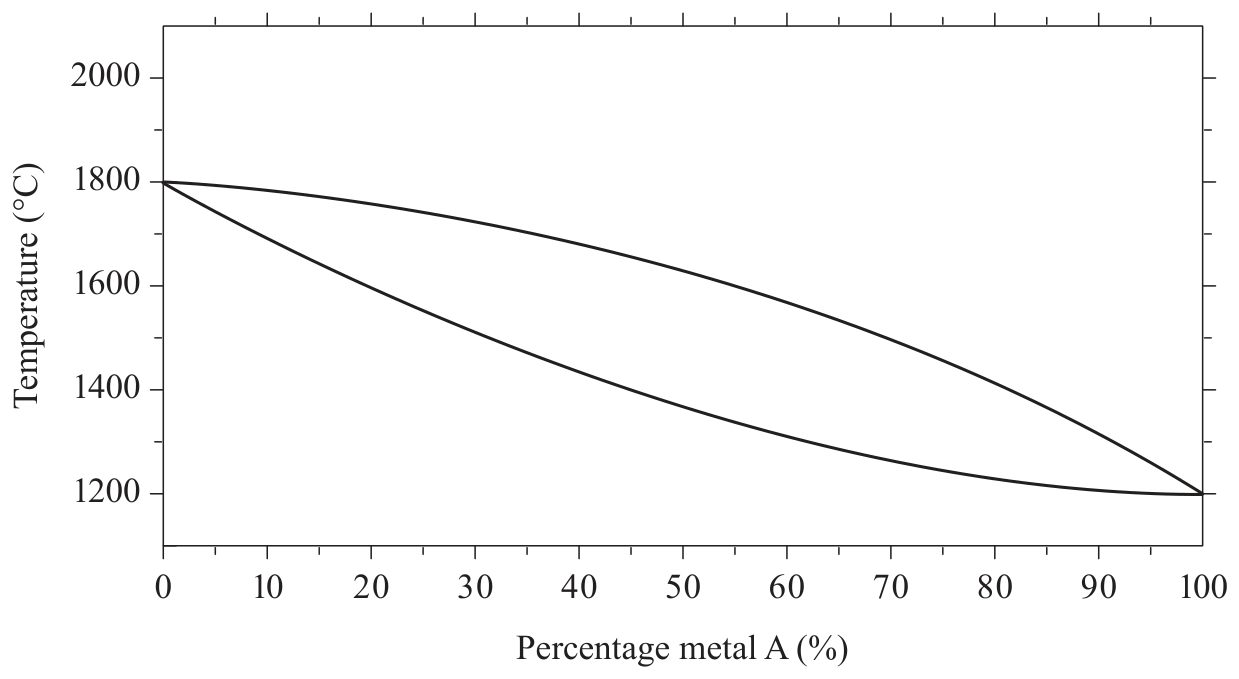
Use and annotate the binary equilibrium diagram for an alloy of metals A and B to calculate the percentage proportion of solid and liquid material present for an alloy of 50% metal A and B at 1400 °C. Answer to the nearest whole unit.
The tie line balances on the alloy, so each phase takes the arm on the far side
The alloy cools to 1400 °C and lands inside the lens. Watch the tie line lift out of the diagram and balance like a lever on the alloy composition.
The solid is the heavy end, so it sits on the short arm. Its share is the long arm, the one reaching towards the liquid, over the whole tie line.
Drag the alloy around the diagram and watch the tie line
This is QCAA’s diagram. Drag the orange point, or use the sliders. Inside the lens a tie line appears and the lever rule runs on whole-percent readings off QCAA’s curves. At 1400 °C it uses QCAA’s own readings, 45% and 82% A.
This is the question. The tie line runs from 45% A on the solidus to 82% A on the liquidus. The alloy at 50% A sits right next to the solid end, so most of it is solid, 86%.
Inside the lens the alloy is part solid, part liquid. The solid has the composition at the solidus end and the liquid the composition at the liquidus end. The closer the alloy sits to an end, the more of that phase there is.
The point is above the liquidus, so the alloy is 100% liquid. There is no tie line and nothing to calculate.
The point is below the solidus, so the alloy is 100% solid. The lever rule only works between two boundaries.
This is the swap QCAA’s question is built to catch. The near arm gives the other phase. The two answers still add to 100%, so the sum check cannot see the error. The alloy sits closest to the phase you have most of, so check against the picture.
Work through the solution one mark at a time
Try each step yourself before you reveal it.
Rule a vertical line at 50% A and a horizontal tie line at 1400 °C. Read where the tie line meets each curve and write the readings on the diagram.
The lower curve is the solidus, so its reading is the solid, 45% A. The upper curve is the liquidus, so its reading is the liquid, 82% A.
QCAA notes: “Accept 1% as the maximum variation above or below provided readings.” The printed liquidus actually crosses 1400 °C at 81.4% A, so 81% and 82% both sit inside that window.
Marker: provides evidence that the diagram is used to plot percentage of metal A and B
The solid takes the arm on the far side from it, from the alloy across to the liquidus. Divide it by the whole tie line.
$$\text{solid}=\frac{82-50}{82-45}\times\frac{100}{1}$$
This is why QCAA calls it the inverse lever rule. The arm nearest the solid gives the liquid, never the solid.
Marker: includes correct use of the inverse lever rule to calculate solid
Round to the whole unit only at the end and write the % sign. The range QCAA accepts for reading variations is “solid: 84–89%”.
Marker: provides correct working to give correct percentage of solid to the nearest whole unit with correct unit provided
The liquid takes the other arm, from the solidus across to the alloy.
$$\text{liquid}=\frac{50-45}{82-45}\times\frac{100}{1}$$
The guide also accepts working out one phase and subtracting it from 100%: “Solution may include the calculation for either solid or liquid, with the result subtracted from 100% to determine the remaining value.”
Marker: provides correct use of the inverse lever rule to calculate liquid
QCAA accepts “liquid: 11–16%” and insists “Solid and liquid result must add to 100%.” Check the picture as well. The alloy sits much nearer the solid end, so solid must be the bigger share.
Marker: provides correct working to give correct percentage of liquid to the nearest whole unit with correct unit provided
Each phrase of the question gave you something
The 2020 subject report says the effective responses accurately annotated the diagram at 1400 °C and then used the inverse lever rule for both phases, to the nearest whole unit. The high-level sample it chose shows the diagram work and the calculation together.
Everything comes off one tie line and two divisions, and every reading is printed on a single diagram. QCAA published the 2020 split in the subject report, two simple familiar calculation questions worth 10 marks, and the two 5-mark calculations, this one and Question 18, are the only pair that fits. In Unit 4 the 2025 syllabus names the lever rule for alloys with complete solid insolubility and partial solid solubility. This lens shape, complete solid solubility, now sits in Unit 2 and is outside the 2026 exam, but the tie-line method transfers unchanged.
If I had to guess where you might lose marks, it would be the swap. The alloy is close to the solidus, so the near arm, 5, looks like it belongs to the solid, and $5\div37$ gives 14% solid. That answer still adds to 100% with its partner, so only the picture catches it. The other is the unit. Two of the five marks say “with correct unit provided”, so 86 without the % sign is not 86%.
Only mark this done when you could do it without help. Reading the solution does not count.
Question wording, any figures and marking-guide steps are from the 2020 QCAA Engineering external assessment, © State of Queensland (QCAA) 2020, licensed under CC BY 4.0, and have been adapted, except where a third-party source is named. Tangent Tuition is not affiliated with the QCAA.
Spot a mistake on this page? Report it