
Question 13
Explain how the microstructure of a 62% tin and 38% lead binary alloy changes during cooling from liquid to solid. Provide an annotated sketch of the microstructure to support your explanation.
At 62% tin the liquid freezes all at once at 183 °C, straight into plates of α and β
Follow the orange point down the diagram on the left, and watch the microscope view on the right. Notice where the point stops, and what grows while it waits.
A eutectic alloy has no solid-plus-liquid stage. All of the liquid turns into α and β at 183 °C, and the thin alternating plates it makes are the laminar structure the marks ask for.
Build the answer and see which marks it earns
Choose a sketch, annotate it, then pick the sentences you would write. The tally shows the five marks from QCAA’s guide as you earn them. Two of the sentences are wrong for this alloy.
Work through the solution one mark at a time
Three marks are for the explanation and two are for the sketch. Try each step yourself before you reveal it.
Start with the alloy as a liquid and say what happens at the eutectic temperature. A 62% tin alloy is the eutectic composition to the nearest whole percent (61.9% Sn on QCAA’s later diagrams), so it does not pass through a solid-plus-liquid field. All of it freezes at 183 °C.
QCAA’s sample: “Microstructure changes occur when the cooling of the completely soluble liquid solution reaches the eutectic temperature of 183 °C. Here the liquid solution completely freezes …”
Marker: explains changes correctly using wording indicative of the mixture solidifies directly from liquid to solid
Name what the liquid turns into. It is a eutectic mixture of two solid phases, $\alpha$ (lead with a little tin dissolved in it) and $\beta$ (tin with a little lead dissolved in it).
QCAA’s sample: “… to become a totally solid eutectic mixture with partial solid solubility as the temperature continues to fall.”
Marker: explains changes correctly using wording indicative of the eutectic mixture
Describe the shape of the mixture. The $\alpha$ and $\beta$ grow side by side as thin alternating plates, which is a laminar structure.
QCAA’s sample paragraph never uses the word laminar. It shows the idea in the sketch. Write the word anyway, because this mark is for the explanation. Textbooks call the same structure lamellar.
Marker: explains changes correctly using wording indicative of the laminar structure
Draw a circular field of view filled with groups of thin parallel plates, the plates in each group running a different way. This is the sketch from QCAA’s sample response.
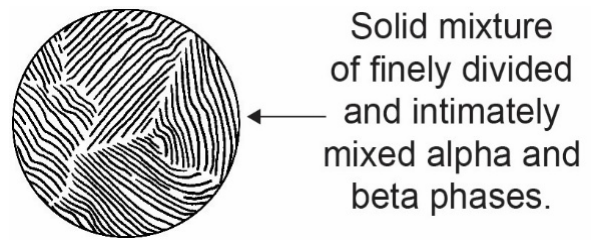
Marker: provides a sketch that indicates a laminar structure
Annotate the sketch. QCAA’s note says it is a “Solid mixture of finely divided and intimately mixed alpha and beta phases.” Labelling the dark plates $\alpha$ and the light plates $\beta$ does the same job. The guide also accepts lead for $\alpha$ and tin for $\beta$.
Marker: provides a sketch that is appropriately annotated
Each phrase of the question gave you something
The question names the one composition on the diagram with the simplest cooling story, and the marks are for recalling it and drawing it. The 2020 subject report lists Section 2 as six simple familiar questions and one complex familiar question worth 6 marks, so this 5-mark question is simple familiar by QCAA’s own count.
If I had to guess where you might lose marks, it would be telling the story of a different alloy, with primary $\alpha$ forming first and the eutectic after it. That is what a 40% tin alloy does, and the 2025 syllabus now names it as hypoeutectic, so expect that version too. The other trap is a sketch of plain grains with no plates, or plates with no labels. The 2025 subject report made a related point about Question 11, where the effective responses labelled the phases as alpha and beta, those of a lead-tin alloy, and not those of a carbon steel.
Only mark this done when you could do it without help. Reading the solution does not count.
Question wording, any figures and marking-guide steps are from the 2020 QCAA Engineering external assessment, © State of Queensland (QCAA) 2020, licensed under CC BY 4.0, and have been adapted, except where a third-party source is named. Tangent Tuition is not affiliated with the QCAA.
Spot a mistake on this page? Report it