
Question 17
A lead–tin thermal-equilibrium diagram is shown.
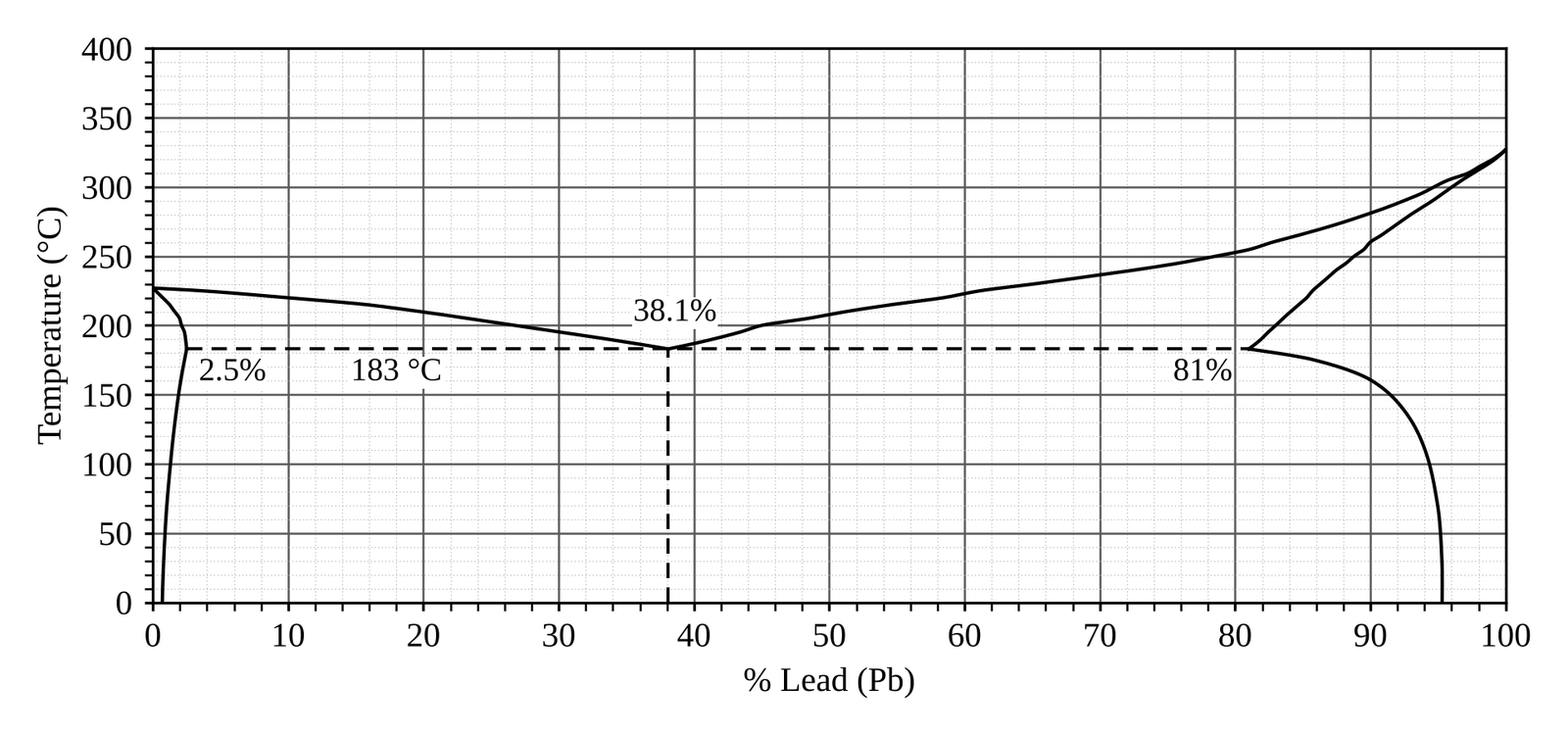
Identify the percentage of tin in the eutectic composition.
[1 mark] b)Determine the percentages of solid and liquid in a 75% lead 25% tin alloy at 220 °C. Annotate the diagram to support your response.
[3 marks]One tie line at 220 °C gives both percentages
This is the printed diagram. Watch the eutectic give part a), then the 75% lead alloy rise to 220 °C, the tie line reach the liquidus and the solidus, and the two arms turn into the percentages.
Each phase takes the arm on the far side of the alloy. The alloy sits closer to the solidus, so there is more solid than liquid.
Drag the alloy and read both answers off one tie line
This is the printed diagram. Drag the orange point, or use the sliders. The point stays inside the lead-rich solid and liquid field, and the readings come off the same curves, to one decimal place. Watch the end readings change only with the temperature, while the percentages change with the alloy too.
This is the question. The curves give 58.4% and 85.3% Pb here, so the readout shows 61.7% solid and 38.3% liquid. Read to the whole percent, as you would on the paper, and the tie line runs from 58% to 85% Pb, the arms are 17 and 10, and the alloy is 17/27 = 63% solid and 10/27 = 37% liquid. Both pairs sit inside the accepted 59 to 67% solid and 33 to 41% liquid.
Slide the alloy along the 220 °C tie line and the end readings stay put, because they belong to the temperature. Only the arms and the percentages change.
A new temperature moves the tie line, so both end readings change. The closer the alloy sits to the solidus, the more of it is solid.
This is the swap. The near arm gives the other phase, and the swapped answers still add to 100%. At 75% Pb and 220 °C it gives about 38% solid (37% from the whole-percent readings), which earns neither calculation mark. The alloy sits closest to the phase you have most of, so check against the picture.
Just above 183 °C the ends close in on the printed 38.1% and 81%. Those printed values belong to 183 °C only. At 220 °C you must read the curves.
Work through the solution one mark at a time
Try each step yourself before you reveal it.
Read the eutectic composition off the diagram, then take it from 100%.
$$\begin{aligned}\%\ \text{Sn}&=100-38.1\\&=61.9\%\end{aligned}$$
The eutectic point is printed as 38.1% lead, and the alloy is only lead and tin.
Accept 61.9% or 62% tin.
Do not accept 38.1% (the percentage of lead).
Marker: correctly identifies the percentage of tin in the eutectic composition from the diagram
Annotation: draw a vertical line up from 75% Pb and a horizontal tie line at 220 °C through it. The tie line meets the liquidus at 58% Pb and the solidus at 85% Pb. Label both readings.
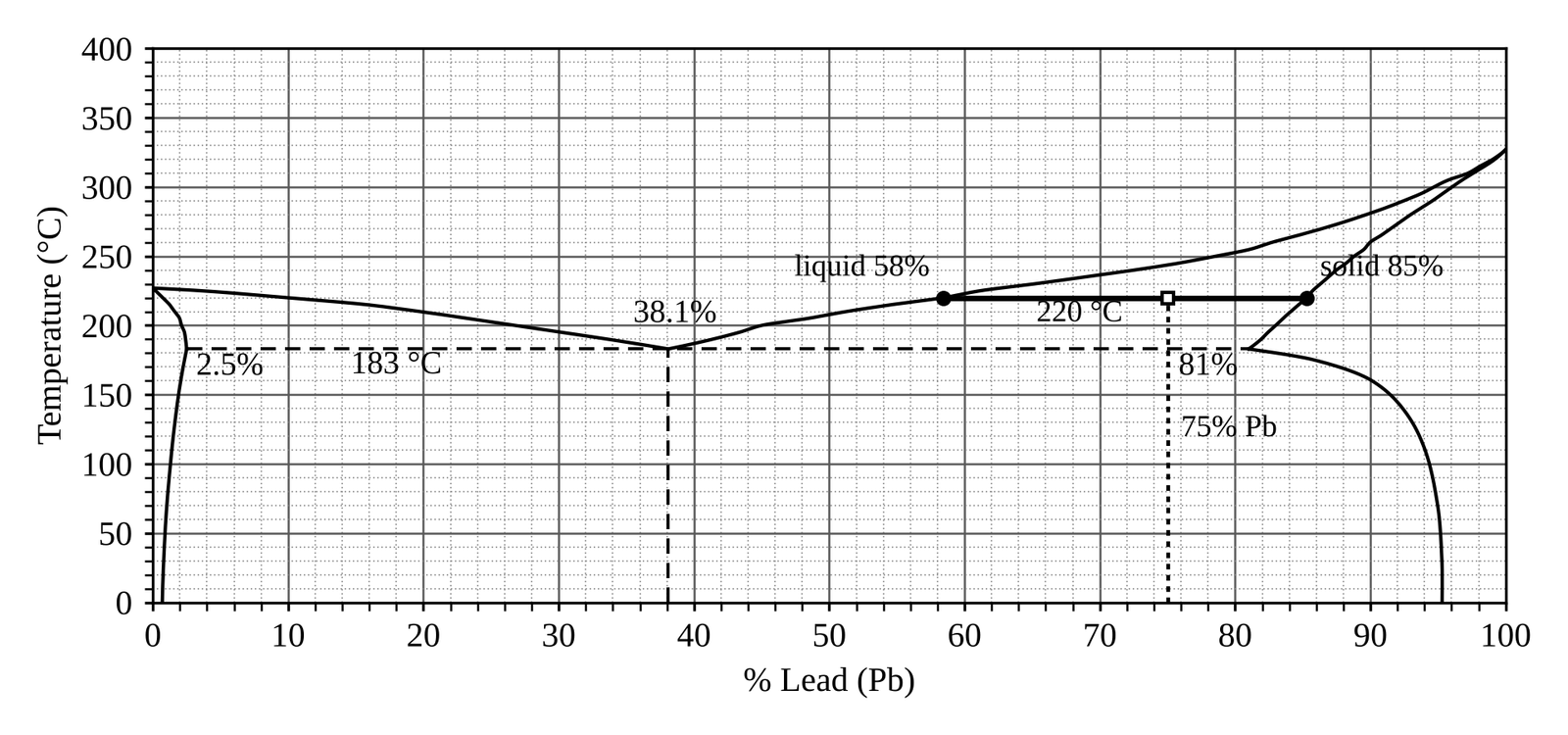
The lever rule needs the compositions of the liquid and the solid that coexist at 220 °C.
Accept liquidus reading 57–59% Pb and solidus reading 84–86% Pb inclusive, and subsequent FT marks.
Marker: correctly annotates the diagram to show the intersection of the 75% lead alloy and 220 °C, with the tie line meeting the liquidus and solidus
Use the lever rule for the solid, with the arm from the alloy back to the liquidus.
$$\begin{aligned}\%\ \text{solid}&=\frac{\text{alloy}-\text{liquid}}{\text{solid}-\text{liquid}}\times100\%\\&=\frac{75-58}{85-58}\times100\%\\&=\frac{17}{27}\times100\%\\&=62.96\%\\&\approx63\%\end{aligned}$$
The fraction of solid is the lever arm on the liquid side of the alloy over the whole tie line.
Enter 17 ÷ 27 × 100. It gives 62.963.
Accept either solid or liquid being calculated first.
Accept 59%–67% solid inclusive.
Readings taken from the values printed at 183 °C (81%, 38.1%) do not earn the solid or liquid marks.
Marker: calculates the percentage of solid at 220 °C
Use the lever rule for the liquid, with the arm from the alloy to the solidus.
$$\begin{aligned}\%\ \text{liquid}&=\frac{\text{solid}-\text{alloy}}{\text{solid}-\text{liquid}}\times100\%\\&=\frac{85-75}{85-58}\times100\%\\&=\frac{10}{27}\times100\%\\&=37.04\%\\&\approx37\%\end{aligned}$$
The fraction of liquid is the lever arm on the solid side over the whole tie line.
Enter 10 ÷ 27 × 100. It gives 37.037.
Accept 33%–41% liquid inclusive.
Accept percentage of liquid as 100 percent minus the percentage of solid.
Marker: calculates the percentage of liquid at 220 °C
Each phrase of the question gave you something
If I had to guess where you might lose marks…
- Giving 38.1% for a). That is the lead content of the eutectic, not the tin content.
- Using the printed 183 °C values. Using 81% and 38.1% instead of reading the curves at 220 °C gives about 86% solid and earns neither calculation mark.
- Swapping the lever arms. This gives 37% solid and 63% liquid. The solid fraction uses the arm between the alloy and the liquidus.
- Calculating without annotating. If you do not draw the tie line and label the liquidus and solidus readings on the diagram, you forfeit Mark 2.
The past QCAA questions this one was modelled on
Only mark this done when you could do it without help. Reading the solution does not count.
A Tangent Tuition mock exam question. It is not a past QCAA question, and Tangent Tuition is not affiliated with the QCAA.
Spot a mistake on this page? Report it