
Question 16
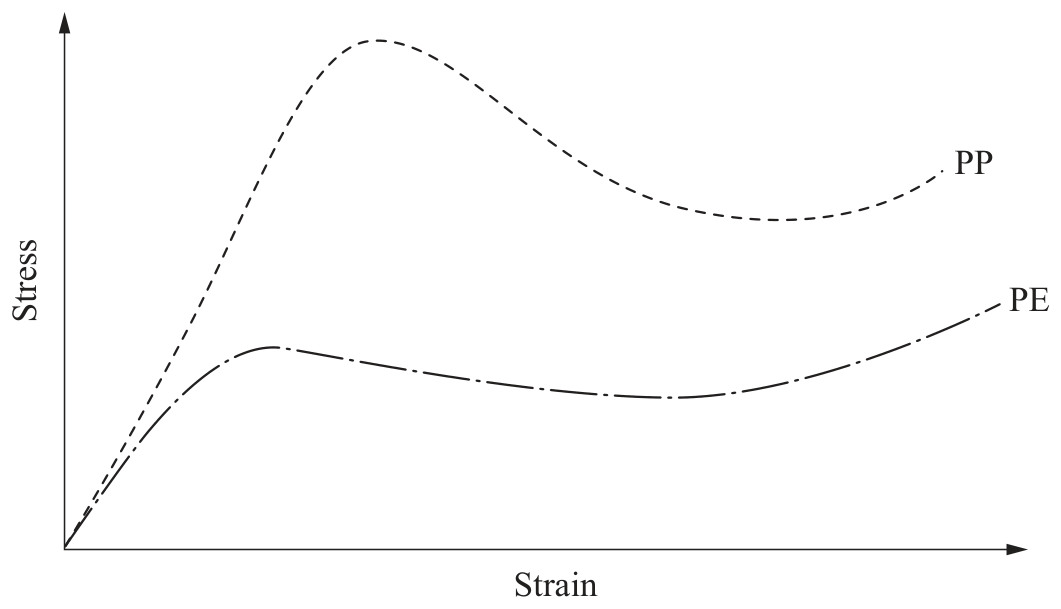
A stress–strain diagram for polypropylene (PP) and polyethylene (PE) and a table comparing their properties are shown.
| Properties | Polypropylene (PP) | Polyethylene (PE) |
|---|---|---|
| Chemical | excellent chemical resistance (including solvents, alkalis and many acids)non-toxic | good chemical resistance |
| Thermal | heat resistance up to 135 °C | heat resistance up to 120 °C |
| Electrical | excellent electrical insulation | excellent electrical insulation |
Identify a suitable application for each material. Justify your response by analysing the stress–strain diagram and the table to identify two properties for each material that make it suitable. Annotate the stress–strain diagram with one of the identified properties.
[7 marks]
The diagram gives you the mechanical properties and the table gives you the rest
This is QCAA’s stimulus, the diagram above the table, traced to scale. Watch which rows PP wins, then the three annotations QCAA accepted.
Take the mechanical properties from the curves and the chemical, thermal and electrical ones from the table. Then write one of them onto the diagram, because the annotation is a mark of its own.
Read the curves, annotate one property, then match each material to a job
The axes have no scale, so readings are relative: the largest value on the diagram is 100. Choose a property and a curve, hover or tap to read it, then pin it to the diagram as your annotation.
Choose an application and two properties for each material
A property only earns its mark if it comes from the diagram or the table and it does something for the job you chose.
Work through the solution one mark at a time
Try each step yourself before you reveal it. Three marks per material, and one for the annotation.
Name a real product. The PP curve is the high one, so choose a job that needs strength and toughness.
“Polypropylene could be used for manufacturing a car bumper …”
The notes also accept laboratory equipment, kettles and toasters, and automobile products such as instrument panels, door trims and wheel covers.
Marker: identifies a suitable application for polypropylene
“… because it has high toughness, so it will be able to absorb the energy of an impact.”
Read off the diagram: the area under PP is about twice the area under PE.
Marker: justifies the application by analysing the diagram and table to identify one relevant property
“It also has high tensile strength, so it will be able to withstand a lot of stress without breaking.”
PP’s peak is about twice PE’s highest point. Both of QCAA’s PP properties come from the diagram, which is fine. The table’s excellent chemical resistance and 135 °C heat resistance would also work for a job that needs them, such as laboratory equipment.
Marker: justifies the application by analysing the diagram and table to identify a second relevant property
“Polyethylene could be used for manufacturing plastic food containers, such as frozen microwave meals …”
The notes also accept water bottles, fuel cans, water pipes and cable insulation.
Marker: identifies a suitable application for polyethylene
“… because it is able to withstand the temperatures of the microwave without deforming too much.”
From the table: heat resistance up to 120 °C. Food heated in water does not pass 100 °C.
Marker: justifies the application by analysing the diagram and table to identify one relevant property
“It also has good chemical resistance, so it can be used for the storage of acidic foods.”
The notes add a property from the diagram: PE’s “low Young’s modulus of elasticity (gradient of the slope in the elastic region is fairly shallow), so flexible, durable, resistant to cracking and leaking”.
Marker: justifies the application by analysing the diagram and table to identify a second relevant property
Write one of your properties onto the printed diagram. QCAA’s sample hatched the area under PP and labelled it toughness.
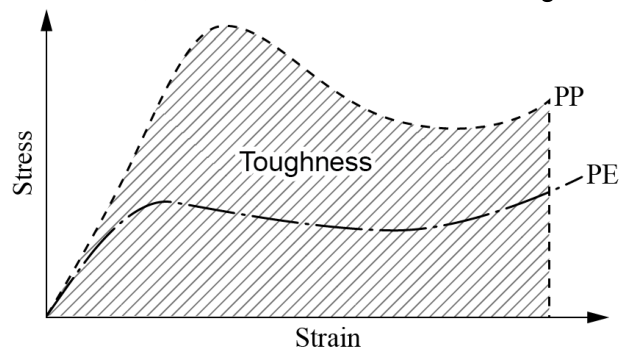
“Appropriate annotations to the diagram include indicating that the: proportional section of the curve up to the yield point is the elastic region, gradient of the slope in the elastic region is Young’s modulus, highest stress point in the curve is the ultimate tensile strength.”
Marker: appropriately annotates the diagram with an identified property of polypropylene or polyethylene
Each phrase of the question gave you something
QCAA did not publish a band for this question. It reads as complex familiar because you choose the applications yourself, weave two sources together and finish with a drawn annotation, all for seven marks with no part letters to guide you. PP and PE are no longer Unit 4 plastics for 2026. The structure carries over exactly: a 2026 version would give you ABS, PC or PA6 curves and a table, and automobile parts such as a bumper are now on the 2026 ABS list.
If I had to guess where you might lose marks, it would be the annotation. It is the last sentence of the stem, it sits on a different page from the lines you write on, and it is a whole mark for a label. The other loss is a property that does nothing for the job, such as electrical insulation for a car bumper. Both plastics have it, and a bumper does not need it.
Only mark this done when you could do it without help. Reading the solution does not count.
Question wording, any figures and marking-guide steps are from the 2025 QCAA Engineering external assessment, © State of Queensland (QCAA) 2025, licensed under CC BY 4.0, and have been adapted, except where a third-party source is named. Tangent Tuition is not affiliated with the QCAA.
Spot a mistake on this page? Report it