Unit 4 names three engineering plastics: ABS, polycarbonate (PC) and polyamide (PA6, nylon 6). The syllabus prints a property list and an application list for each, and those lists are the examinable content.
Since 2024 the marks have moved from reciting the lists to analysing a table or a graph and justifying a choice. This guide covers both, and how to read a stress–strain diagram when one is supplied. Tick off each skill once you can do it without help.
35
Section 2 marks on plastics, 2020–2025
6 of 6
papers with a stress–strain diagram to read
4
plastics no longer in Unit 4 (QCAA: “reduced”)
Skills in this topic
Only tick a skill when you could do it in the exam. Your ticks are saved in this browser only.
Part 1
What the exam asks about plastics
Plastics appear in every year of the past papers. They carried 35 Section 2 marks from 2020 to 2025, plus a multiple choice question in five of the six years (all but 2021).
The form has changed. From 2020 to 2023 the items were mostly recall, such as “list four properties” and “state four applications”. The one interpretation item was 2022 Question 17, a nylon stress–strain diagram. From 2024 every written plastics item has supplied a table or a graph and asked for a justified selection or application. 2024 Question 12 and 2025 Questions 14 and 16 are all of that kind.
Several plastics named in the older questions (polyethylene, polypropylene, PVC and PLA) are no longer in Unit 4 (Part 2 has the details). ABS and nylon, the subjects of 2021 Question 11, 2022 Question 17 and 2023 Question 11, still are. The analysis skill the newer questions test is unaffected.
What the syllabus says
This is the Unit 4 Topic 3 dot point, word for word:
Comprehend the mechanical properties of and current uses for engineering plastics, including
•acrylonitrile butadiene styrene (ABS): high heat resistance, good low-temperature resistance, high impact resistance, high chemical resistance, excellent electrical insulation, good dimensional stability. Automobile parts, personal protective equipment (e.g. face shields, hard hats, helmets), electrical equipment (e.g. power tools housings, printers, vacuum cleaners) and high-strength applications in the construction industry
•polycarbonate (PC): high transparency, good toughness, high impact strength, good chemical resistance, high heat resistance, good electrical properties, high dimensional stability. Lenses and shields (e.g. automotive headlamps, security windows, motorcycle face shields and windscreens, prescription lenses, safety glasses, machinery guards, skylights, and streetlamps) and electrical and electronic device housings
•polyamide (PA6/nylon 6): high strength, high abrasion resistance, good thermal resistance, good chemical resistance, good electrical properties, good fatigue resistance. Machine parts (e.g. gears, rollers, guides, bearings, wear pads and wheels), medical implants, electrical connectors and fishing line.
The syllabus sets each plastic out as a property line and an application line. They are joined here with a full stop.
The verb is comprehend. The syllabus prints the properties and the applications, and they answer most questions in this topic, so learn them in the order the syllabus gives them.
What the formula book gives you
The formula book gives you nothing you need for this topic. Its materials formulas have never been used (see Part 4), and there are no property tables, no material data and no applications. The topic is all recall, plus analysis of whatever stimulus the question supplies.
When a question supplies a table, everything you need is in that table. When it does not, everything you need is in the syllabus lists.
Part 2
The three Unit 4 plastics
ABS
Acrylonitrile butadiene styrene. High heat resistance, good low-temperature resistance, high impact resistance, high chemical resistance, excellent electrical insulation and good dimensional stability.
Used for automobile parts, personal protective equipment such as face shields, hard hats and helmets, housings for power tools, printers and vacuum cleaners, and high-strength applications in construction.
PC
Polycarbonate. High transparency, good toughness, high impact strength, good chemical resistance, high heat resistance, good electrical properties and high dimensional stability.
Used for lenses and shields (headlamps, security windows, motorcycle face shields and windscreens, prescription lenses, safety glasses, machinery guards, skylights and streetlamps) and electrical and electronic device housings.
PA6
Polyamide, nylon 6. High strength, high abrasion resistance, good thermal resistance, good chemical resistance, good electrical properties and good fatigue resistance.
Used for machine parts such as gears, rollers, guides, bearings, wear pads and wheels, and for medical implants, electrical connectors and fishing line.
To tell them apart quickly, start from the job. PC is the transparent one, so anything you look through is polycarbonate. PA6 runs against other parts, so anything that slides, meshes or wears is nylon. ABS is the impact-resistant moulded housing that also copes with cold and insulates.
What changed for 2026
A full-text search of the revised syllabus confirms that polyethylene, polypropylene, PLA and PVC do not appear anywhere in Unit 4. QCAA’s 2025 syllabus revision report lists, under Unit 4, “applications of … polyethylene, polypropylene, PLA and PVC” as reduced subject matter.
Polycarbonate was added, and it is new content for 2026.
Two things this does not mean:
•The plastics have not vanished from the course. PP, PVC, polystyrene, LDPE, HDPE and others are still listed in Unit 2 as examples of synthetic polymers. The external exam assesses Unit 4 only, so they are out of scope for the exam, but you may well have met them in Year 11.
•The old questions are still useful. The skill they test, reading a property table or a stress–strain curve and justifying a choice, is still examinable, and it is the form that is growing.
Plastic
Status for the 2026 external
ABS
In Unit 4. Properties and applications examinable.
Polycarbonate (PC)
In Unit 4. New for 2026.
Polyamide (PA6, nylon 6)
In Unit 4. Properties and applications examinable.
Polyethylene (PE, LDPE, HDPE)
No longer in Unit 4. Still in Unit 2, which the external exam does not assess.
Polypropylene (PP)
No longer in Unit 4. Still in Unit 2.
Polyvinyl chloride (PVC)
No longer in Unit 4. Still in Unit 2.
Polylactic acid (PLA)
No longer in Unit 4. Not named anywhere in the 2025 syllabus.
Which past questions to skip, and which to keep
Skip for content: 2020 Question 12 (four properties of PLA) and the multiple choice items 2020 Q4 (cable insulation, keyed polyethylene), 2022 Q2 (drainage pipe, keyed PVC), 2023 Q1 (laboratory beaker, all four options out of scope), 2024 Q4 (medical screw, keyed PLA) and 2025 Q5 (an application for PLA).
Keep for the skill and ignore the material: 2024 Question 12 (PVC against polyethylene from a property table) and 2025 Question 16 (an application for PP and for PE from a table and a graph). The materials have gone, but the analyse-and-justify structure is what a 2026 question about ABS, PC or PA6 is likely to use.
Keep entirely: 2023 Question 11 (applications of ABS), 2022 Question 17 (nylon for gears from a stress–strain diagram) and 2025 Question 14 (choose a polymer from a lettered stress–strain diagram, which needs no material knowledge at all).
Part 3
Telling the three plastics apart
When nothing is supplied, start from what the job needs and find the plastic whose list contains it.
If the application…
The plastic is probably…
needs to be seen through: lenses, shields, skylights, safety glasses
Polycarbonate. It is the only one the syllabus calls transparent.
PA6 (nylon). High abrasion resistance and good fatigue resistance.
gets struck or dropped: helmets, hard hats, power tool housings, car parts
ABS. Good low-temperature resistance and excellent electrical insulation. Impact fits PC too.
goes inside a body: medical implants
PA6. The syllabus lists medical implants under polyamide.
must not conduct: electrical insulation
ABS. Its electrical insulation is listed as excellent, where PC and PA6 get good electrical properties.
Overlaps worth knowing
ABS and PC both make housings. ABS covers power tools, printers and vacuum cleaners. PC covers electrical and electronic device housings. If a question names a housing, either can usually be justified, so say which property drives your choice.
Face shields appear in both lists. ABS has face shields as personal protective equipment, and PC has motorcycle face shields. If you choose PC for a shield, justify it with transparency.
All three resist chemicals and all three are listed with good or excellent electrical properties. Those are the least useful properties to cite, because they do not separate the options. Impact does not separate ABS from PC either. Reach for a property the syllabus gives to only one of them:
•transparency or toughness (PC)
•abrasion resistance, fatigue resistance or high strength (PA6)
•low-temperature resistance or excellent electrical insulation (ABS)
Practise
Exam question: the application lists
Solutions show where each mark goes, based on the QCAA marking guide.
2023 Question 11
Section 2 · Band not published · [4 marks]
State four contemporary engineering applications for acrylonitrile butadiene styrene (ABS).
State means express something clearly and definitively, so four nouns will do. Nothing needs explaining.
The published sample answer is a list: “1. automobile bumper bar 2. electrical wall socket 3. face shield 4. hard hat”.
The response:
Marks
provides a contemporary engineering application
1
provides a second contemporary engineering application
1
provides a third contemporary engineering application
1
provides a fourth contemporary engineering application
1
The marking guide notes that these applications “require impact resistance” and lists automobile parts (dashboards, interior trims), household electrical appliances (kitchen appliance housings, light switches) and business equipment (keyboard components, printer parts, power tool housings).
The face shield in the sample answer matters. Face shields appear under ABS in the syllabus as personal protective equipment, as well as under PC.
Answer
Any four, e.g. bumper bar, wall socket, face shield, hard hat
Part 4
Reading a stress–strain diagram
What “reduced” means here
The QCAA Engineering 2025 general senior syllabus revision report (July 2024) lists stress–strain diagrams as reduced subject matter in Unit 4. The revised Unit 4 no longer has a stress–strain dot point, and reading one is now Unit 1 content. A 2026 diagram is likely only as stimulus for the plastics dot point, which asks you to “comprehend the mechanical properties” of ABS, PC and PA6.
Separately, the formula book prints $\sigma = \frac{F}{A}$, $\varepsilon = \frac{\Delta L}{L}$ and $E = \frac{\sigma}{\varepsilon}$, and no question from 2020 to 2025 used them. Learn to read the graph and its symbols. You do not need to drill the calculations.
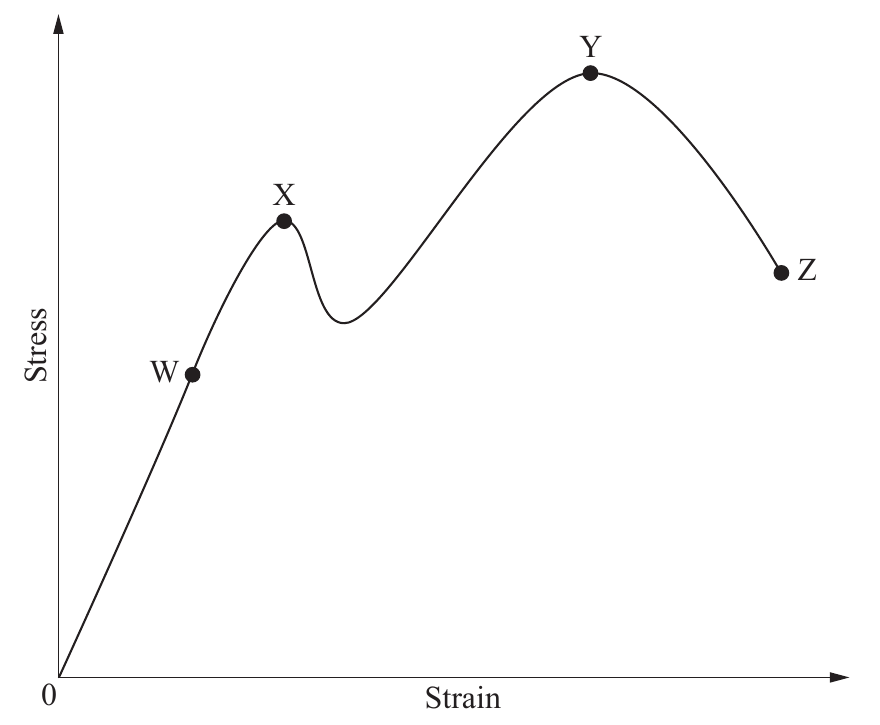
The features QCAA names. The proportional limit is the end of the straight line. The yield point comes just after it, where permanent deformation begins.
Feature on the curve
What it tells you
Steeper initial slope
Higher Young’s modulus: stiffer, more rigid, less flexible
Higher yield point
Withstands more stress before deforming plastically
Higher peak stress
Higher ultimate tensile strength: withstands more stress before failing
Longer horizontal extent
Greater elongation at break: more ductile
Larger area under the curve
Greater toughness: absorbs more energy before breaking
The yield point and the peak are different features. The yield point is where the material begins to deform permanently. The peak, further along, is the ultimate tensile strength. A question about deforming plastically wants the yield point. A question about breaking wants the peak.
Every past diagram you were given to read
These are all the stress–strain diagrams QCAA has given students to read from 2020 to 2025. The sketch items (2020 Q11, 2021 Q11 and 2021 Q14) are not listed.
Item
Curves
What it asked
2020 MC Q10
1, with an arrow to a feature
name the feature (yield stress)
2021 MC Q3
1, regions J, K, L and M
which region shows stiffness
2022 MC Q1
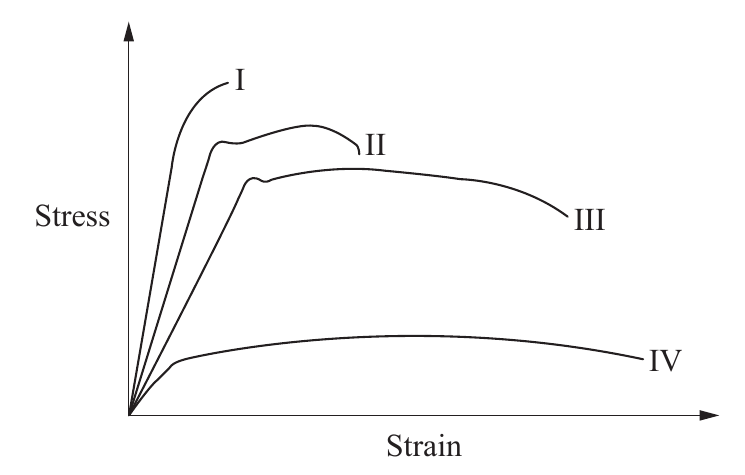
4, all solid, I to IV, no crossing
which is toughest
2022 Q17
4, all solid, labelled by % ENR, no crossing
interpret four mechanical properties
2023 MC Q6
4, all solid, I to IV, no crossing
best within its proportional limit
2024 MC Q7
1, points W, X, Y and Z
the feature at X (yield stress)
2025 MC Q9
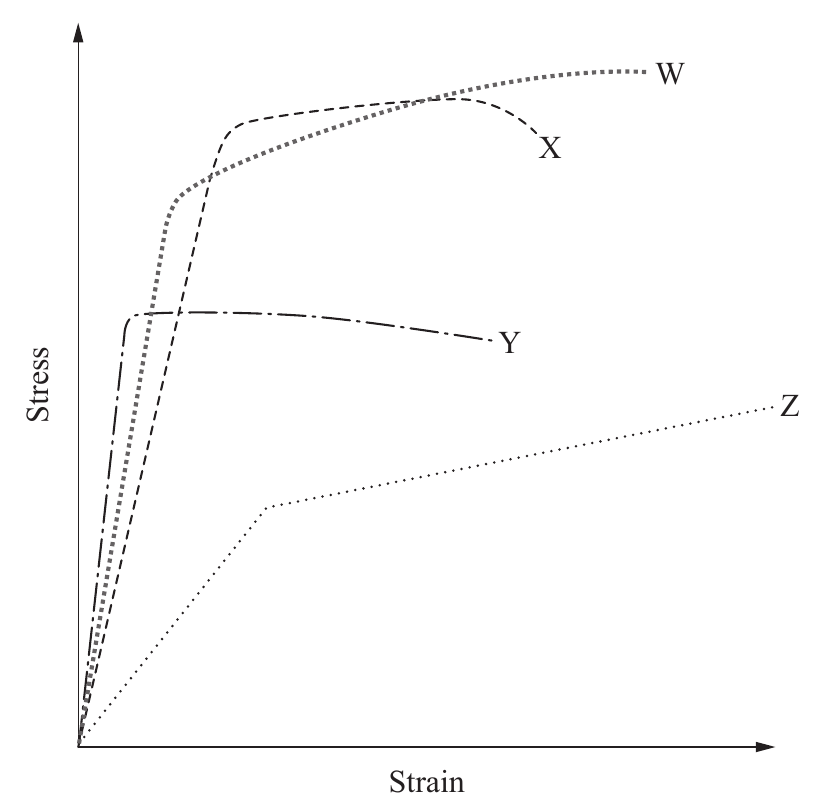
4, four line styles, W to Z, curves cross
greatest toughness
2025 Q14
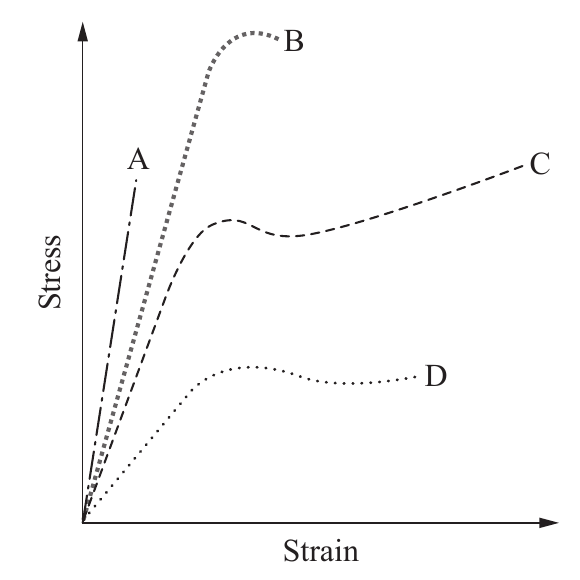
4, four line styles, A to D, no crossing
(a) yield (b) toughness
2025 Q16
2, two line styles, PP and PE, no crossing
application, justify, annotate
That is a diagram to read in every paper from 2020 to 2025, plus Section 2 diagrams in 2022 (Q17) and 2025 (Q14 and Q16). Be ready to read one.
What the table tells you
1Most stimuli show four curves. Five of the nine do.
2Crossing has appeared in one stimulus, 2025 multiple choice Question 9, where W crosses X and both rise through the level of Y. Curves may cross.
3Crossing is not what makes different features pick different curves. 2022 Question 1 has no crossings at all, yet the highest peak is I, the longest extension is IV and the toughest is III.
4QCAA never uses colour. In 2022 and 2023 the curves were all solid and told apart by their labels. In 2025 each curve also had its own line style, such as dashed, dotted or dash-dot.
The top curve does not win every question
Four features, four different curves. A is the stiffest but breaks first, B peaks highest, C encloses the largest area and D stretches furthest.
Toughness is the area under the curve, so it goes to whichever curve combines height and length. That can be a middle curve, as in 2022 Question 1, or the highest curve, as in 2025 Question 9.
A steep gradient on its own tells you stiffness. It does not tell you strength. In 2025 Question 14(a), polymer A had the steeper line but broke first, and the answer was B. Check how far a curve goes before you commit to it.
When the curves are lettered rather than named, as in 2025 Question 14, the whole answer is in the diagram. Do not go looking for material knowledge you were not given.
2023 Question 6 had two accepted answers
QCAA’s multiple-choice scrutiny panel reviewed the item and found it had two correct keys, A and B. Both were accepted.
When two curves are close, naming the feature that drove your choice protects you. In a written question a justified choice is safe even when the diagram is tight.
Practise
Exam questions: reading the curves
For the written question, the solution shows where each mark goes, based on the QCAA marking guide.
2022 Question 1
Section 1 · Multiple choice · [1 mark]
The graph shows the tensile stress–strain curves of four different materials.
The toughest of the four materials is
Toughness is the area under the curve. III is nearly as high as II and runs much further, so it encloses the most area.
(A) I peaks highest but breaks early, so its area is small. 23.56% of the cohort chose it. (B) II is high but short. (D) IV runs furthest but stays low, so its area is smaller than III. 60.18% chose the correct answer.
Answer
(C) III
2024 Question 7
Section 1 · Multiple choice · [1 mark]
A stress–strain diagram is shown.
Identify the key feature represented by point X on the diagram.
X sits just past the straight line, at the top of the first rise before the curve dips. That is the yield point, so the stress there is the yield stress.
(C) The proportional limit is the end of the straight line, around W, below X. 18.01% chose it. (D) The ultimate tensile strength is the highest point, Y. (B) “Plastic limit” is not the name of this point. 66.87% chose the correct answer.
Answer
(A) yield stress
2025 Question 9
Section 1 · Multiple choice · [1 mark]
A stress–strain diagram for four aluminium alloys is shown.
Which aluminium alloy has the greatest toughness?
Toughness is the area under the curve. W ends at the highest stress and runs further along the strain axis than X and Y, so it encloses the most area. Only Z runs further, and Z stays far lower.
(B) X is higher than W in the middle of the graph, but W crosses it and X stops much earlier. This is the only QCAA stimulus so far in which curves cross. (C) Y is lower and shorter. (D) Z runs furthest but stays far lower, so its area is smaller. 71.60% chose the correct answer.
Answer
(A) W
2025 Question 14
Section 2 · Band not published · [6 marks]
A stress–strain diagram for four polymers is shown.
a) Identify the most suitable polymer for applications that require the ability to withstand high stress before deforming plastically. Use two features of the polymer from the diagram to justify your response. [3 marks]
b) Identify the most suitable polymer for applications that require the ability to absorb energy and withstand stress while deforming plastically without breaking. Use two features of the polymer from the diagram to justify your response. [3 marks]
Each part is marked the same way. One mark is for the polymer, then one mark for each of two features from the diagram.
Part (a): polymer B
“Before deforming plastically” points to the yield point. B reaches the highest stress before its curve bends over, so it has the highest yield stress.
The published sample: “Polymer B is the most suitable because it has high yield stress, making it resistant to plastic deformation and able to withstand considerable stress without permanently changing shape. It also has a high Young’s modulus, indicating a stiff material, able to resist elastic deformation.” It ends by saying B is “not so stiff that it is brittle”.
The response:
Marks
identifies polymer B as the most suitable polymer
1
justifies the selection using one feature from the stress–strain diagram
1
justifies the selection using a second feature from the stress–strain diagram
1
A has the steeper line, but it breaks first, at a lower stress than B reaches. Steepness alone tells you stiffness.
Part (b): polymer C
“Absorb energy” points to toughness, the area under the curve. C runs much further than A or B and stays well above D, so it encloses the most area.
The published sample: “Polymer C is the most suitable because it has high toughness, which is needed to absorb a lot of energy, while also having high ultimate tensile strength, making it able to withstand a high amount of stress while deforming plastically before the material fails or breaks.”
The response:
Marks
identifies polymer C as the most suitable polymer
1
justifies the selection using one feature from the stress–strain diagram
1
justifies the selection using a second feature from the stress–strain diagram
1
On the diagram B peaks higher than C, so “high ultimate tensile strength” is a weak second feature for C. The published sample uses it anyway, and that is the answer QCAA printed. In your own answer, pair toughness with elongation, which the marking guide notes also list.
Answer
(a) B (b) C
Part 5
Analysing a table and justifying a choice
The newer questions give you a table, a graph or both, and want a decision or an application backed by properties. The marks are easy to predict, because the question tells you how many things to give.
Count what the question asks for
Question
What the question lists
Marks
2020 Q12
four properties
4
2023 Q11
four applications
4
2024 Q12
the decision, justified with four properties from the table
5
2025 Q14(a)
the polymer, plus two features from the diagram
3
2025 Q16
an application for each material (2), two properties for each (4), one annotation (1)
7
The counting rule holds cleanly here
Every question in this topic that names a number gets exactly that many marks, plus one for the decision when a decision is asked for.
2024 Question 12 is the clearest case. Four properties from the table earn four marks, and determining that PVC is most suitable earns the fifth. The marking guide has exactly five dot points in that shape.
So underline the numbers in the question, add one if a decision is required, and check the total against the mark value before you start writing.
Practise
Exam question: a property table
The solution shows where each mark goes, based on the QCAA marking guide.
2024 Question 12
Section 2 · Band not published · [5 marks]
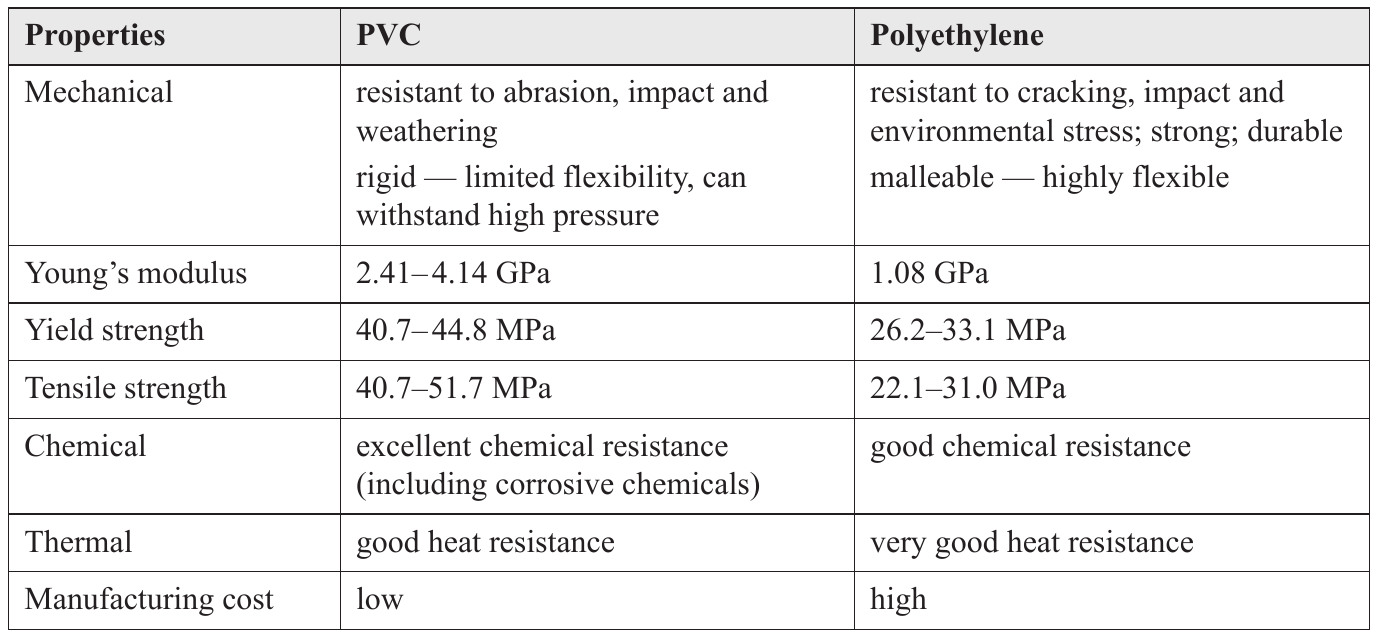
Analyse the information in the table to determine whether polyvinyl chloride (PVC) or polyethylene is the most suitable material for wastewater pipes in the home. Justify your response with four properties from the table.
The materials are out of scope for 2026. The method is not.
Four properties from the table earn four marks, and the decision earns the fifth. These are the marking-guide dot points, each described “appropriately using wording indicating” the comparison:
The response describes…
The move
that PVC has greater chemical resistance than polyethylene [1 mark]
Property one, stated comparatively
that polyethylene has better thermal properties so is more heat resistant than PVC, but this is not an important property for this application [1 mark]
Property two, which argues against the answer
that PVC is more rigid or less flexible than polyethylene [1 mark]
Property three
that PVC is cheaper than polyethylene [1 mark]
Property four
and determines that PVC would be most suitable for wastewater pipes in the home [1 mark]
The decision
The notes also accept PVC’s higher yield strength, tensile strength or Young’s modulus, or the values themselves.
A property that argues against your choice still earns a mark. The second dot point credits noticing that polyethylene wins on heat resistance, as long as you say why that does not matter here. Analysing the table means using all of it.
The decision mark depends on the right decision. The notes say properties favouring polyethylene may be credited, “however, more properties favour PVC. Therefore, the response must determine that PVC is most suitable to be awarded that mark.”
Answer
PVC, justified with four comparative properties from the table
How you earn the marks on an application question
2024 Question 13 asked for two industrial applications of high carbon steel and two mechanical properties for each. The same pattern fits a plastics question. These are its dot points:
The response:
Marks
identifies one suitable industrial application for the material
1
describes appropriately a mechanical property that makes it suitable for the application
1
describes appropriately a second mechanical property that makes it suitable for the application
1
repeats all three for a second application
3
Describe means property plus consequence
“High impact resistance” is a label. “High impact resistance, so a hard hat absorbs the force of a falling object without cracking” is a description tied to the application.
Not: PA6 has high abrasion resistance.
Yes: PA6 has high abrasion resistance, so the gear teeth survive continuous meshing without wearing away.
Every marking guide that asks you to describe or justify rewards the second version. The pattern is the one used for steels: the property, what it allows, in this application.
Part 6
Earning the marks on plastics
Past QCAA questions: engineering plastics
Question
Marks / band
What it tests
2020 Q4 (MC)
1 · SF
Plastic for high-voltage transmission cable insulation. Keyed polyethylene. Out of scope.
Toughest of four materials from stress–strain curves. The materials are unnamed, so it is still valid.
2022 Q2 (MC)
1 · SF
Plastic for waste water drainage pipe. Keyed PVC. Out of scope.
2023 Q1 (MC)
1 · SF
Plastic for a laboratory beaker. Out of scope.
2024 Q4 (MC)
1 · SF
Plastic for a medical screw. Published answer PLA. Out of scope.
2025 Q5 (MC)
1 · SF
An application for PLA. Out of scope.
2020 Q12
4 · SF
List four properties of PLA. Out of scope.
2021 Q11
4 · SF (est.)
Sketch nylon’s stress–strain curve on the supplied axes. The marking guide credits labelling toughness (area under the curve) and Young’s modulus (stiffness), although the stem asks for the ability to “absorb and store energy”.
2022 Q17
5 · SF
Interpret a stress–strain diagram for nylon with added ENR: four mechanical properties.
Select polymers from a lettered stress–strain diagram, two features each.
2025 Q16
7 · CF (est.)
Identify an application for PP and for PE from a graph and a table, justify each with two properties, and annotate. Materials out of scope, method in scope.
Band tags are my estimates, except 2020 (QCAA published the split) and 2022 Q17 (the 2022 subject report calls it simple familiar). The other stress–strain multiple choice items are in the table in Part 4.
The recall item has been replaced by the analysis item
2020 Q12 and 2023 Q11 were four-mark list questions. Neither form has appeared since 2023. From 2024 the written plastics questions have all supplied stimulus and asked for a justified selection or application, and the marks have grown with them: 5 in 2024, then 6 and 7 in 2025.
Expect stimulus. You still need the syllabus lists to recognise what a property implies, but they are unlikely to be the whole answer.
Self-checks to run inside the question
Checkpoint
How to run it
Is there a table or graph?
If so, the justification comes from it. Quote the properties it gives.
Did I make the decision?
Compare questions want a choice as well as a comparison.
Did I use a property that argues the other way?
Noticing a property that favours the other option earns a mark if you say why it does not decide the case.
Is my property distinguishing?
All three Unit 4 plastics resist chemicals and have good or excellent electrical properties, and ABS and PC share impact. Use a property the syllabus gives to only one of them: transparency or toughness (PC), abrasion resistance, fatigue resistance or high strength (PA6), low-temperature resistance or excellent electrical insulation (ABS).
Property plus consequence?
“High abrasion resistance, so the gear teeth survive continuous meshing”. A bare label is not a description.
Right number?
Four properties means four.
Is this plastic even in Unit 4?
ABS, PC and PA6 are the Unit 4 list.
What changes for 2026
Unit 4’s plastics are ABS, polycarbonate and PA6 (nylon 6). Polycarbonate is new. Polyethylene, polypropylene, PLA and PVC are no longer in Unit 4, and PLA is not in the syllabus at all.
Because polycarbonate is new, I expect it to be examined close to the syllabus wording. Its distinguishing property is transparency, and its applications are lenses, shields and housings.
Game plan
Your game plan for engineering plastics
1Check the plastic is in Unit 4: ABS, PC or PA6.
2Find the stimulus. If there is a table or a graph, every property you use comes from it.
3Name what the job needs, then match a property that only one option has.
4Write each property with its consequence for the job, one property per mark.
5Count the marks, and state the decision in words if one is asked for.
Which plastic is most suitable for a motorcycle windscreen?
A windscreen has to be seen through. Polycarbonate is the only Unit 4 plastic the syllabus calls transparent, and windscreens appear only in its application list.
(A) ABS is the strongest distractor, because it makes helmets and hard hats, and the syllabus even lists face shields under ABS. That overlap is why this question asks about a windscreen. ABS is not transparent. (C) PA6 has the wrong property set for a windscreen. (D) Polypropylene is no longer in Unit 4, so it cannot be the answer.
State four contemporary engineering applications for polycarbonate (PC).
State wants four clear answers and no explanation. Each one earns a mark.
For example: motorcycle face shields and windscreens, safety glasses and prescription lenses, machinery guards, and automotive headlamps.
Also accept security windows, skylights, streetlamps, electrical and electronic device housings, or any other suitable response.
The response:
Marks
provides a correct contemporary engineering application for polycarbonate
1
provides a second correct application
1
provides a third correct application
1
provides a fourth correct application
1
The form copies 2023 Question 11 (four applications for ABS, 4 marks). The list item has not appeared since 2023, but polycarbonate is new, and I expect new content to be examined close to the syllabus wording.
Answer
Any four, e.g. windscreens, safety glasses, machinery guards, headlamps
Identify two industrial applications of PA6 nylon. Describe two mechanical properties of this material that make it suitable for each application.
Identify the applications and describe the properties. There are six things to give and six marks.
Application 1, gears. “PA6 has high abrasion resistance, so the teeth survive continuous meshing against another gear without wearing away. It also has good fatigue resistance, so it withstands the repeated loading of each tooth engaging without cracking.”
Application 2, bearings. “PA6 has high strength, so the bearing carries the shaft load without deforming. It also has high abrasion resistance, so it survives the shaft rubbing against it as it turns.”
The response:
Marks
identifies one suitable industrial application for PA6 nylon
1
describes appropriately a mechanical property that makes it suitable for the application
1
describes appropriately a second mechanical property that makes it suitable for the application
1
identifies a second suitable industrial application
1
describes appropriately a mechanical property that makes it suitable for the application
1
describes appropriately a second mechanical property
1
The question asks for mechanical properties, so use high strength, high abrasion resistance or good fatigue resistance. Good thermal, chemical and electrical properties are not mechanical, and they are shared with the other plastics anyway.
Applications may include gears, rollers, guides, bearings, wear pads, wheels, medical implants, electrical connectors and fishing line. The dot points copy 2024 Question 13 with the material changed.
Answer
e.g. gears (abrasion, fatigue) and bearings (strength, abrasion)
An engineer must select a material for the outer housing of a hand-held power tool used on building sites. The housing must survive being dropped onto concrete, insulate the user from the motor, and hold its shape in direct sun.
Compare ABS and polycarbonate for this application, and determine which is more suitable. Justify your response with reference to four relevant material properties.
This follows the 2024 Question 12 shape, four properties plus a decision, with the fifth mark for the decision itself. Both materials are defensible, so the marks are in the quality of the justification. Say which property decides it and why.
A response that would earn all five marks:
“ABS has high impact resistance, so the housing survives being dropped onto concrete without cracking. Polycarbonate has high impact strength as well, so impact does not separate them.”
“ABS has excellent electrical insulation, where polycarbonate has good electrical properties, so ABS gives the user better protection from the motor.”
“Both have high heat resistance, so both cope with direct sun. Polycarbonate has high dimensional stability against ABS’s good dimensional stability, so polycarbonate holds its shape slightly better, but both are adequate for a housing in the sun.”
“ABS is more suitable, because its excellent electrical insulation most directly meets the user-safety requirement, and the syllabus lists power tool housings among its applications. Polycarbonate’s distinguishing property, transparency, is not needed here.”
Predicted criteria: the response
Marks
describes impact resistance comparatively and links it to surviving a drop
1
describes electrical insulation comparatively and links it to protecting the user
1
describes heat resistance and links it to holding shape in direct sun
1
describes dimensional stability comparatively, recognising that it favours PC but does not decide the case
1
determines that ABS is more suitable, with a reason naming the property that decides it
1
Treat the decision mark as conditional on the reason naming the deciding property. Polycarbonate can be accepted if the response argues impact strength and dimensional stability are decisive and acknowledges that transparency is not needed, but ABS is the stronger answer because the syllabus lists power tool housings under ABS.
A response that says “ABS is tougher” without saying what the toughness is for loses the mark. The syllabus gives toughness to PC only, and every property needs a consequence attached to the stated requirement.
Answer
ABS, decided by its excellent electrical insulation
Sources: QCAA Engineering external assessment question and response books, multiple choice question books and marking guides 2020 to 2025. Engineering 2025 v1.4 general senior syllabus, Unit 4 Topic 3 and Unit 2. QCAA Engineering 2025 general senior syllabus revision report (July 2024). QCAA Engineering subject reports 2020 to 2025. Scope changes checked by full-text search of the revised syllabus and against the revision report.