
Question 18
An effort of 120 N is applied at the end of the lever arm of a screw jack for 180 seconds to raise an object 150 mm.
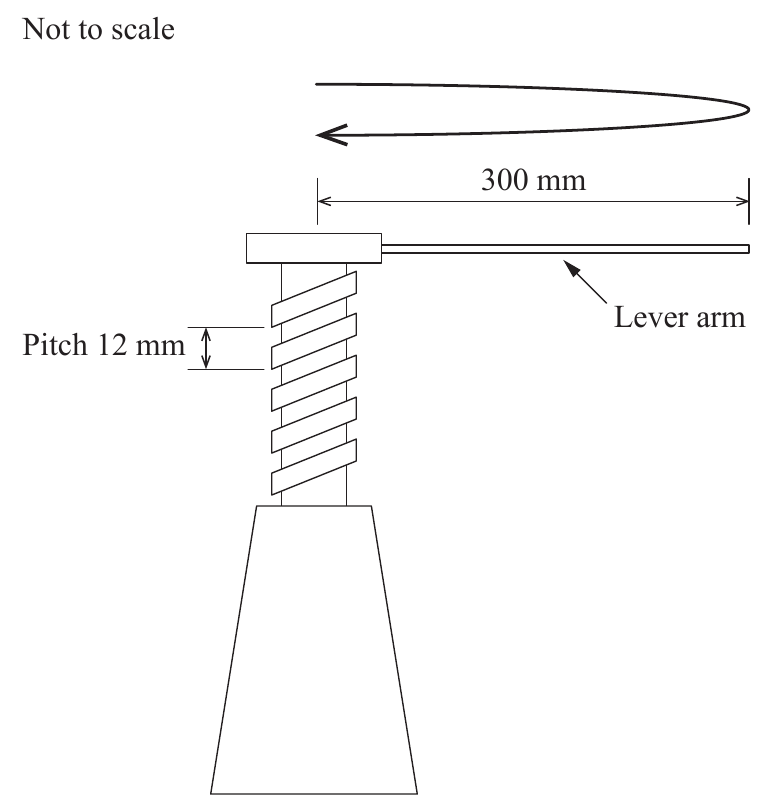
The object rises 150 mm, but the end of the lever arm travels 23.56 m
This is QCAA’s screw jack set moving. Each turn of the lever arm lifts the head one pitch. Watch the two bars at the bottom, which share one scale.
The 120 N is applied at the end of the arm, so the work done on the lever arm uses the arm’s 23.56 m. The 150 mm only tells you how many turns there were.
Change the pitch, the lever arm and the lift, then try the slips
The ruler on the right of the figure splits the lift into one tick per turn. The question is 120 N, a 300 mm arm, a 12 mm pitch, a 150 mm lift and 180 s.
This is the question. 12.5 turns of a 0.3 m radius move the effort 23.56 m, so the work done on the lever arm is 2827.2 J and the power input is 15.71 W.
A finer pitch or a longer arm makes the effort travel further for the same lift. With the same 120 N, that means more work on the lever arm, even though the object rises the same height.
The 300 mm is measured from the centre of the screw to the end of the arm, so it is a radius. Using it as a diameter halves the distance and the work. The guide accepts $12.5\times\pi\times\text{diameter}$, but only with the diameter, 0.6 m.
Leaving the radius in millimetres makes the work a thousand times too big. Converting it to 0.3 m is a mark of its own in the guide.
The 120 N does not act on the object, and it does not move only 150 mm. A force and a distance must come from the same side of the machine. The effort’s distance is the long one.
Work through the solution one mark at a time
Try each step yourself before you reveal it.
One full turn of the screw raises the object by one pitch. Count the pitches in the lift.
$$\text{number of rotations}=\frac{150}{12}=12.5$$
Both lengths are in millimetres, so the units cancel and nothing needs converting yet.
Marker: demonstrates appropriate mathematical reasoning to determine correct number of rotations
The 300 mm runs from the centre line of the screw to the end of the arm, so it is the radius of the circle the effort travels. Convert it before it goes into a distance in metres.
$$r=300\text{ mm}=0.3\text{ m}$$
This line is worth a mark by itself. Write it down even though it feels too obvious to bother with.
Marker: recognises that radius needs to be converted from mm to metres
Each turn moves the end of the arm one circumference, $2\pi r$.
$$\begin{aligned}d_E&=12.5\times2\pi r\\&=12.5\times2\times\pi\times0.3\\&=23.56\text{ m}\end{aligned}$$
The guide also accepts $12.5\times\pi\times\text{diameter}$, with the diameter 0.6 m. Either way it is the same 23.56 m.
Marker: calculates the distance travelled by the effort. “Accept distance range from 23.56–23.6 m inclusive.”
The work done on the lever arm is the effort times the distance the effort moves.
$$\begin{aligned}W&=F_E\,d_E=120\times23.56\\&=2827.2\text{ J}\end{aligned}$$
Carrying every digit gives 2827.43 J, also inside the range. Keep the decimal. Rounded to a whole unit, 2827 J sits just under the bottom of the accepted range.
Marker: calculates work done. “Accept work done range from 2827.2–2832 J inclusive.”
The effort is applied for 180 seconds, so that is the time for the power input.
$$P=\frac{W}{t}=\frac{2827.2}{180}=15.71\text{ W}$$
The stem asks for no precision. The guide’s front page says final answers go to the nearest whole unit unless the question says otherwise, which would be 16 W, yet the accepted range for this question stops at 15.73 W. Write 15.71 W first and round after it, so the marker sees a value inside the range.
Marker: calculates power input. “Accept power range from 15.7–15.73 W inclusive.”
Each phrase of the question gave you something
The 2024 subject report praised responses that set out the reasoning for the effort distance before using it, and it showed two valid methods for the work done and the power. Its general advice is to leave rounding until the end of a multi-step calculation, so your answers stay inside the tolerance ranges.
QCAA did not publish a band for this question. It reads as simple familiar because it is the standard screw chain: turns from the pitch, distance from the circumference, then $W=Fs$ and $P=W/t$, with every number printed on the diagram. The 2026 formula book now gives the screw’s VR as circumference over pitch, $\tfrac{2\pi\times0.3}{0.012}=157.08$, which is the same idea in one line.
If I had to guess where you might lose marks, it would be pairing the 120 N with the 150 mm and getting 18 J. The effort never moves only 150 mm. The other trap is treating the 300 mm as a diameter, which halves everything that follows.
Only mark this done when you could do it without help. Reading the solution does not count.
Question wording, any figures and marking-guide steps are from the 2024 QCAA Engineering external assessment, © State of Queensland (QCAA) 2024, licensed under CC BY 4.0, and have been adapted, except where a third-party source is named. Tangent Tuition is not affiliated with the QCAA.
Spot a mistake on this page? Report it