
Question 10
A 15 N force is required to raise a box a distance of 12 m using the simple pulley system shown. Assume the friction in the rope is negligible.
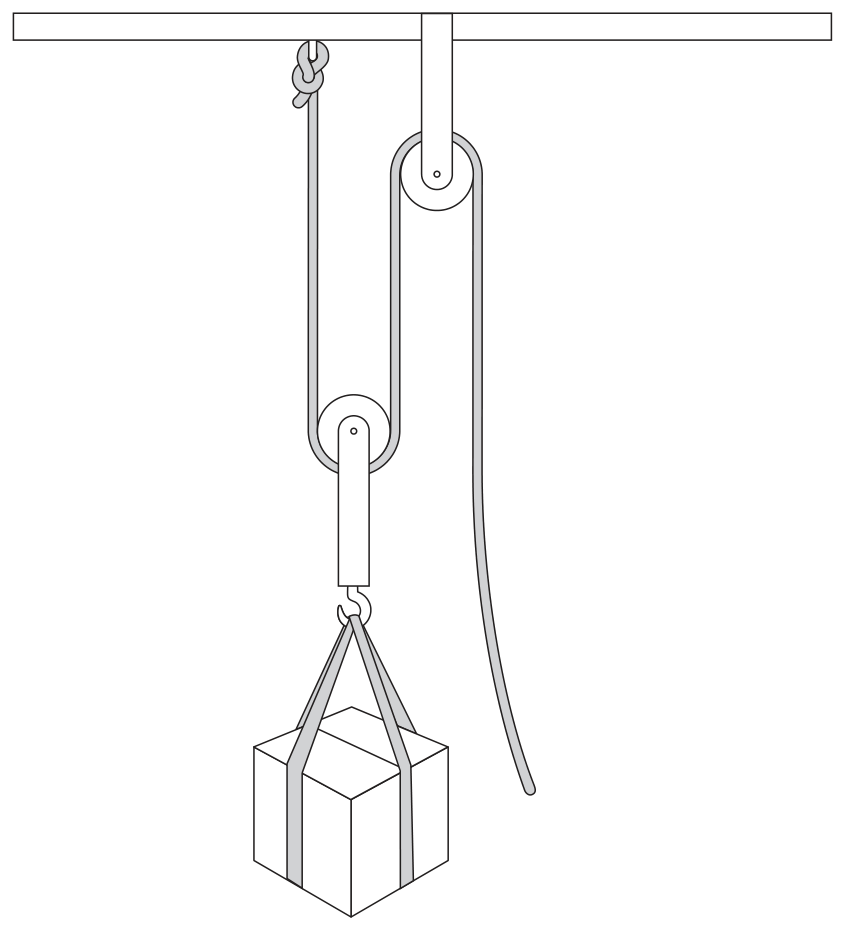
What is the work done to raise the box 12 m?
Not quite. No force times distance in this question comes to 3 J. Work is a force multiplied by a distance, and even 15 N times 12 m is already 180 J. In 2024, 1.4% of Queensland students chose (A).
Not quite. $15\times12\div2=90$ divides by the velocity ratio instead of multiplying. The rope end moves further than the box, $2\times12=24$ m, never less. In 2024, 17.6% of Queensland students chose (B).
Not quite. $15\times12=180$ is the trap most students fell into. The 15 N acts on the rope end, and the rope end moves 24 m, twice as far as the box. Pair each force with the distance that same force moves. In 2024, 58.1% of Queensland students chose (C).
That is it. Step through the hints below to see why. In 2024, 22.5% of Queensland students chose (D).
Draw a boundary around the moving pulley and the box. Two strands of rope cross it: the one knotted to the ceiling and the one running up to the fixed pulley. The free end in your hand does not hold up the box.
To raise the box 12 m, both supporting strands shorten by 12 m, so you pull 24 m of rope through.
Work is a force times the distance that same force moves, $W=Fs$. The 15 N is applied to the rope end, and the rope end moves 24 m.
Multiplying the 15 N by the 12 m the box rises takes a force from one end of the rope and a distance from the other. That is (C).
Friction is negligible, so $\text{MA}=\text{VR}=2$ and the pulleys turn the 15 N effort into 30 N on the box. Work it out from the box end.
Both ends give 360 J, because an ideal machine puts out the same work it takes in. The pulleys halve the force and double the distance.
Two strands hold up the moving pulley, so the rope end moves twice as far as the box. Multiply the 15 N by the 24 m it actually moves. The box end gives the same answer, 30 N times 12 m.
The most common wrong answer was (C), which drew 58.1% of students against 22.5% for the key. It is $W=Fs$ with the two numbers in the stem, the 15 N effort and the 12 m the box rises. No other multiple choice question from 2021 to 2025 had a smaller share of correct answers.
Only mark this done when you could do it without help. Reading the solution does not count.
Question wording and any figures are from the 2024 QCAA Engineering external assessment, © State of Queensland (QCAA) 2024, licensed under CC BY 4.0, and have been adapted, except where a third-party source is named. Tangent Tuition is not affiliated with the QCAA.
Spot a mistake on this page? Report it