
Question 8
A 45 kg box is pulled up an incline as shown.
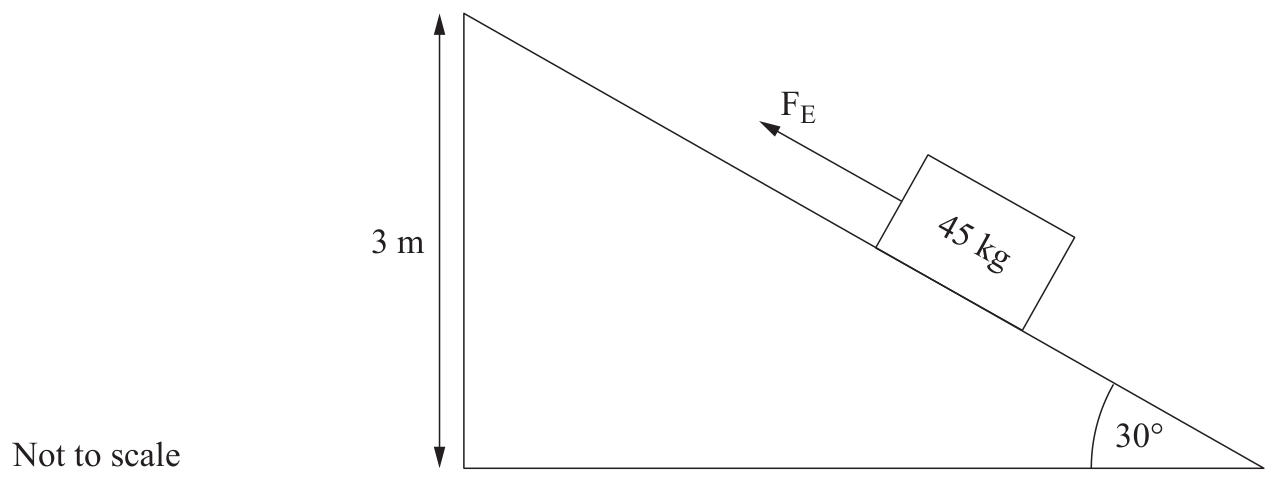
If the system is 80% efficient and the velocity ratio is 2, what force is required to move the box?
Not quite. 84 N is what you get from $45\times3\div1.6$, the mass times the height divided by the MA. A mass times a height is not a force. The load is the weight, $mg=441\text{ N}$. In 2023, 5.0% of Queensland students chose (A).
Not quite. $441\div2=220.5\text{ N}$ is the effort for a perfect incline with no friction. This one is 80% efficient, so you divide by the MA, $0.8\times2=1.6$, and need more effort. In 2023, 23.9% of Queensland students chose (B).
That is it. Step through the hints below to see why. In 2023, 60.3% of Queensland students chose (C).
Not quite. 441 N is the full weight, the force to lift the box straight up with no machine at all. The incline is there to reduce that force. In 2023, 9.9% of Queensland students chose (D).
The incline is the machine. The box rises 3 m while the effort pulls it $3\div\sin30^\circ=6\text{ m}$ along the slope, which is where the stem’s VR of 2 comes from. The load is the weight the machine lifts.
$$F_L=mg=45\times9.8=441\text{ N}$$
Do not resolve the weight. $mg\sin30^\circ$ already has the slope in it, because $\sin30^\circ=3\div6=1\div\text{VR}$.
The formula book gives $\eta=\frac{\text{MA}}{\text{VR}}\times100\%$. Rearrange it with $\eta$ as a decimal.
$$\text{MA}=\eta\times\text{VR}=0.80\times2=1.6$$
The MA is below the VR because friction on the slope wastes some of the effort.
Rearrange $\text{MA}=\frac{F_L}{F_E}$ for the effort.
$$\begin{aligned}F_E&=\frac{F_L}{\text{MA}}=\frac{441}{1.6}\\[10pt]&=275.63\text{ N}\approx276\text{ N}\end{aligned}$$
Check that your answer sits between the perfect-machine effort, 220.5 N, and the full weight, 441 N. Only (C) does.
$$\begin{aligned}F_E&=\frac{mg}{\eta\times\text{VR}}\\[10pt]&=\frac{45\times9.8}{0.80\times2}\\[10pt]&=275.63\text{ N}\approx276\text{ N}\end{aligned}$$
The load is the full weight, the MA comes from the efficiency and the VR, and the effort is the load over the MA.
The most common wrong answer was (B), the effort for a perfect machine. It drops the 80%. Do not resolve the weight along the slope as well. The VR of 2 already accounts for the slope, so the QCAA key of 276 N is correct.
Only mark this done when you could do it without help. Reading the solution does not count.
Question wording and any figures are from the 2023 QCAA Engineering external assessment, © State of Queensland (QCAA) 2023, licensed under CC BY 4.0, and have been adapted, except where a third-party source is named. Tangent Tuition is not affiliated with the QCAA.
Spot a mistake on this page? Report it