
Question 6
The graph shows the stress–strain curves of four different materials.
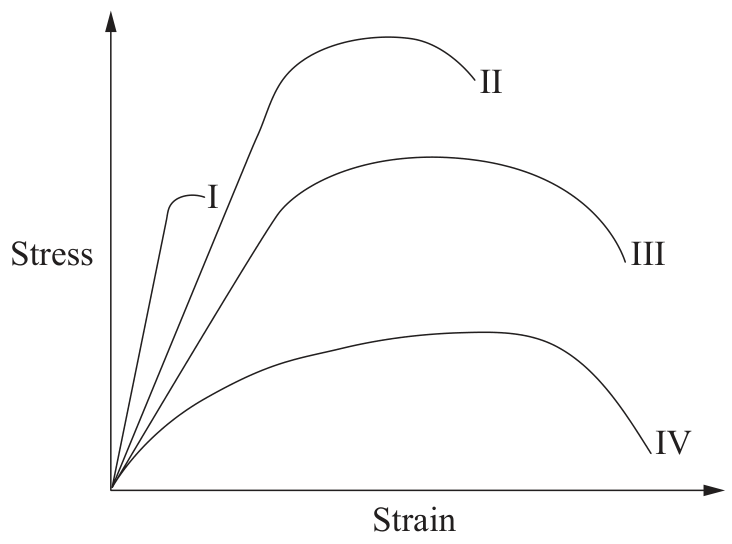
Which material can best withstand deformation within its proportional limit?
That is it. Step through the hints below to see why. QCAA accepted (B) as well. The stem can be read two ways. Read as “resists deformation”, it asks for the stiffest material, and I has the steepest straight line. In 2023, 16.4% of Queensland students chose (A).
That is it. Step through the hints below to see why. QCAA accepted (A) as well. The stem can be read two ways. Read as “takes the most load before leaving its straight line”, it asks for the highest proportional limit, and that is II. In 2023, 44.8% of Queensland students chose (B).
Not quite. III loses on both readings. Its straight line is shallower than I’s and II’s, so it is less stiff, and it leaves the line at a lower stress than II. III wins on area under the whole curve, which is toughness, and toughness includes plastic deformation. In 2023, 21.8% of Queensland students chose (C).
Not quite. IV bends away from a straight line almost at once, so it has the lowest proportional limit and the shallowest start of the four. It loses on both readings. In 2023, 16.7% of Queensland students chose (D).
“Within its proportional limit” points you at the straight line from the origin to where each curve first bends. Ignore everything after that.
“Withstand deformation” then has two fair readings. It can mean resist being deformed, which is stiffness. It can mean put up with deformation, which is how much stress the straight line carries before it ends.
Stiffness is Young’s modulus, the slope of the straight line. I is the steepest, about twice as steep as II on QCAA’s figure.
$$E=\frac{\sigma}{\varepsilon}\qquad E_{\text{I}}\approx2.0\times E_{\text{II}}$$
The 2021 subject report described Young’s modulus as “the ability to withstand elastic deformation within the material’s proportional limit”. That is almost the stem word for word, and it gives (A).
II keeps its straight line going to the highest stress of the four, about 88% of the top peak against about 62% for I. It also stretches nearly three times as far as I before it bends, so it stores far more elastic energy.
Read that way, II withstands the most before it leaves its proportional limit, and that gives (B). The scrutiny panel determined that there were two keys for this item, so both earned the mark.
This question has two accepted keys. The marking guide lists the answer as “A and B”, with a footnote: “The multiple-choice scrutiny panel reviewed the question and determined that there were two keys for this item.” Either answer earned the mark.
(A) reads “withstand deformation” as resist it. I has the steepest straight line, so it has the highest Young’s modulus and is the stiffest. (B) reads it as carry the most before the proportional limit. II stays straight up to the highest stress of the four.
More students chose (B) than any other option, so the double key mattered. The most common answer that earned nothing was (C), III, which wins on area under the whole curve. Area is toughness, and it counts plastic deformation the stem told you to leave out. If a stem can be read two ways in the exam, answer the reading that matches the QCAA definition, here stiffness.
Only mark this done when you could do it without help. Reading the solution does not count.
Question wording and any figures are from the 2023 QCAA Engineering external assessment, © State of Queensland (QCAA) 2023, licensed under CC BY 4.0, and have been adapted, except where a third-party source is named. Tangent Tuition is not affiliated with the QCAA.
Spot a mistake on this page? Report it