
Question 12
Explain how the gearing system on a bicycle provides a mechanical advantage to a cyclist moving up an incline, and the system’s effect on the work done on the pedals. Sketch the mechanical components involved to support your response.
[5 marks]
A low gear makes the pedals turn further for a smaller force, and the work stays the same
The same bicycle on the same hill in two gears, drawn to scale. The tooth counts are illustrative. Both rear gears make one full turn. Count the turns of the orange pedal.
The chain moves the same number of teeth past both gears. A small pedal gear has fewer teeth, so it has to turn more times to move the chain one turn of a big rear gear. More pedal distance for a smaller force means the same work done on the pedals.
Set up the sketch, write the four sentences and see which marks they earn
Four of the five marks are for the wording, one statement each. Set up the sketch, then pick the sentence you would write in each row. Each pick tells you whether it earns its mark and why, and the checklist ticks the marking guide criteria your answer meets.
Your sentences appear here as you pick them. To climb, the cyclist changes to a larger pedal gear and a smaller rear wheel gear. To climb, the cyclist uses a pedal gear that is smaller, with fewer teeth, than the rear wheel gear. The gears give the cyclist extra energy to get up the hill. The smaller the pedal gear compared with the rear wheel gear, the higher the mechanical advantage, so less force is needed to push the pedals. The gearing gives the cyclist a mechanical advantage. Because the pedal gear is smaller, the pedals must make more rotations to move the bicycle the same distance. The pedals turn fewer times, so the cyclist reaches the top sooner. Less work is done on the pedals because the force is smaller. More work is done on the pedals because they turn more times. The work done on the pedals stays the same, because the smaller force moves through a greater distance, $W=Fs$.
Change the sketch or pick a sentence. The note here explains why it earns a mark or misses it.
Five of five. Four statements and one sketch, which is the split the 2023 guide used.
No mark. That is a high gear, for speed on the flat. For a hill you want the opposite, with the pedal gear smaller than the rear wheel gear.
Earns the mark. The gear sizes, compared the right way round. The guide also accepts radius, diameter or the reverse wording.
No mark. Gears cannot create energy. The mark is for less force being needed to move the pedals.
Earns the mark. It says what the mechanical advantage does for the cyclist, in the words of the criterion.
No mark. This repeats the question without explaining it. The mark is for stating that less force is needed to move the pedals.
Earns the mark. More pedal rotations for the same distance. This is the price of the smaller force.
No mark. The opposite. A smaller pedal gear has fewer teeth, so it has to turn more times to move the chain the same length.
No mark. Force alone is not work. $W=Fs$, and the pedal distance goes up by the same factor that the force goes down.
No mark. The extra turns are matched by the smaller force. For the same climb the work is the same.
Earns the mark. Work stays the same, with the reason. This answers the second half of the stem.
Work through the solution one mark at a time
Try each step yourself before you reveal it. The guide opens with “appropriately explains the mechanical advantage, using wording that indicates”, then gives one mark for each of four statements and one for the sketch.
Say which gear is smaller. For a hill the pedal gear is smaller than the rear wheel gear.
“The gear attached to the pedal arm that the cyclist pushes will need to be much smaller and have fewer teeth than the gear attached to the rear wheel.”
The notes accept the comparison in teeth, radius or diameter, and the reverse wording, that the rear wheel gear is larger than the pedal gear.
Marker: the pedal gear would be smaller than the rear wheel gear
Now say what the mechanical advantage does for the cyclist.
“The smaller the pedal gear compared to the rear wheel gear, the higher the mechanical advantage and the easier it is for the cyclist to turn the pedals.”
The gear pair multiplies the turning effect by rear teeth over pedal teeth. In the animation’s low gear that is $32\div24=1.33$, against $16\div48=0.33$ in the high gear, which is why the force on the pedals drops to a quarter.
Marker: less force is required to move the pedals
The price of the smaller force is more turns of the pedals for the same distance travelled.
“As the gear attached to the pedals has a smaller circumference than the gear attached to the rear wheel it will need to make more rotations to get the bicycle to travel a greater distance.”
The sample’s “to travel a greater distance” is loose. Write it as more pedal rotations to move the bicycle the same distance, which is what the criterion means.
Marker: more rotations of the pedals will be required
This is the second half of the stem. A smaller force over a greater distance does the same work.
$$W=Fs$$
“However, the work done by the cyclist remains the same, because while the force required to move the pedals will be less, the distance moved by the pedals will be more.”
Marker: work done remains the same
Draw a small pedal gear linked by the chain to a larger rear wheel gear, and label them. This is QCAA’s sample sketch. It labels the pedal gear and the pedal, which is how the marker knows which circle is which.
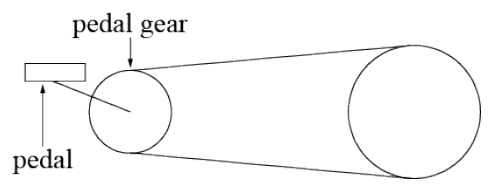
Marker: provides an appropriate sketch, including the larger rear wheel gear linked to the smaller pedal gear
Each phrase of the question gave you something
The 2023 subject report says effective responses explained that less force was needed to move the pedals, said clearly that the work done stayed the same, and gave an annotated sketch that showed the large rear wheel gear linked to the smaller pedal gear.
A machine you ride, four plain statements and a two-circle sketch. QCAA did not publish a band for this question, but it reads as simple familiar because it is the explain-with-a-sketch shape that the 2022 subject report called simple familiar. For 2026 the gear ratio formulas are in the formula book and gears are still a named dot point. The definitions of MA and VR are listed as reduced, which matters less here because the marks were for what the gearing does.
If I had to guess where you might lose marks, it would be the work. It feels natural to say an easier gear means less work, and that sentence loses the mark. The other loss is folding three ideas into one sentence about “a higher mechanical advantage”. The guide wants the gear sizes, the force, the rotations and the work said separately, so give each its own sentence.
Only mark this done when you could do it without help. Reading the solution does not count.
Question wording, any figures and marking-guide steps are from the 2023 QCAA Engineering external assessment, © State of Queensland (QCAA) 2023, licensed under CC BY 4.0, and have been adapted, except where a third-party source is named. Tangent Tuition is not affiliated with the QCAA.
Spot a mistake on this page? Report it