
Question 4
A scissor jack is used to lift a 1.5 tonne vehicle.
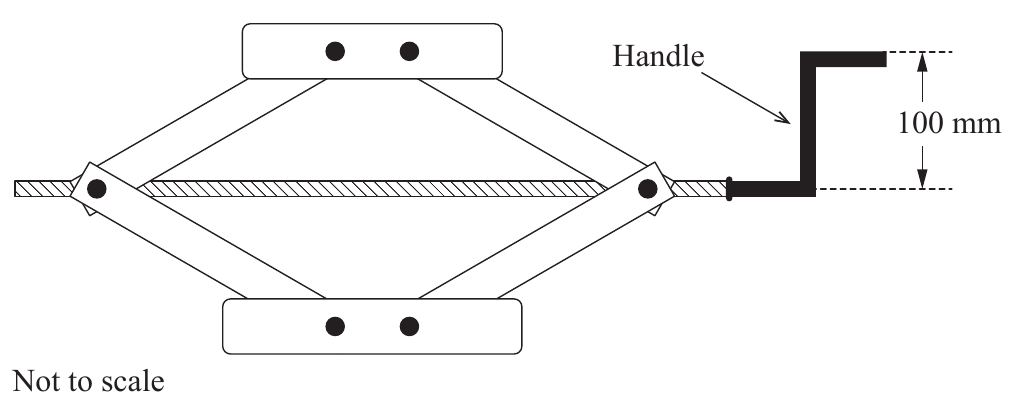
If the 2.5 mm pitch of the central screw allows the vehicle to be raised 5 mm during one revolution of the handle, the velocity ratio of the jack is
Not quite. 40 is $100\div2.5$. It leaves out the $2\pi$, so it uses the handle’s radius instead of the distance your hand travels, and it uses the pitch instead of the 5 mm rise. In 2022, 26.4% of Queensland students chose (A).
That is it. Step through the hints below to see why. In 2022, 41.8% of Queensland students chose (B).
Not quite. 251 is $2\pi\times100\div2.5$, which divides by the screw pitch. The question says the vehicle rises 5 mm for each turn of the handle, and that rise is the load distance. In 2022, 25.0% of Queensland students chose (C).
Not quite. 300 is $1500\div5$, the vehicle’s mass in kilograms over the rise. A VR is a ratio of two distances, and the mass plays no part in it. In 2022, 6.1% of Queensland students chose (D).
The 100 mm on the diagram runs from the screw’s axis to the grip, so it is the radius of the circle your hand travels. In one revolution your hand goes once round it.
$$\begin{aligned}d_E&=2\pi r=2\pi\times100\\[6pt]&=628.32\text{ mm}\end{aligned}$$
Using the 100 mm on its own, with no $2\pi$, is the first half of (A).
The question tells you the vehicle rises 5 mm during one revolution. That is the load distance. The 2.5 mm pitch describes the thread on the screw, not the lift of the vehicle.
$$d_L=5\text{ mm per revolution}$$
When a stem states how far the load moves per turn, use that figure in place of the pitch. Dividing by 2.5 gives (C).
Divide the two distances for one revolution.
$$\begin{aligned}\text{VR}&=\frac{2\pi r}{\text{rise per turn}}\\[6pt]&=\frac{628.32}{5}\\[6pt]&=125.66\approx126\end{aligned}$$
The 2026 formula book now prints VR for screws as circumference ÷ pitch. The 2022 paper was sat without it. Here the stated 5 mm rise takes the place of the pitch.
$$\text{VR}=\frac{2\pi\times100}{5}=125.66\approx126$$
Your hand travels 628 mm for every 5 mm the vehicle rises, so the VR is 126:1.
The most common wrong answer was (A), from dropping the $2\pi$ and dividing the radius by the pitch. Fewer than half the state chose the key, so this is a question worth drilling.
Only mark this done when you could do it without help. Reading the solution does not count.
Question wording and any figures are from the 2022 QCAA Engineering external assessment, © State of Queensland (QCAA) 2022, licensed under CC BY 4.0, and have been adapted, except where a third-party source is named. Tangent Tuition is not affiliated with the QCAA.
Spot a mistake on this page? Report it