
Question 19
A 2 kg package is moving at 5 m/s in the direction of the arrow, as shown. The package drops into a 250 g carton moving in the same direction at 2 m/s on a second conveyor.
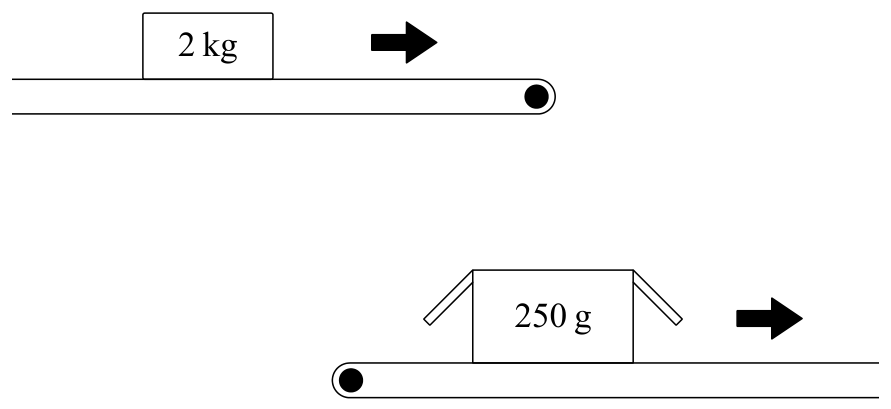
Ride along with the belt and the package arrives at 3 m/s, then friction slows it to a stop
The view switches from the ground to the lower belt, because the question wants the distance along the belt. The slide is shown in slow motion. The forces are drawn to scale, and so is the 1.53 m slide.
Friction acts only while the carton slides over the belt. Once their speeds match, the carton rides along with no friction at all.
Change the speeds, the package and the belt surface
Part b) is set up here. Change the package speed, the belt speed, the package mass and the coefficient of kinetic friction, and watch the slide. The question is 5 m/s, 2 m/s, 2 kg and 0.3.
This is the question. Relative to the belt the pair starts at 3 m/s, friction slows it at 2.94 m s⁻², and it slides 1.53 m, which is 1531 mm.
The forces changed but the slide did not. A heavier package presses harder on the belt, so friction grows in the same proportion as the mass it has to slow. The deceleration is always $\mu_k g$.
Only the speed difference and the coefficient matter. The distance goes with the square of the speed difference, so halving it quarters the slide. A rougher belt stops the carton sooner.
Work through the solution one mark at a time
Try each step yourself before you reveal it.
Draw the carton on its own. The package pushes it forwards with a force $F$, static friction $F_f$ holds it back, and the normal force balances the weight.
QCAA’s diagram showed $F_N$, $mg$ and $F_f$ and left out the push. Including it does no harm and makes the balance obvious.
Marker: provides an appropriate free-body diagram. QCAA’s note: “An appropriate free-body diagram includes correctly applied force vectors for FN, mg and Ff.”
Convert 250 g to kilograms first. The belt is horizontal, so the normal force is the whole weight.
$$F_N=mg=0.25\times9.8=2.45\text{ N}$$
The guide uses the carton’s weight alone here, as if the package shoves the carton before its weight rests on the belt. Follow that reading in part a).
Marker: provides correct working to give normal force acting on the box
“Just causes the carton to begin sliding” means the push equals the maximum static friction.
$$\begin{aligned}F&=F_f=\mu_s F_N\\&=0.4\times2.45=0.98\text{ N}\end{aligned}$$
Nearest whole unit, so 0.98 N becomes 1 N. Write the unit.
Marker: provides correct working to give correct answer to the nearest whole unit with correct unit provided. QCAA’s note: “Allow FT error for incorrect FN in determining the answer.”
Now the package is inside, so draw the carton and package together. Friction points backwards because the pair slides forwards over the belt. Show the distance you are finding and the final state.
Marker: provides an appropriate free-body diagram. QCAA’s note: “An appropriate free-body diagram includes correctly applied force vectors for FN, mg, Ff and evidence of acknowledging distance moved.”
State the starting speed relative to the belt, then the normal force for both masses.
$$\begin{aligned}&u=5-2=3\text{ m/s}\\&m=2+0.25=2.25\text{ kg}\end{aligned}$$
$$F_N=2.25\times9.8=22.05\text{ N}$$
The guide simply subtracts the speeds. Treating the landing as a collision that shares momentum would give a slower start and a shorter slide, about 1209 mm, but momentum is not in the Engineering syllabus. Use the 3 m/s. The guide adds that other appropriate approaches earned full marks.
Marker: provides correct working to give correct normal force acting on the box and carton
The carton is sliding, so use the coefficient of kinetic friction.
$$\begin{aligned}F_f&=\mu_k F_N\\&=0.30\times22.05=6.62\text{ N}\end{aligned}$$
Marker: provides correct working to give correct force of kinetic friction. QCAA’s note: “Correct force of kinetic friction range: 6.615 to 6.62 N”.
Friction is the only horizontal force, so it is the net force. Divide by the total mass.
$$a=\frac{F}{m}=\frac{6.62}{2.25}=2.94\text{ m s}^{-2}$$
This is a deceleration. Check it: $\mu_k g=0.3\times9.8=2.94$.
Marker: provides correct working to give correct deceleration. QCAA’s note: “Correct deceleration range: 2.94 to 2.942 222 222 m/s².”
You know $u=3$, $v=0$ and $a=-2.94$, and there is no time, so rearrange $v^2=u^2+2as$.
$$\begin{aligned}s&=\frac{v^2-u^2}{2a}\\&=\frac{0-3^2}{2\times-2.94}\\&=1.5306\text{ m}=1530.6\text{ mm}\end{aligned}$$
QCAA’s sample prints 1530 mm, because it rounded to 1.53 m before converting. Convert first, then round to the nearest millimetre, as the question asks.
Marker: provides correct working to give correct answer to the nearest whole unit with correct unit provided. QCAA’s notes: “Allow FT error for incorrect: … initial velocity in determining the answer” and “Additional appropriate responses to be awarded full marks.”
Each phrase of the question gave you something
The 2021 subject report said the strong responses drew appropriate free-body diagrams and set out every step in order: the static friction to overcome, the normal force on the carton and package, the kinetic friction and deceleration, then the distance to the nearest millimetre. It also noted that students took different routes and that other correct approaches were credited.
The 2021 subject report calls it complex unfamiliar. The situation is new, two moving surfaces instead of one slope, and you have to decide for yourself that the starting speed is the difference between the two speeds and that the normal force changes once the package is inside. Static friction in part a) and kinetic friction in part b) use different masses as well as different coefficients.
If I had to guess where you might lose marks, it would be the units at the end. The answer is wanted in millimetres, and 1.53 m is the right number in the wrong unit. The other trap is starting part b) at 5 m/s. That gives 4252 mm, and follow-through only saves the earlier marks.
Only mark this done when you could do it without help. Reading the solution does not count.
Question wording, any figures and marking-guide steps are from the 2021 QCAA Engineering external assessment, © State of Queensland (QCAA) 2021, licensed under CC BY 4.0, and have been adapted, except where a third-party source is named. Tangent Tuition is not affiliated with the QCAA.
Spot a mistake on this page? Report it