
Question 13
Explain how the microstructure of a 3% carbon cast iron changes during cooling between the eutectic and eutectoid temperatures. Annotate the diagram to identify the material’s approximate location and the eutectic and eutectoid temperatures to support your explanation.

Between A and B the austenite gives up carbon as cementite, then turns to pearlite at B
This is QCAA’s diagram. Follow the orange point down the 3% carbon line, the blue tie line that tracks the austenite, and the microscope view in the empty corner of the diagram.
Two temperatures carry the story. At the eutectic, A, the last liquid freezes into ledeburite. At the eutectoid, B, the austenite that is left turns into pearlite. In between, austenite holds less carbon as it cools, so cementite grows out of it.
Cool the alloy one stage at a time and annotate the diagram
Step the 3% carbon alloy down through each stage and watch the microstructure. Three stages carry the explanation marks, and the two annotation buttons carry the diagram marks. Cast iron is out of the 2026 syllabus, but what happens to the austenite here still happens in a high-carbon steel.
Work through the solution one mark at a time
Three marks are for the explanation, one event each, and two are for the annotated diagram. Try each step yourself before you reveal it.
Start at the eutectic, A. Austenite dendrites have already grown on the way down from the liquidus, and the liquid that is left has reached 4.3% carbon. At A it freezes at one temperature into a mixture of austenite and cementite.
QCAA’s sample: “When the eutectic temperature of approximately 1147º C is reached at point A, the residual liquid forms the eutectic mixture of austenite and cementite along with the previously formed austenite dendrites.”
The guide also accepts the name of that mixture, ledeburite.
Marker: explains appropriately using wording indicative of upper eutectic residual liquid forms a mixture of austenite and cementite
Between A and B, austenite can hold less and less carbon. Its carbon content falls down the upper edge of the austenite field, from about 1.9% at A to 0.8% at B on QCAA’s drawing, and the carbon it loses comes out as cementite. Textbooks put the top of that edge at 2.1%.
QCAA’s sample: “As the temperature drops towards point B, carbon precipitates out of the austenite to be deposited as growing areas of eutectic cementite.”
QCAA’s wording is loose here. Cementite that comes out of solid austenite is not eutectic cementite, because the eutectic is the liquid reaction at A. Its proper name is secondary cementite. The guide accepts plain “cementite”, so write that. It also accepts “solid solubility reduces in the austenite, reducing its carbon content”.
Marker: explains appropriately using wording indicative of carbon precipitates out of the austenite to form eutectic cementite
Finish at the eutectoid, B. The austenite that is left now has the eutectoid composition and changes, solid to solid, into pearlite.
QCAA’s sample: “When the eutectoid temperature of approximately 723ºC is reached at point B, the remaining austenite with 0.8% carbon changes to pearlite.”
The 0.8% is the eutectoid composition, which the other QCAA papers and the 2025 syllabus give as 0.83%.
Marker: explains appropriately using wording indicative of pearlite forms at the eutectoid
Rule a vertical line at 3% carbon. The carbon axis has no numbers, so place it from the landmarks QCAA drew: the right-hand edge is 6.67% carbon (cementite), the V where the liquidus meets the upper horizontal is 4.3%, and the left end of that horizontal is about 2% (QCAA drew it at about 1.9%, and textbooks give 2.1%). 3% sits a little less than half way from that end to the V, and just under half way across the whole axis.
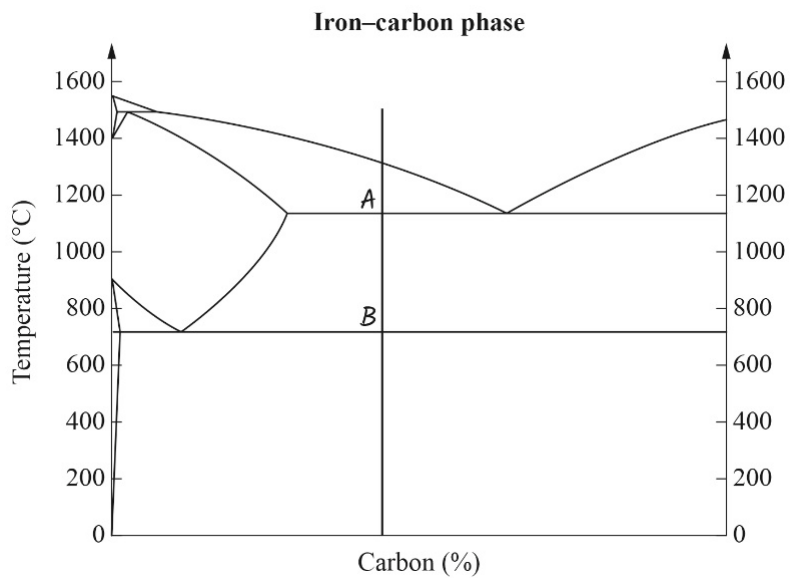
Marker: provides an appropriately annotated sketch indicating an approximately correct location for 3% carbon
Mark A where your 3% line meets the upper horizontal, the eutectic at about 1147 °C, and B where it meets the lower horizontal, the eutectoid at about 723 °C. Then use A and B in your sentences, as the sample does, so the explanation and the diagram support each other.
Marker: provides an appropriately annotated sketch indicating the eutectic and eutectoid temperatures (A and B locations)
Each phrase of the question gave you something
The 2021 subject report does not discuss this question on its own, but its advice to teachers asks for in-depth knowledge of the cast iron section of the iron-carbon diagram, specifically how the microstructure changes with carbon content and temperature. That advice predates the 2025 syllabus.
QCAA did not publish a band for this question. It reads as simple familiar, because the question names the alloy and both temperatures, the three explanation marks are one recalled sequence, and the two diagram marks are a ruled line and two letters. Cast iron above about 2.1% carbon is out of the 2026 syllabus, so this question cannot be set again. What transfers is the austenite story, which is the same in a hypereutectoid steel: below the upper edge of the austenite field carbon comes out as cementite, and at 723 °C the austenite left turns to pearlite. Reading QCAA’s unnumbered carbon axis from its landmarks transfers too.
If I had to guess where you might lose marks, it would be mixing up eutectic and eutectoid. The eutectic is liquid to two solids at A, and the eutectoid is solid to two solids at B. The other trap is putting A at the V of the liquidus, at 4.3% carbon. A belongs on your 3% line, where it meets the eutectic horizontal.
Only mark this done when you could do it without help. Reading the solution does not count.
Question wording, any figures and marking-guide steps are from the 2021 QCAA Engineering external assessment, © State of Queensland (QCAA) 2021, licensed under CC BY 4.0, and have been adapted, except where a third-party source is named. Tangent Tuition is not affiliated with the QCAA.
Spot a mistake on this page? Report it