
Question 3
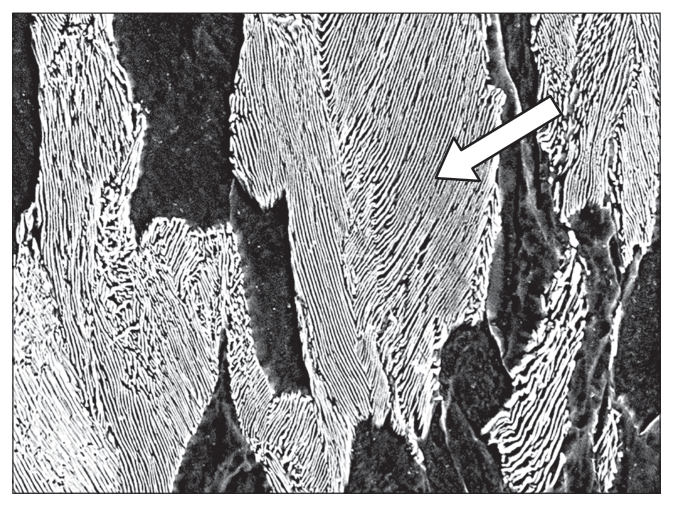
What is the hypo-eutectoid formation indicated by the arrow in this carbon steel microstructure?
Not quite. Ferrite is the smooth, dark regions between the striped colonies. The dark gaps between the bright lines are ferrite too, but the arrow points at the whole layered colony, and that colony is pearlite.
That is it. Step through the hints below to see why.
Not quite. In a plain-carbon steel austenite only exists above 723 °C. A micrograph of the steel at room temperature cannot show it.
Not quite. The bright lines are cementite, but each one is a single layer. The arrow points at the whole colony of layers, ferrite and cementite together, which is pearlite. A hypoeutectoid steel has no separate cementite.
The QCAA micrograph, with its own white arrow. Move the orange arrow and turn the labels on.
Read the stem first. Hypo-eutectoid means less carbon than the eutectoid, 0.83%.
Slow cooled, a hypoeutectoid steel is ferrite and pearlite and nothing else. That rules out austenite, (C), which needs a temperature above 723 °C, and cementite as a separate constituent, (D).
Now look at what the arrow touches. It sits on a colony of fine parallel layers, not on a smooth region.
Layers mean pearlite, alternating ferrite and cementite that formed together at 723 °C. The smooth dark regions are the ferrite that formed first. Move the arrow on the left to see both.
Why not cementite? The bright lines are cementite, but they are only part of the pearlite. The lever rule at the eutectoid gives the split inside every pearlite colony.
$$\frac{0.83}{6.67}\approx12\%\text{ cementite}$$
The rest, about 88%, is ferrite. The question asks for the formation, the whole layered structure, so the answer is pearlite.
A hypoeutectoid steel, less than 0.83% carbon, is ferrite and pearlite at room temperature. The arrow sits on a colony of fine parallel layers of ferrite and cementite. That layered structure is pearlite.
With no published distribution, my guess at the main trap is (D). The bright lines in the image really are cementite, but the arrow points at the whole layered colony. Name the structure, not one of its layers.
Only mark this done when you could do it without help. Reading the solution does not count.
Question wording and any figures are from the 2020 QCAA Engineering external assessment, © State of Queensland (QCAA) 2020, licensed under CC BY 4.0, and have been adapted, except where a third-party source is named. Tangent Tuition is not affiliated with the QCAA.
Spot a mistake on this page? Report it